Jack McGurn was the most feared gunman in Al Capone’s Chicago Outfit, and he is remembered for one crime above all others: the St. Valentine’s Day Massacre of 14 February 1929, in which seven men of the rival North Side Gang were shot dead in a Clark Street garage. McGurn is widely believed to have planned the massacre. It was never proven, and he was never charged with it. Seven years later, almost to the day, he was shot dead himself in a Chicago bowling alley, and his killers left behind a mocking Valentine’s Day note. The symmetry was not lost on anyone in Chicago.
McGurn was born Vincenzo Antonio Gibaldi on 2 July 1902 in Licata, Sicily, the eldest son of Tommaso and Giuseppina Gibaldi. His family emigrated to the United States in 1906, arriving at Ellis Island that November, and settled in Chicago’s Little Italy. As a young man McGurn was a small-time professional boxer. He drifted into Capone’s organisation, where his talent with a gun made him one of Capone’s most trusted men. He became a made man and a caporegime in the Outfit, and his nickname, “Machine Gun Jack,” described his preferred weapon and his reputation.
The Green Mill
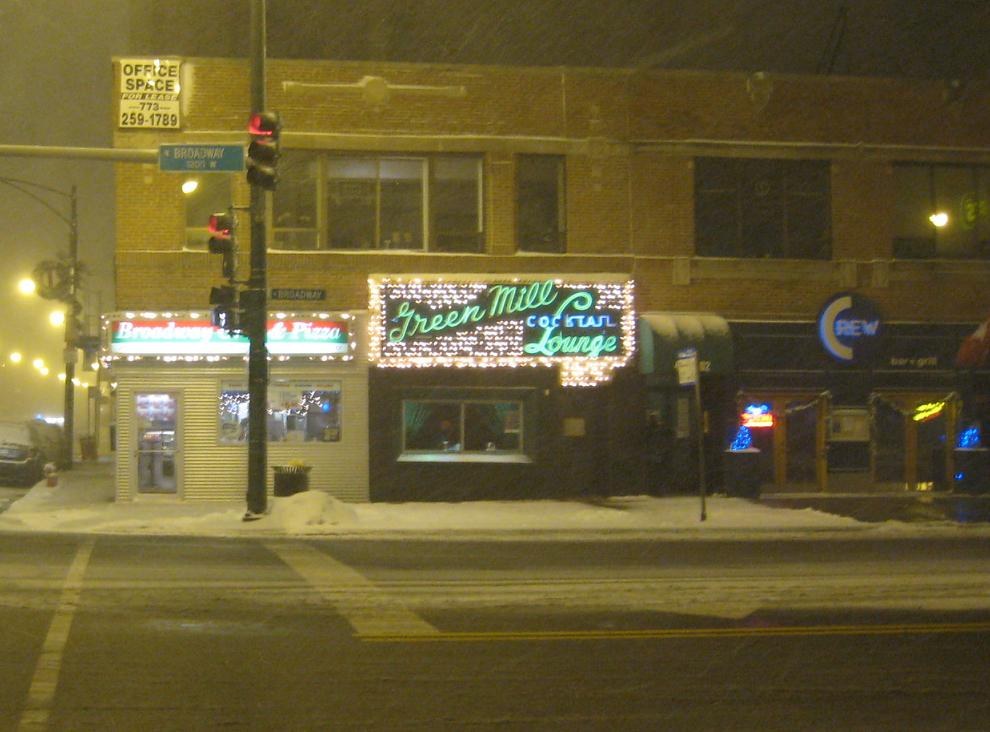
McGurn’s base of power was the Green Mill, the speakeasy jazz club at 4802 North Broadway, in the middle of what had been North Side territory. McGurn was a part-owner of the club, which still operates today as the Green Mill Cocktail Lounge, and it was there that he held court. In 1927 he was blamed for a brutal attack on the singer and comedian Joe E. Lewis, who had refused to renew his contract with the club. Lewis’s throat was cut and part of his tongue removed; he survived, and he eventually recovered enough to perform again. McGurn was widely blamed for the attack, though it was never proven against him in court, and the episode became part of his legend: the hitman who enforced the Outfit’s control over Chicago’s nightlife.
The St. Valentine’s Day Massacre made McGurn’s name. On the morning of 14 February 1929, men dressed as police officers entered a garage on Clark Street and lined seven members of the North Side Gang against a wall and shot them dead. McGurn is widely believed to have planned the operation, and the belief has persisted for nearly a century. It has never been proven. McGurn had an alibi for the morning of the massacre: he was with his girlfriend, Louise Rolfe, who was known in the press as the “blonde alibi.” Whether the alibi was genuine or arranged has been debated ever since. No one was ever charged with the massacre.
The Fall
Capone’s conviction for tax evasion in 1931 ended McGurn’s protection. The Outfit’s new leadership had no use for a gunman whose reputation was built on a massacre, and McGurn was steadily pushed out. Frank Nitti told him he was no longer a partner in the Green Mill and the other businesses, and his income dried up. By 1936 McGurn was impoverished and reduced to bookmaking at the racetracks, covering fifty-cent bets at Melrose Park. On the night of Friday 14 February 1936 — the seventh anniversary of the massacre — he went bowling with two friends at the Avenue Recreation Bowling Alley, on the second floor of 805 North Milwaukee Avenue.
At about one o’clock in the morning, three men walked in and ordered everyone to stand still. McGurn, who seems to have thought at first that it was a robbery, stood with his back to them. The gunmen opened fire. He was hit several times, including three times in the head, and died on the floor of the bowling alley. He was thirty-three years old, and he had three dollars and eighty-three cents in his pockets. A comic Valentine’s note was left at the front desk of the bowling alley — an illustrated page with a poem that mocked everything McGurn had lost: “You’ve lost your job, you’ve lost your dough, your jewels and handsome houses. But things could still be worse, you know — you haven’t lost your trousers.” The popular version of the story says the note was placed beside his body; the more careful accounts say it was left at the desk. Either way, the message was the same: the killers wanted Chicago to know that this was payback for the massacre. No one was ever charged with McGurn’s murder. Less than a month later, on 2 March 1936, his brother Anthony was shot dead in a Chicago pool hall after saying that he knew who had killed Jack.
McGurn’s life traces the arc of the Chicago Outfit itself: a poor immigrant boy who became a boxer, then a hitman, then a partner in one of the city’s most famous nightclubs, then a discarded gunman bowling for pennies on the anniversary of his greatest crime. He was never convicted of the massacre, and he was never proven to have planned it. But the men who killed him believed he had, and they chose their date carefully.
What Is Documented — and What Is Not
Documented: Jack McGurn was born Vincenzo Antonio Gibaldi on 2 July 1902 in Licata, Sicily; his family emigrated to the United States in 1906, arriving at Ellis Island on 24 November 1906. He was a small-time professional boxer before becoming a made man and caporegime in Al Capone’s Chicago Outfit. He was a part-owner of the Green Mill speakeasy jazz club at 4802 North Broadway, Chicago. He is widely believed to have planned the St. Valentine’s Day Massacre of 14 February 1929, in which seven men of the North Side Gang were shot dead in a Clark Street garage; this has never been proven, and no one was ever charged. After Capone’s conviction in 1931 McGurn was pushed out of the Outfit and lost his share in the Green Mill. In the early hours of 15 February 1936 he was shot dead by three men at the Avenue Recreation Bowling Alley, 805 North Milwaukee Avenue, Chicago, one day after the seventh anniversary of the massacre. He was 33. A comic Valentine’s note mocking his losses was left at the bowling alley. No one was ever charged with his murder. His brother Anthony was shot dead on 2 March 1936.
Not documented / unverified: McGurn’s part in planning the St. Valentine’s Day Massacre is widely believed but has never been proven, and his alibi for the morning — that he was with his girlfriend Louise Rolfe — has never been confirmed or disproved. The claim that McGurn ordered the 1927 attack on Joe E. Lewis is widely repeated but was never proven in court. Accounts differ on whether the Valentine’s note was placed beside McGurn’s body or left at the front desk of the bowling alley; the front-desk version is better sourced. The claim that the killers were avenging the massacre is an interpretation, not an established fact.
Sources
https://en.wikipedia.org/wiki/Jack_McGurn
https://nationalcrimesyndicate.com/jack-machine-gun-mcgurn-death-photos/
https://americanmafiahistory.com/machine-gun-jack-mcgurn/
http://www.myalcaponemuseum.com/id175.htm
https://www.coopertoons.com/caricatures/machinegunjackmcgurn_louiserolf.html