The eight-hour day
In the spring of 1886, the American labour movement was fighting for a single demand: the eight-hour working day. On 1 May, between 300,000 and 500,000 workers across the United States walked off the job. In Chicago, the centre of the movement, some 35,000 workers struck, and the city’s anarchist press — August Spies’s German-language Arbeiter-Zeitung and Albert Parsons’s The Alarm — called for a general strike and a shorter working day.
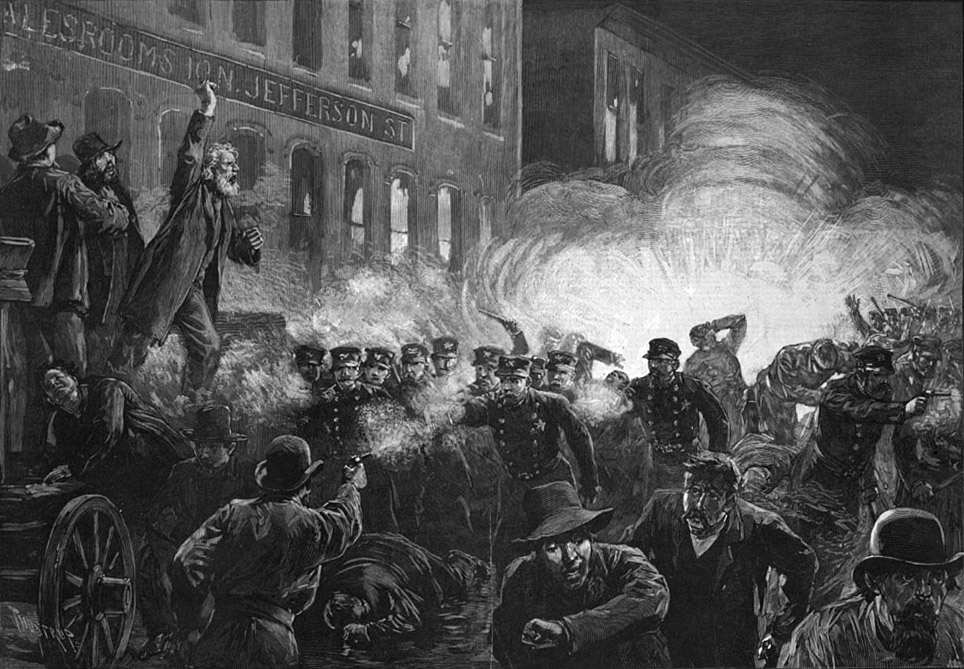
The strike turned violent on 3 May, when police fired into a crowd of pickets at the McCormick Harvesting Machine Company, killing at least one striker and wounding several others. The anarchists called a mass meeting for the next evening, 4 May, in Haymarket Square, to protest the shooting. The meeting was peaceful at first: Spies, Parsons and Samuel Fielden spoke to a crowd of several hundred. The mayor of Chicago, Carter Harrison, attended and later said the meeting had been orderly. As the crowd was thinning, a detachment of police marched into the square to disperse it. Someone — no one has ever established who — threw a bomb into the line of advancing officers. The explosion killed one officer instantly; six more died of their wounds, and at least four civilians were killed in the gunfire that followed.
The trial
The city was in an uproar. The police arrested eight anarchist leaders — Spies, Parsons, Fielden, Michael Schwab, Adolph Fischer, George Engel, Louis Lingg and Oscar Neebe — and charged them with conspiracy to commit murder. The case against them was not that any of them had thrown the bomb. The prosecution did not claim to know who had. Its case was that the eight had, through their speeches and writings, conspired to overthrow the law by force, and that the policeman’s death had been committed in pursuance of that conspiracy. State’s Attorney Julius Grinnell told the jury directly that identifying the actual bomb thrower was not the point.
The trial opened on 21 June 1886, before Judge Joseph E. Gary. It took three weeks to seat a jury, and many of those chosen openly acknowledged their prejudice against the defendants. Parsons, who had fled after the bombing, walked into the courtroom on the first day and surrendered, so that he could stand trial with his comrades. The prosecution presented the defendants’ speeches, their newspapers, and evidence of bomb-making — most of it tied to Lingg, a young German carpenter who had made bombs in his workshop. Neebe, who had not even been at Haymarket Square that night, was charged because he had helped run the Arbeiter-Zeitung’s business office. On 19 August, after three hours of deliberation, the jury convicted all eight. Seven were sentenced to death. Neebe was sentenced to fifteen years at hard labour.
The hangings
The verdict was appealed to the Illinois Supreme Court and then to the United States Supreme Court, and both let it stand. An international campaign for clemency followed, and Governor Richard J. Oglesby commuted the death sentences of Fielden and Schwab to life imprisonment. The executions were set for 11 November 1887.
The night before, Louis Lingg — the one defendant against whom there was any real evidence of bomb-making — killed himself in his cell with a smuggled dynamite cap. Parsons, Spies, Fischer and Engel refused to sign the petition the law required for clemency, on principle, choosing to hang rather than ask. On the morning of 11 November 1887, the four men were hanged in the Cook County Jail. Their last words, according to witnesses, were defiant: Spies is reported to have said, “The time will come when our silence will be more powerful than the voices you strangle today.”
The pardon
Six years later, the case was re-examined. John Peter Altgeld, who became governor of Illinois in 1893, reviewed the trial record and concluded that it had been unfair: the jury had been packed, the judge had been biased, and the evidence had not proved that any of the defendants had thrown the bomb or planned the bombing. On 26 June 1893, Altgeld pardoned Fielden, Schwab and Neebe, the three survivors still in prison. His pardon message was a blistering attack on Judge Gary and on the conduct of the trial, and it damaged Altgeld’s political career — but it has been vindicated by history. The state has never discovered who threw the bomb.
The four men who were hanged — Parsons, Spies, Fischer and Engel — are remembered in labour history as the Haymarket Martyrs. They are buried at Waldheim Cemetery, now Forest Home Cemetery, in Forest Park, Illinois, alongside Lingg. A sixteen-foot granite monument, sculpted by Albert Weinert, was dedicated there on 25 June 1893. And the date of the strike that started it all — 1 May — became International Workers’ Day, observed around the world, though not in the United States, where Labour Day is celebrated in September.
What the case changed
The Haymarket trial is one of the most consequential trials in American history, not because of what it proved, but because of what it failed to prove. It established, in practice, that a person could be convicted of murder for their words — for speeches and newspaper articles — even when the state could not show that they had committed, or even planned, the killing. That precedent has haunted American law ever since, and it is cited in every debate about free speech, conspiracy, and the limits of criminal liability for advocacy.
It also changed the labour movement. The executions turned the eight anarchists into martyrs, and the eight-hour day — the demand that had brought them to Haymarket Square — became the central cause of the international labour movement. The pardon, six years later, was an admission that the trial had been a political prosecution, not a fair one. And the monument at Waldheim is still visited, every year, by workers and historians who remember the four men who died for a demand that is now, in most of the world, the law.
The eight-hour movement
The Haymarket rally did not come out of nowhere. In 1884, the Federation of Organized Trades and Labor Unions — the forerunner of the American Federation of Labor — had passed a resolution calling for the eight-hour day to take effect on 1 May 1886, and unions across the country had spent two years organising for it. In Chicago, the movement was led in part by German immigrant anarchists, who published newspapers, ran meeting halls, and organised the city’s workers in their own language. August Spies, the editor of the Arbeiter-Zeitung, was one of the most influential labour voices in the city. Albert Parsons, a former Confederate soldier who had become a socialist and then an anarchist, edited the English-language paper The Alarm and was, by 1886, the best-known radical in America.
The McCormick Harvesting Machine Company, on Chicago’s South Side, was the flashpoint. Its owner, Cyrus McCormick Jr., had locked out his union workers in February 1886 and replaced them with strikebreakers, protected by Pinkerton guards. On 3 May, when the strikers and their supporters gathered outside the plant, the police opened fire. The shooting was the reason the Haymarket meeting was called — and the reason the crowd that gathered on 4 May was angry. The bomb, thrown as the police moved in to break up a meeting that the mayor had already judged peaceful, turned a labour dispute into a national crisis, and the trial that followed turned the eight anarchists into symbols.
The monument at Waldheim Cemetery, dedicated on 25 June 1893 — the day before Altgeld’s pardon — was the work of the sculptor Albert Weinert, himself a German immigrant. It shows a woman, representing Justice, placing a laurel wreath on the head of a fallen worker, above the words of August Spies: “The day will come when our silence will be more powerful than the voices you are throttling today.” The monument was designated a National Historic Landmark in 1997, and it remains a place of pilgrimage for the labour movement.
What is documented — and what is not
Documented: On 4 May 1886, a bomb was thrown at a labour rally in Haymarket Square, Chicago, killing seven police officers and at least four civilians. Eight anarchists — August Spies, Albert Parsons, Samuel Fielden, Michael Schwab, Adolph Fischer, George Engel, Louis Lingg and Oscar Neebe — were tried for conspiracy to murder. The trial opened on 21 June 1886 before Judge Joseph E. Gary, and on 19 August the jury convicted all eight; seven were sentenced to death and Neebe to fifteen years at hard labour. Lingg killed himself in his cell on 10 November 1887. Parsons, Spies, Fischer and Engel were hanged on 11 November 1887. Fielden’s and Schwab’s sentences were commuted to life, and on 26 June 1893 Governor John Peter Altgeld pardoned the three survivors.
Unverified or unproven: Who threw the bomb — the identity of the bomb thrower has never been established, and no defendant was proven to have thrown it. Whether any of the eight planned the bombing — the prosecution’s case rested on their speeches and writings, not on evidence of a plan to bomb the rally. The exact words spoken by the condemned men on the scaffold rest on contemporary newspaper accounts, which differ in detail. The number of civilian deaths is usually given as at least four, but contemporary reports vary.
Sources
https://www.leftwingmerch.com/causes/may-day
http://grokipedia.com/page/Haymarket_affair
https://condor.depaul.edu/tps/resources/chicago/chm/Haymarket_case.pdf
https://www.calendarz.com/amp/on-this-day/may/1/haymarket-affair