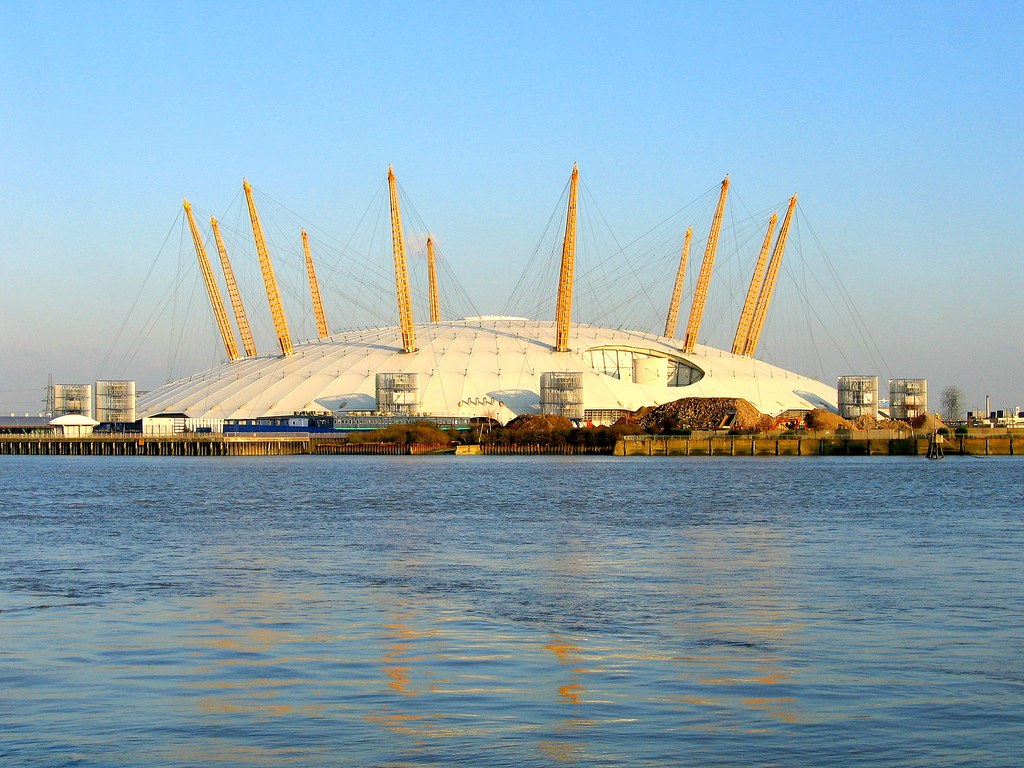
On 7 November 2000, a gang drove a JCB earth digger through the perimeter fence of the Millennium Dome in Greenwich, south-east London, and crashed through the side wall of the building itself. Their target was the De Beers diamond exhibition in the Dome’s Money Zone, including the Millennium Star — a flawless 203.04-carat pear-shaped diamond with an estimated worth of £200 million — and eleven rare blue diamonds. Had the raid succeeded, the haul would have been worth about £350 million, making it one of the biggest burglaries in history.
It did not succeed. The gang did not know it, but the police had been watching them for months. The real diamonds had been replaced with replicas. And behind a false wall inside the exhibition room, twenty armed officers were waiting.
The Target
The De Beers Millennium Collection was the centrepiece of the Dome’s diamond exhibition, unveiled in October 1999. The Millennium Star, cut from a 777-carat rough stone, was considered one of the most perfect gems in the world, displayed alongside eleven rare blue diamonds from the Premier Mine in South Africa. De Beers has never put it on the market.
Operation Magician
The Metropolitan Police Flying Squad, led by Detective Superintendent Jon Shatford, had been aware of a significant armed robbery plot since the summer of 2000, after receiving a tip-off. The location was initially unclear, but the identities of some of the robbers were known, because Kent Police Serious Crime already had the gang under surveillance for suspected roles in several unsuccessful armoured vehicle robberies. The police set up an operation codenamed Operation Magician.
The gang had already tried twice to rob security vans — at Nine Elms in February 2000 and at Aylesford, Kent, in July — escaping both times by speedboat. The Aylesford attempt led police to track vehicles to two isolated farms in rural Kent, which were placed under 24-hour surveillance. A further tip-off from an informer then pointed to the Dome: at a meeting to discuss the earlier attempts, one detective who had recently visited the Dome joked that the gang might be “after the Millennium jewels”.
Watching the Gang
On 1 September 2000, the team identified three suspected robbers — Lee Wenham, Raymond Betson, and William Cockram — making repeated visits to the Dome. Police noticed that the River Thames was at high tide every time they visited, and that the men were recording video footage of the exhibition. Surveillance was increased, and the Dome was placed under close watch.
The precautions taken by the Flying Squad included replacing the priceless gems with replicas of the same size — one of which is now held in the Crime Museum — allowing the originals to be stored elsewhere, and installing a false wall inside the exhibit room, behind which twenty police officers in full tactical gear could wait.
Aborted attempts coincided with the highest tides, letting police predict possible raid days — one of which was the day it happened.
The Morning of 7 November 2000
On 7 November, Operation Magician was underway, commanded by Shatford. A total of 200 officers were involved, including 40 from the Specialist Firearms Command, with 60 more armed officers stationed around the Thames and 20 on the river.
Four members of the gang were identified in a JCB earth digger, wearing body armour and gas masks, armed with smoke bombs, sledgehammers, and nail guns to penetrate the security glass protecting the exhibit. The digger broke through the perimeter fence and crashed through the side wall of the Dome to reach the Money Zone, then parked outside it.
Once inside, Aldo Ciarrocchi began throwing smoke bombs, and Cockram attacked the glass where the diamonds were stored. The police then pounced on the four men as they attempted to smash their way into the display case. As they were arrested, other officers arrested another man in a high-powered boat on the Thames. Another suspect, Terry Millman, was apprehended in a van. By noon, some areas of the Dome had reopened, though the Money Zone remained cordoned off.
The Trial
The case came to trial a year later, on 8 November 2001, at the Old Bailey. Only six members of the gang were present, because Terry Millman had died of cancer before the trial. The court heard that the gang had invested tens of thousands of pounds in planning the raid.
After three months of trial, the jury reached a 10–2 majority verdict after deliberating for nearly seven court days. The judge, Michael Coombe, told the defendants they had played for very high stakes, describing the plan as wicked and professional and carried out with minute attention to detail.
Betson and Cockram, considered the two leaders of the gang, were each given 18-year sentences for conspiracy to rob; both sentences were later reduced to 15 years on appeal. Aldo Ciarrocchi and Robert Adams were sentenced to 15 years; Ciarrocchi’s sentence was reduced to 12 years in 2004. Kevin Meredith was cleared of conspiracy to rob but found guilty of conspiring to steal and was sentenced to five years. Lee Wenham pleaded guilty to conspiracy to steal and was sentenced to four years, and at the same time received nine years after pleading guilty to the Aylesford attempted robbery of July 2000.
Nobody was hurt, nothing was stolen, and the Millennium Star was unharmed. The operation was commended by the trial judge. It remains the biggest operation in the Flying Squad’s history, and it is still studied as a textbook example of intelligence-led policing: a gang that had rehearsed tides, tested boats, and spent tens of thousands of pounds on equipment was defeated not by force, but by the fact that the police had known about the plan for months — and had quietly swapped the treasure for glass.
What Is Documented — and What Is Not
Documented: the date (7 November 2000); the target (the De Beers exhibition, including the 203.04-carat Millennium Star and eleven blue diamonds); the estimated values (£200 million for the Star; about £350 million for the full haul); the police operation (Operation Magician, commanded by Detective Superintendent Jon Shatford, with 200 officers, 40 from the Specialist Firearms Command); the gems replaced with replicas and the false wall concealing twenty officers; the JCB digger, smoke bombs, sledgehammers and nail guns; the speedboat escape plan and the tide pattern; the arrests at the scene; the Old Bailey trial from 8 November 2001, the 10–2 majority verdicts, and the sentences above, including the reductions on appeal; and the fact that nobody was hurt and nothing was stolen.
Unverified or disputed: the exact number of officers involved is reported differently across sources — this article follows the Wikipedia account of 200, but contemporary press reports gave figures from around 100 to 300, so the precise count should be treated as approximate. The informer’s identity and exact role have not been publicly established. The £350 million valuation is a contemporary press and police estimate; De Beers has never sold the Millennium Star, so no market price exists to confirm it.