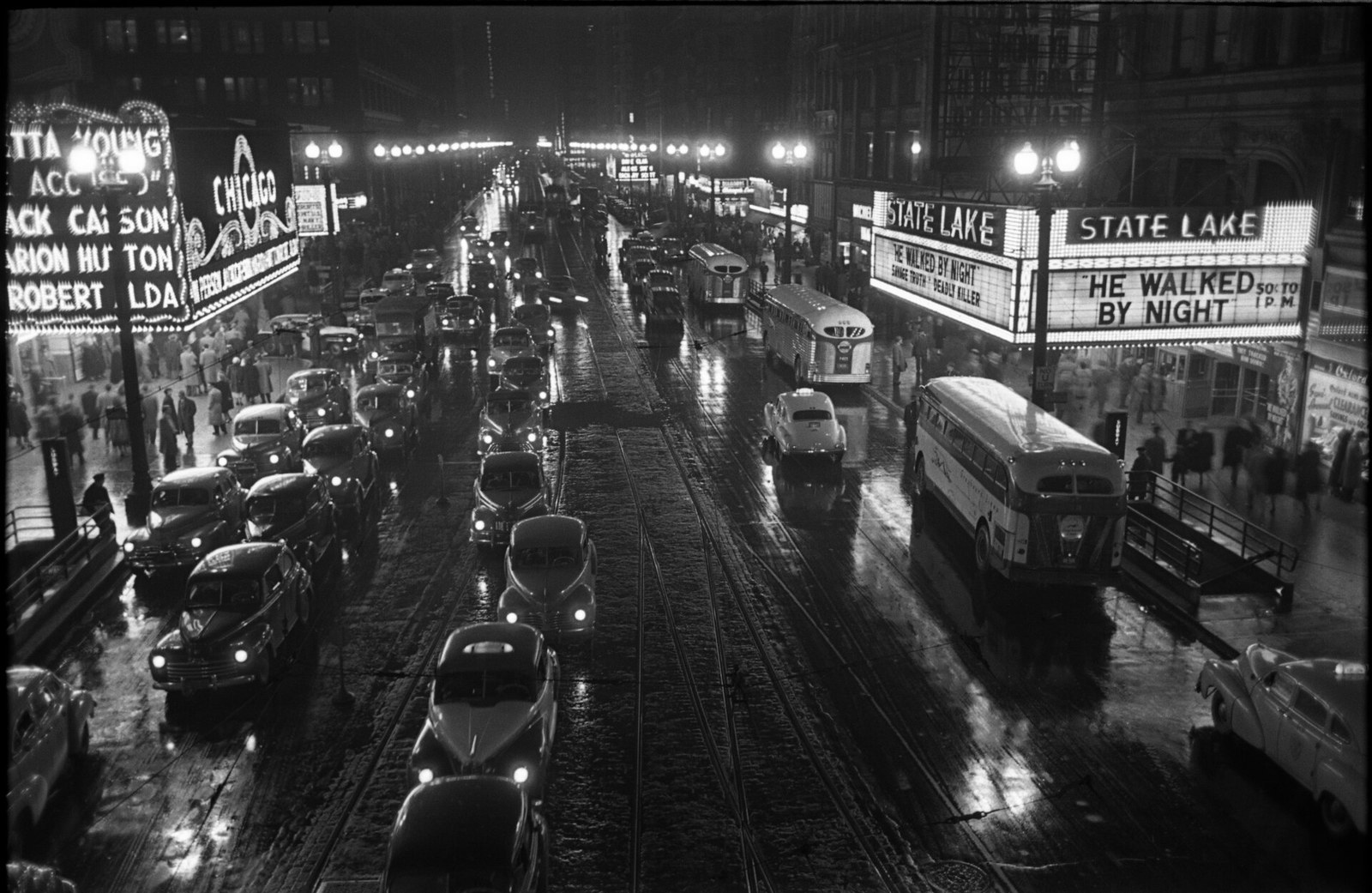
On the night of 10 December 1945, a 31-year-old woman named Frances Brown was found dead in her Chicago apartment. On the wall beside her body, written in lipstick, was a message: “For heavens sake catch me before I kill more I cannot control myself.” It was the message that gave the case its name, and it turned three separate murders into a single nightmare that gripped Chicago for a year.
The man who was convicted of the murders, William Heirens, was 17 years old, a student at the University of Chicago, and a known burglar. He pleaded guilty in September 1946 and was sentenced to three consecutive life terms. Within days he had taken it back, and he spent the rest of his life — sixty-six years in prison — insisting he was innocent. The evidence against him has been disputed ever since: by handwriting experts, by fingerprint experts, and by the courts themselves. No court ever set his convictions aside. But no one has ever settled the question of whether the right man was convicted, either. This is the story of a case that was closed in law, and never closed in fact.
Three murders
The first killing attributed to the Lipstick Killer took place on the night of 4 June 1945. Josephine Ross, 43, was found stabbed to death in her Chicago apartment. There was little to link the murder to any suspect, and the case went nowhere.
Six months later, on 10 December 1945, Frances Brown was found shot and stabbed in her apartment. The lipstick message on the wall turned the case into a sensation. The newspapers gave the killer his name, and the city began to lock its doors.
The third murder was the one that broke Chicago’s nerve. On the night of 6–7 January 1946, six-year-old Suzanne Degnan was taken from her bedroom in her family’s home on the city’s North Side. A ransom note was left behind, demanding 20,000 dollars in five- and ten-dollar bills and warning the parents not to contact the police or the FBI. The child’s dismembered body was found in the days that followed, in storm drains near her home.
The police had almost nothing. Then, in June 1946, a 17-year-old was caught trying to burgle an apartment near where Suzanne Degnan had been killed. His name was William George Heirens.
The arrest
Heirens was a student at the University of Chicago with a long record as a burglar. He had been stealing since childhood, and the police knew him. When he was arrested on 26 June 1946, they told him his fingerprint matched one found on the Degnan ransom note, and the FBI confirmed the match. He was held for days without a lawyer, questioned around the clock, and given sodium pentothal — so-called truth serum — without his consent or his parents’ consent. He later said he had been beaten, starved, and denied sleep.
What happened in those days of questioning has been argued over ever since. The police said Heirens confessed, claiming that an alternate personality named George Murman had committed the murders. Heirens said he remembered little of the interrogation, that the transcript had disappeared, and that a psychiatrist who had taken part later said, in 1952, that Heirens had said nothing that implicated him in any of the murders. The newspapers, meanwhile, published a supposed confession that had never actually been made.
The physical evidence was thin. A bloody fingerprint smudge found on a door jamb at the Brown apartment was first declared not a match for Heirens. Twelve days later, it was announced that it matched by 22 points — but a fingerprint expert later testified that it matched by no more than eight. The FBI required 12 points for a positive identification. The prints on the Degnan ransom note matched Heirens by nine points, three short of the FBI’s standard. There was no forensic evidence at all linking Heirens to the murder of Josephine Ross, and only a partial fingerprint connecting him to Frances Brown.
There were other problems. Before Heirens was arrested, another man, Richard Russell Thomas, had confessed to Suzanne Degnan’s murder. His confession was overlooked. And the handwriting evidence, which the prosecution relied on to link Heirens to the ransom note and the lipstick message, would later be challenged by experts who concluded that the two writings were by different people, and that neither was Heirens.
The guilty plea
On 4 September 1946, Heirens pleaded guilty to all three murders and to 26 other indictments for burglary, robbery and assault. He was sentenced to three consecutive life terms. His lawyers had urged him to plead guilty, believing he was guilty and wanting to save him from the electric chair. Within days, Heirens recanted. He said he had confessed only to escape execution.
He spent the rest of his life trying to undo the plea. In 1954, the Illinois Supreme Court agreed that the police had committed “flagrant violations of his rights” during his interrogation, but held that his guilty pleas, entered more than a month later on the advice of his own lawyers, had not been caused by that conduct. The convictions stood. Federal courts later declined to disturb them.
In 1994, the social activist Dolores Kennedy formed a forensic team to review the evidence. The team reported several inconsistencies, including that the fingerprint from the Brown scene appeared to have been taken from a fingerprint card rather than from the crime scene, and that the handwriting of the lipstick message and the ransom note were not the same, and that neither matched Heirens. Five handwriting experts reached the same conclusion. The state’s own handwriting expert, Herbert J. Walker, later said the samples had few superficial similarities and a great many dissimilarities.
A life in prison
Heirens became a model prisoner. He earned a university degree behind bars, worked in the prison library, and was repeatedly described by prison staff as a man who had been rehabilitated. He applied for parole again and again, and was denied again and again, most recently by a vote of 14 to 0 in 2007. A clemency application was denied in 2002.
He died in custody on 5 March 2012, aged 83, having spent nearly sixty-six years in prison — one of the longest prison terms ever served in the United States. He maintained his innocence to the end.
The case has never been reopened. No court ever set the convictions aside, and as of 2026 no exoneration has been reported. But the doubts have never gone away, either. In 2009, a retired Los Angeles detective, Steve Hodel, suggested a connection between the Lipstick Killer case and the Black Dahlia murder, implicating his own father — a theory that has not been accepted by investigators. More importantly, the core evidence in the case — the fingerprints, the handwriting, and the confession — has been challenged by experts for decades, and none of those challenges has ever been answered in a courtroom.
What remains
The Lipstick Killer case sits in an uncomfortable place in criminal history. In law, it is closed: a man pleaded guilty, was convicted, and died in prison. In fact, it has never been settled. The three murders themselves are not in doubt — three people were killed in Chicago in 1945 and 1946, and the lipstick message was real. What is in doubt is whether William Heirens killed them.
That doubt matters, because of what it says about how the case was built. A 17-year-old was questioned for days without a lawyer, drugged without consent, and presented to the public as a killer before he had been tried. The fingerprint evidence did not meet the FBI’s own standard. The handwriting evidence has been contradicted by independent experts. And a confession by another man was set aside without explanation.
If Heirens was guilty, then a dangerous man spent his life in prison, and justice was done. If he was not, then the real killer was never caught, and an innocent teenager lost sixty-six years of his life. There is no way to know which is true. The evidence that could have settled it — the fingerprints, the handwriting, the interrogation records — was disputed at the time, and much of it has been lost or discredited since. That is why the case belongs in any honest account of cold cases: not because it was never solved, but because it was never truly proven.
What is documented — and what is not
Documented: Josephine Ross, 43, was stabbed to death in her Chicago apartment on 5 June 1945. Frances Brown, 31, was shot and stabbed in her apartment on 10 December 1945, and a message was found written in lipstick on the wall. Suzanne Degnan, 6, was taken from her home on 7 January 1946, and a ransom note demanding 20,000 dollars was left behind; her body was later found in storm drains. William Heirens, 17, a University of Chicago student, was arrested on 26 June 1946 for burglary. On 4 September 1946 he pleaded guilty to all three murders and 26 other indictments, and was sentenced to three consecutive life terms. He recanted within days and maintained his innocence for the rest of his life. In 1954 the Illinois Supreme Court found that police had committed “flagrant violations of his rights” but upheld the pleas. He was denied parole repeatedly, most recently 14 to 0 in 2007, and died in custody on 5 March 2012, aged 83. No court ever set the convictions aside.
Unverified or unproven: Whether William Heirens committed any of the three murders has never been established by evidence that has survived independent scrutiny. The fingerprint matches did not meet the FBI’s 12-point standard; independent handwriting experts concluded the lipstick message and the ransom note were written by two different people and that neither was Heirens; and Heirens said his confession was extracted under duress and drugging, which the Illinois Supreme Court acknowledged in part. Richard Russell Thomas’s earlier confession to the Degnan murder was never investigated to a conclusion. Claims linking the case to other murders, including the Black Dahlia, are speculation and have not been accepted by investigators.