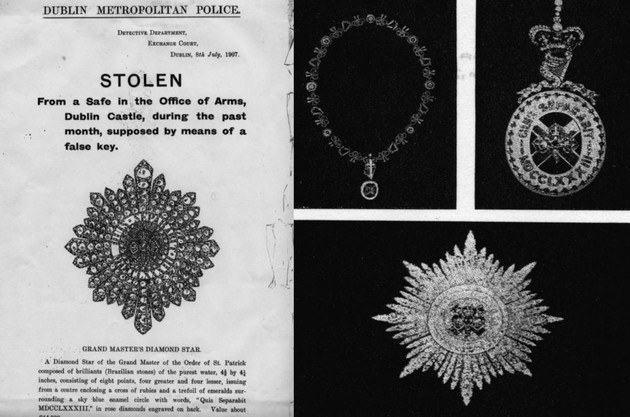
On the morning of Saturday 6 July 1907, a messenger named William Stivey walked into the Office of Arms in Dublin Castle and found the safe standing open. The safe was unlocked. Inside, where the Irish Crown Jewels should have been, there was nothing. Stivey ran to find the man in charge, Sir Arthur Vicars, the Ulster King of Arms, who took one look and cried out, “My God, they are gone!”
The theft could not have come at a worse time. In four days, King Edward VII and Queen Alexandra were due in Dublin for a state visit, and the jewels were to be worn by the Lord Lieutenant at the opening of the Irish International Exhibition. Instead, the castle was in chaos, the police were called, Scotland Yard was called, and the most famous jewel theft in Irish history had begun — a theft that has never been solved, in which no one was ever arrested, and in which the jewels have never been seen again.
The jewels and the safe
The “Irish Crown Jewels” were not a crown. They were the regalia of the Order of St Patrick, Ireland’s order of chivalry, founded in 1783. The most valuable pieces were the star and badge worn by the Grand Master of the Order, the Lord Lieutenant of Ireland, created in 1831 and encrusted with diamonds, rubies, emeralds, Brazilian diamonds and other precious stones. The star alone was worth a fortune. The jewels were valued at more than £30,000 in 1907, an enormous sum, and they carried a symbolic weight far beyond their monetary value. They were the visible sign of the Crown’s authority in Ireland, and they were kept, under lock and key, in the Bedford Tower of Dublin Castle, in the office of the Ulster King of Arms.
That office was the responsibility of Sir Arthur Vicars, who had held the post since 1893. Vicars was a decorated soldier, a former Royal Engineers officer, and a man of considerable charm. He was also, by his own admission and his staff’s account, a man who liked a drink, and who was known to fall asleep on duty. The jewels were kept in a safe that had been bought recently, and the safe was too large to fit through the door of the strongroom. So it was placed, instead, in Vicars’s library, where it stood beside his desk.
The security arrangements were, by any standard, hopeless. The office door had seven latch keys, and the keys were held by a number of people. The safe had two keys, and Vicars held both of them. No one else was authorised to open it. Vicars was known to drink on overnight duty, and on one occasion he had woken up to find the jewels around his neck, placed there, he said, by someone playing a practical joke. Whether it was a joke or a rehearsal, no one ever established.
The jewels were last seen on 11 June 1907, when Vicars showed them to a visitor. On 28 June, Vicars’s front-door key went missing. It reappeared two days after the theft was discovered. The theft itself was discovered on 6 July, when Stivey found the safe open and empty. It was not only the Grand Master’s star and badge that were gone. Five gold collars, belonging to the Marquess of Ormonde and the Earls of Howth, Enniskillen and Mayo, and to the late Earl of Cork, had also been taken, along with Vicars’s own mother’s jewellery, worth £1,500, which he had kept in the safe for safekeeping.
The investigation
The investigation was led by the Dublin Metropolitan Police, with Scotland Yard’s Chief Inspector John Kane sent to Dublin. The police interviewed everyone with access to the office, and the list was long. The seven latch keys were held by a number of people, and the safe was an old-fashioned one that could be opened with a duplicate key or, some said, with a bent wire.
Vicars was the first suspect, and he knew it. He refused to resign, and he refused to appear before the Viceregal Commission set up to investigate the theft, under Judge James Johnston Shaw, which began its hearings on 10 January 1908. Instead, Vicars made a public accusation of his own. He blamed his deputy, Francis Shackleton, the Dublin Herald of Arms, and the brother of the explorer Ernest Shackleton. Vicars claimed that Shackleton had a key to the office, that he had been seen in the castle at night, and that he had a motive: he was in debt, and he was, Vicars said, a man of “unnatural” habits. The accusation was never proved, and Shackleton was never charged. But the damage was done. Vicars was dismissed from his post, his staff were dismissed with him, and the commission’s report, when it came, was devastating: it blamed Vicars for the loss, and it blamed the system that had allowed a man to keep the nation’s treasures in a library, in a safe he alone could open, in a building where the keys were passed around like office stationery.
Shackleton’s life after the theft was not a happy one. He was later imprisoned for a separate theft, and he died in disgrace, his name forever linked to a crime he was never convicted of. Vicars never accepted the blame. He spent the rest of his life trying to clear his name, turning in his later years to clairvoyants and psychics, convinced the jewels could be found by supernatural means. He was shot dead at his home in County Kerry in April 1921, during the War of Independence.
The theories
The theft has never been solved, but it has never lacked theories. One of the most persistent is that the jewels were stolen as a practical joke by Lord Haddo, the son of the Lord Lieutenant, who was said to have taken a key from his father’s study and returned the jewels by post. A box, said to contain the jewels’ case, was indeed returned by post in 1928, twenty-one years after the theft, but the jewels themselves were not in it. Another theory blames Captain Richard Gorges, a friend of Shackleton’s, who was said to have been seen in the castle on the night of the theft. A third theory blames Vicars himself, on the grounds that he was in debt and that he had the keys.
None of these theories has ever been proved, and the evidence for each of them is thin. What is known is that the jewels were taken by someone who knew the castle, knew the safe, and knew when the jewels would be unguarded. The thief left no fingerprints, no footprints, and no witnesses. The safe was opened, not forced. The jewels were taken, and the thief walked out of Dublin Castle, past the guards, and into the night.
The most likely explanation, favoured by most modern historians, is that the jewels were broken up and sold soon after the theft. The stones were valuable but recognisable, and a thief who tried to sell them whole would have been caught. Cut up and sold stone by stone, they would have disappeared into the diamond trade, where they could never be traced. That is what happened to the Schiphol diamonds, a century later, and it is probably what happened to the Irish Crown Jewels. If so, the jewels are gone, and they have been gone for more than a hundred years, scattered across the world in pieces too small to identify.
What remains
The theft of the Irish Crown Jewels matters, not because of the money, but because of what it revealed. It revealed that the most valuable objects in Ireland were kept in a safe in a library, guarded by a man who drank on duty, in a building where the keys were held by half a dozen people. It revealed that the British administration in Ireland was, in the words of one historian, “a system that could not guard its own treasures”. And it revealed, in the aftermath, a country that was already changing: the commission’s report, the dismissal of Vicars, the public accusations, the scandal — all of it played out in the newspapers, in a Dublin that was becoming more nationalist, more impatient, and less willing to accept the authority of the Crown.
The Order of St Patrick itself faded after the theft. The last surviving knight of the Order died in 1974, and the Order has been dormant ever since. The jewels, if they still exist, would be the regalia of an order that no longer functions, in a country that no longer has a Lord Lieutenant. They are, in every sense, relics of a vanished world.
But the mystery endures. Every few years, a new theory appears, a new book is published, a new search is announced. In 2024, a team of researchers announced that they had found new evidence in the archives, and that the case was not as closed as it seemed. The jewels have never been found, and no one has ever been charged. More than a century after the theft, the Irish Crown Jewels remain the most famous unsolved jewel theft in British and Irish history, and the most famous theft that never produced a thief.
What is documented — and what is not
Documented: The regalia of the Order of St Patrick — the Grand Master’s diamond star and badge, created in 1831, together with five gold collars and other items — were stolen from a safe in the Office of Arms at Dublin Castle, discovered missing on 6 July 1907, four days before a royal visit. The jewels were last seen on 11 June 1907. The safe stood in Sir Arthur Vicars’s library because it was too large for the strongroom doorway, and Vicars held both safe keys. A Viceregal Commission under Judge James Johnston Shaw investigated from January 1908; Vicars was dismissed. The jewels have never been recovered and no one was ever charged. A box, said to be the jewels’ case, was returned by post in 1928. Vicars was shot dead at his home in County Kerry in April 1921.
Unverified or unproven: That Francis Shackleton was the thief is Vicars’s accusation, never proved and never charged; Shackleton was later imprisoned for a separate theft. That Lord Haddo took the jewels as a joke, that Captain Richard Gorges was involved, or that Vicars stole them himself are all theories without proof. That the jewels were broken up and sold stone by stone is the most widely accepted explanation, but it has never been confirmed, and the jewels’ fate remains unknown.
Sources
https://en.wikipedia.org/wiki/Irish_Crown_Jewels
https://dublincastle.ie/the-theft-of-the-irish-crown-jewels/
https://www.mentalfloss.com/crime/irish-crown-jewels-theft-gay-scandal
https://www.ireland.com/en-us/features/irish-crown-jewels/