In the spring of 1944, in a prisoner-of-war camp in German-occupied Poland, Allied airmen carried out one of the most ambitious escapes of the Second World War. Seventy-six men got out through a tunnel dug in secret over many months. Only three reached freedom. Fifty of the men who were recaptured were executed on the personal orders of Adolf Hitler — killings that were later investigated as war crimes and prosecuted at trial.
The story has been told in books and in the 1963 film The Great Escape, which is a highly fictionalised account. The real events were more methodical, more disciplined — and far more costly.
The Camp the Germans Called Escape-Proof
Stalag Luft III, a Luftwaffe prisoner-of-war camp for Allied air force officers near Sagan — then in Germany, now Żagań, Poland — had been established in March 1942. It was designed to defeat tunnelling: the huts were raised off the ground so digging beneath them could be spotted, the subsoil was a distinctive yellow that would betray any digger, and seismograph microphones were buried around the perimeter.
None of it stopped the prisoners from trying. Escape planning was organised by the camp’s escape committee, led by RAF Squadron Leader Roger Bushell, a pilot shot down over France during the Dunkirk evacuation. Bushell, known as “Big X”, devised a plan of extraordinary scale: three deep tunnels, codenamed Tom, Dick and Harry, dug simultaneously so that if one was discovered the others might survive. The original plan was for 200 men to escape in a single night.
The work was carried out in secret over many months, under the oversight of the camp’s Senior British Officer, Group Captain Herbert Massey. Prisoners dug with improvised tools, disposed of the excavated sand in small quantities, made civilian clothes, forged documents, and built air pumps and trolleys to move men and earth through the tunnels. The tunnel known as Harry, the one eventually used, began beneath the floor of Hut 104.
The Night of 24–25 March 1944
As German scrutiny of escape planning increased, the date was brought forward. On the moonless night of 24 March 1944, the prisoners began moving through Harry. The tunnel came up short of the tree line the escapers had hoped to reach, which slowed the exit and exposed men as they emerged. The escape was discovered before dawn.
Seventy-six men got out. Seventy-three were recaptured, most within days, as German forces mounted a large search. Only three evaded recapture: Norwegian pilots Per Bergsland and Jens Müller, who reached neutral Sweden, and Dutch pilot Bram van der Stok, who reached Spain with the help of the French Resistance.
The Fifty
What happened to the recaptured men is the darkest part of the story. Hitler was furious and initially ordered every recaptured officer shot; his commanders persuaded him to reduce the number, and Heinrich Himmler fixed the total at fifty.
The fifty men — including Bushell — were handed to the Gestapo and killed in small groups at remote locations shortly after recapture. Their ashes were returned to the camp. The killings violated the protections for prisoners of war under international law, and Britain denounced them as a war crime. The fifty came from thirteen countries; the largest groups were 25 Britons, six Canadians, six Poles and five Australians, with smaller numbers from New Zealand, South Africa, Norway, France, Greece and other Allied nations. The other 23 recaptured men were returned to Stalag Luft III.
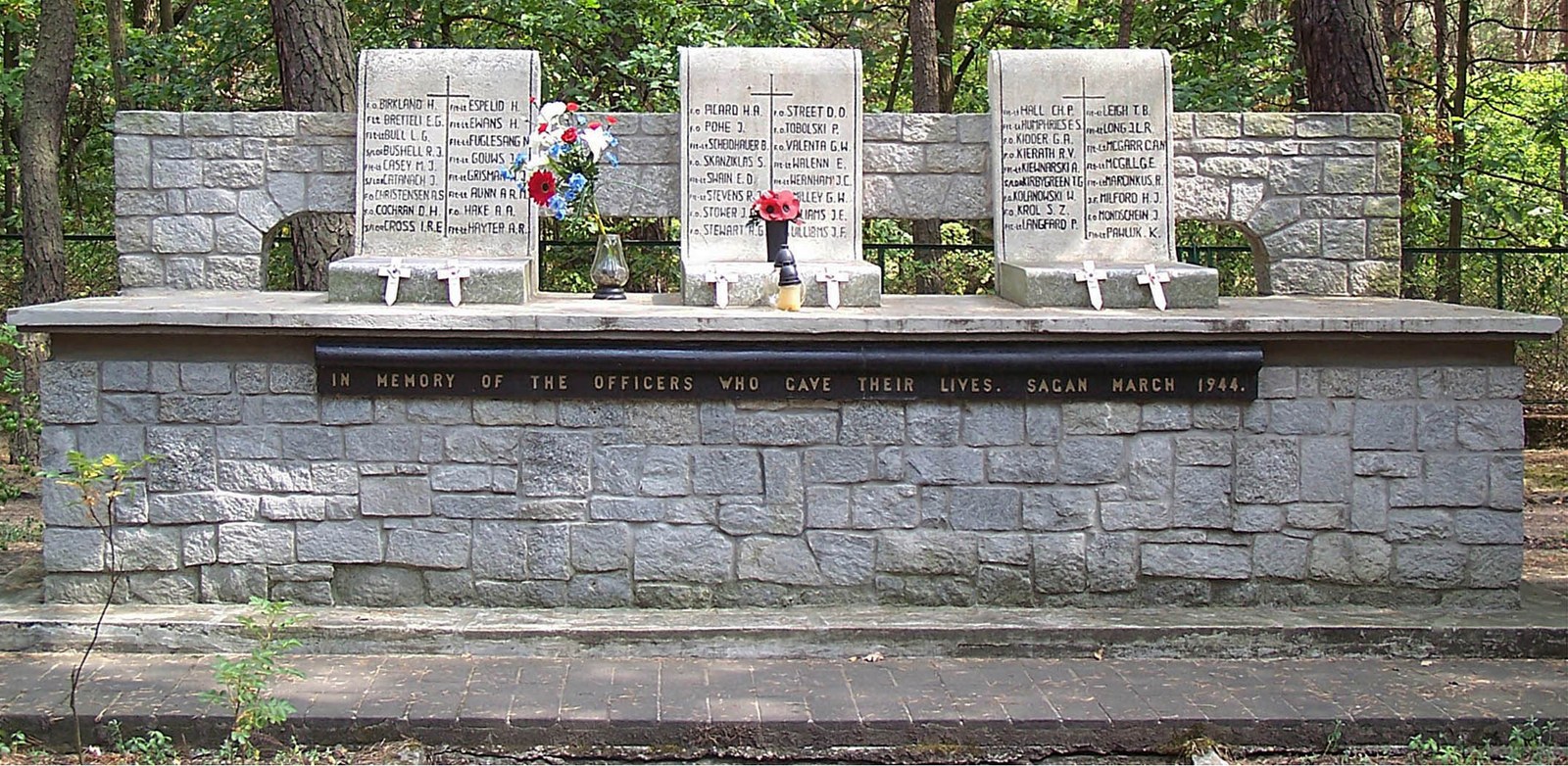
No detailed or graphic description of the killings is included here, out of respect for the victims and because the essential historical facts — who ordered them, who carried them out, and that they were murder — are what the record establishes. The fifty are commemorated by name at the memorial on the site of the camp.
Investigation and Justice
After the war, an extensive investigation was launched into the killings, headed by Wing Commander Wilfred Bowes of the Royal Air Force and Squadron Leader Frank McKenna of the Special Investigation Branch. Their small team — five officers and fourteen non-commissioned officers — worked for three years, identified 72 men as guilty of murder or conspiracy to murder, and accounted for 69 of them.
The first trial dealing specifically with the murders began on 1 July 1947, against 18 defendants. After fifty days, verdicts were handed down on 3 September 1947: all 18 were found guilty of war crimes, and 13 were hanged at Hamelin Prison in February 1948. The investigation also established the chain of orders from Hitler and Himmler down to the Gestapo officers who carried out the killings.
Stalag Luft III itself was evacuated in January 1945 as Soviet forces advanced, and the prisoners were forced on a long march westwards in winter conditions. The camp was liberated soon afterwards.
Memory and Myth
The Great Escape has lived on in popular culture, most famously in Paul Brickhill’s 1950 book — Brickhill was himself a prisoner at Stalag Luft III — and in the 1963 film starring Steve McQueen, James Garner and Richard Attenborough. The film is highly fictionalised: its motorcycle chase, its American leading characters, and its depiction of the murders as a single mass execution all depart from the record. No Americans were among the fifty, and the killings were carried out in small groups, not in one place.
The site at Żagań is now a museum and memorial, and the names of the fifty are read aloud at commemorations. The escape remains a remarkable feat of organisation and courage. But any honest account of it must end where the history ends: with the fifty men who escaped a prison camp and were murdered for it, and with the investigation that named their killers and brought some of them to justice.
What Is Documented — and What Is Not
Documented: The camp’s location and establishment (March 1942, Sagan, now Żagań), the three tunnels Tom, Dick and Harry, Bushell’s leadership as “Big X”, the escape on the night of 24–25 March 1944, the figures of 76 escapees, 73 recaptured and three who reached freedom (Bergsland, Müller and van der Stok), the execution of 50 men on Hitler’s orders, the post-war investigation by Bowes and McKenna, and the 1947 trial and the execution of 13 convicted men at Hamelin in February 1948 are all established in the sources below.
Unverified / to treat with care: Popular accounts, including the 1963 film, add scenes and characters with no basis in the record — notably the motorcycle escape, American participants among the escapers, and a single mass execution. This article does not repeat them as fact. The exact national breakdown of the fifty varies slightly between sources (some list 20 Britons, others 25); the figure of 50 total victims is consistent across all sources. Individual accounts of the fifty’s final hours, including reported last words, come from post-war testimony and secondary retellings and should be treated as such rather than as established fact.