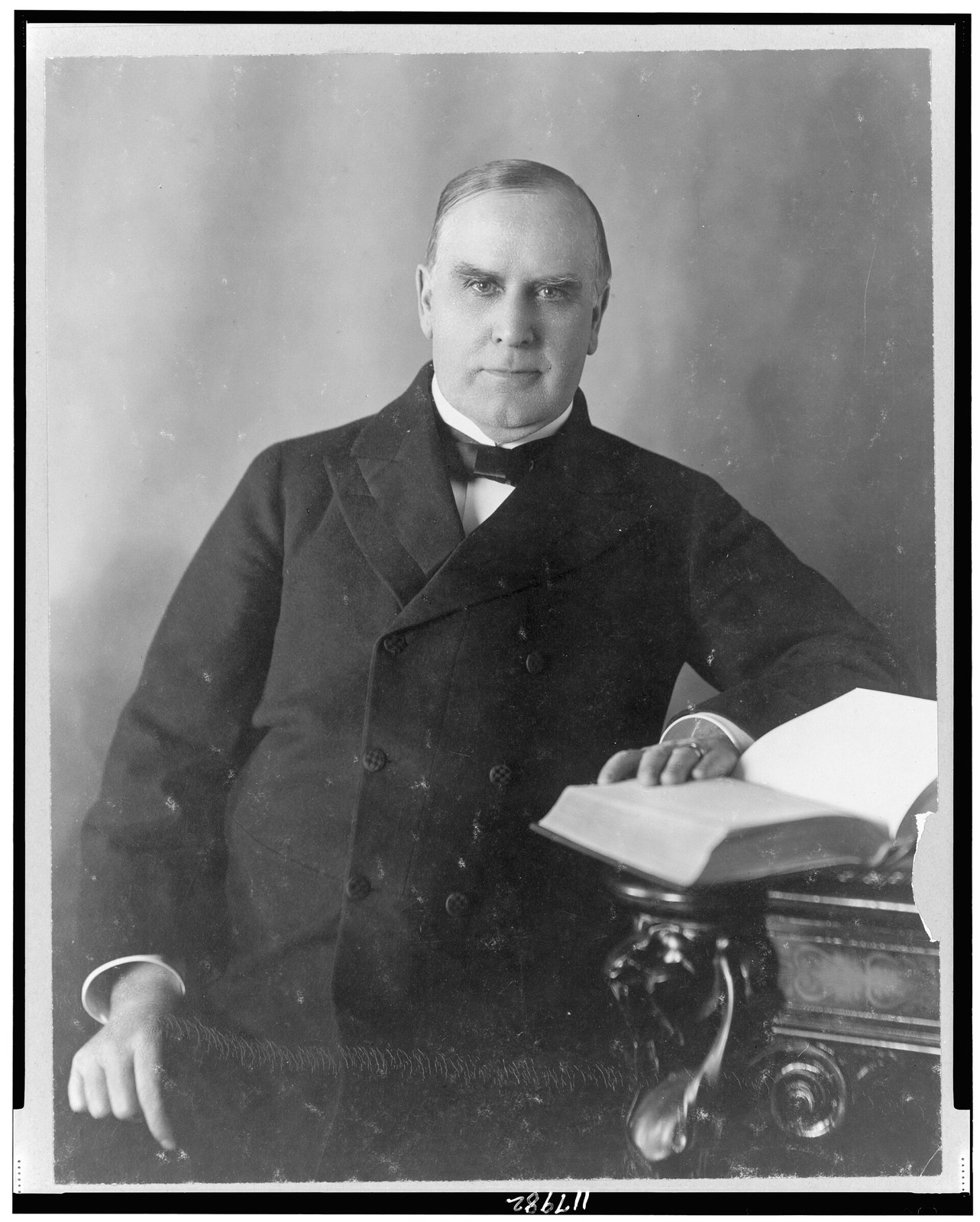
On 6 September 1901, President William McKinley was spending the day at the Pan-American Exposition in Buffalo, New York — a world’s fair celebrating American progress, all electric light and white plaster palaces. At 4:07 in the afternoon, he stood in the Temple of Music, shaking hands with the public in a receiving line, as presidents did in those days. A young man approached with his right hand wrapped in a handkerchief, as if it were injured. Inside the handkerchief was a .32-calibre Iver Johnson revolver. He fired twice at point-blank range. One bullet was deflected by a button on the president’s suit and lodged in his sternum. The other entered his abdomen and lodged in his back.
The shooter was Leon Czolgosz, a twenty-eight-year-old former factory worker from Cleveland, the son of Polish immigrants. He was arrested on the spot. Eight days later, McKinley was dead. It was the third assassination of an American president — after Lincoln in 1865 and Garfield in 1881 — and it made Theodore Roosevelt, at forty-two, the youngest president in the country’s history.
The President
William McKinley, the twenty-fifth president, had been born in Niles, Ohio, in 1843. He had served in the Civil War, then in Congress, then as governor of Ohio, before winning the presidency in 1896 and again in 1900. His first term had brought the Spanish-American War of 1898 and an American empire: Hawaii annexed, Puerto Rico, Guam and the Philippines taken from Spain. He was six months into his second term when he came to Buffalo, a popular president at the height of his power, greeting the public at a fair built to celebrate the country he led.
His assassin had lost his factory job during the Panic of 1893 and had drifted through the labour movement and into anarchism. Czolgosz had heard the anarchist Emma Goldman speak, and had come to believe that the president was the enemy of the common man — the face of an economic system that crushed workers. He later said he had acted to advance anarchism. He had travelled to Buffalo and waited in the receiving line until he reached the president.
Eight Days
McKinley was operated on at the exposition’s emergency hospital. The surgeons could not find the bullet, which had passed through his stomach and lodged in his back, and they closed the wound without removing it. An X-ray machine was on display at the fair, but it was not used on the president. At first he seemed to recover. He was moved to the home of the exposition’s president in Buffalo, and for several days the news was hopeful. Then, on 13 September, his condition turned sharply worse. Gangrene had set in around the wound, unnoticed. He died at 2:15 in the morning of 14 September 1901.
Vice President Theodore Roosevelt, who had been hiking in the Adirondack Mountains when the news reached him, was sworn in as the twenty-sixth president in Buffalo that same day. At forty-two, he was the youngest man ever to become president, and his energetic style — the Square Deal, the conservation movement, the Panama Canal — set a tone McKinley’s quieter administration had not. McKinley was buried in Canton, Ohio, where a great memorial tomb now stands.
The Trial
Czolgosz was tried quickly. His trial opened in Buffalo on 23 September 1901, barely two weeks after the shooting. He offered no real defence and called no witnesses. The jury deliberated for about half an hour and found him guilty of first-degree murder. He was sentenced to death and executed in the electric chair at Auburn Prison on 29 October 1901, seven weeks after the assassination. He was twenty-eight years old.
The assassination had a lasting consequence beyond the change of presidents. Until McKinley, the Secret Service had been concerned mainly with counterfeiting. After his death, Congress formally charged the Service with the protection of the president — a duty it has held ever since.
What Is Documented — and What Is Not
Documented: William McKinley, the twenty-fifth president, was shot on 6 September 1901 at 4:07 p.m. in the Temple of Music at the Pan-American Exposition in Buffalo, New York, by Leon Czolgosz, who fired twice with a concealed .32-calibre Iver Johnson revolver. One bullet was deflected by a suit button; the other lodged in the president’s abdomen. McKinley died of gangrene on 14 September 1901 at 2:15 a.m. Theodore Roosevelt was sworn in as president the same day. Czolgosz was tried on 23 September, convicted of first-degree murder after about thirty minutes of jury deliberation, and executed by electric chair at Auburn Prison on 29 October 1901. Congress subsequently assigned the Secret Service to protect the president.
Not documented / unverified: Accounts differ on whether Czolgosz was a committed anarchist or a disturbed young man who adopted anarchist language to explain his act; his own statements support the anarchist motive, but historians debate how deeply he understood the ideas he claimed. Whether the X-ray machine on display at the exposition could have saved McKinley is a matter of speculation: the machine was available, but the surgeons of the day were uncertain of its use, and the gangrene that killed him was not visible on any image then available. The claim that McKinley would have survived with modern treatment is widely made but cannot be proved.