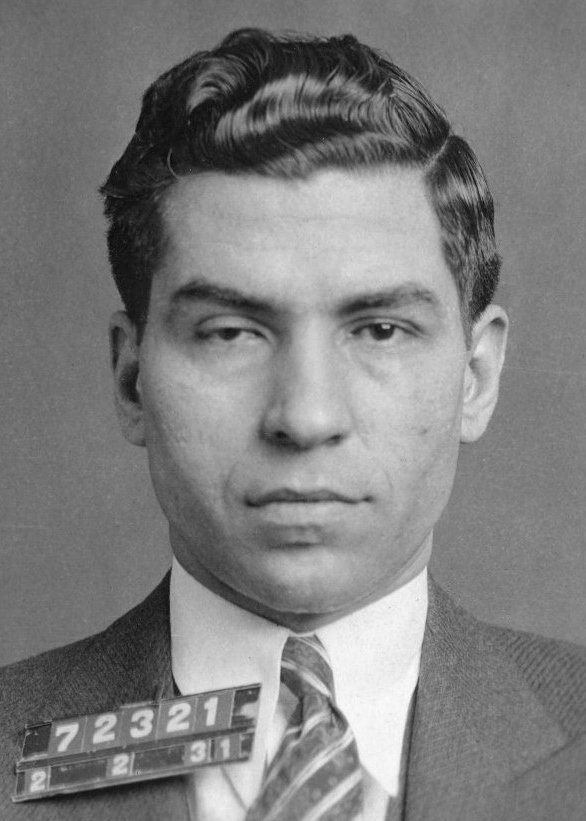
Charles “Lucky” Luciano is often called the father of modern organised crime in America. He did not invent the Mafia — it arrived with Sicilian immigrants in the late nineteenth century — but in the early 1930s he rebuilt it, replacing a system of warring family bosses with a national organisation run like a business. He then spent the rest of his life paying for it: ten years in an American prison, and the rest in exile in Italy.
From Sicily to the streets of New York
Luciano was born Salvatore Lucania in 1897 in Lercara Friddi, Sicily, and emigrated to New York with his family in 1907. He grew up on the Lower East Side, left school early, and by his teens was running with street gangs. During Prohibition, he built a fortune in bootlegging, working alongside the Jewish gangster Meyer Lansky and the Italian-American Frank Costello.
The nickname “Lucky” has several explanations. One story says it came from his survival of a beating and stabbing in 1929, when he was abducted, tortured and left for dead on a Staten Island beach — an attack he survived. Another says it was simply a shortening of his surname, Lucania. The record does not settle which is true.
The Castellammarese War
In 1930, New York’s underworld was torn by the Castellammarese War, a struggle between two Sicilian factions led by Joe “the Boss” Masseria and Salvatore Maranzano. Luciano, who had worked for Masseria, saw the war as bad for business. In April 1931, Masseria was shot dead in a Coney Island restaurant while dining with Luciano, who had excused himself to the washroom. Five months later, in September 1931, Maranzano was killed in his Manhattan office by gunmen posing as federal agents.
With both old bosses dead, Luciano reorganised the New York underworld into five families, and established a national body — the Commission — to settle disputes between crime families across the country. It was a corporate structure, with rules, arbitration and shared interests, and it held American organised crime together for decades.
Prison and exile
Luciano’s success drew the attention of Thomas E. Dewey, the special prosecutor who later became governor of New York and a presidential candidate. In 1936, Dewey prosecuted Luciano on charges of compulsory prostitution, arguing that he ran a network of brothels. The case rested heavily on the testimony of prostitutes and pimps, some of whom were later said to have been pressured. Luciano was convicted and sentenced to 30 to 50 years in prison.
During the Second World War, Luciano was approached by American intelligence. The US Navy, worried about sabotage on the New York docks, sought the help of the underworld to protect the waterfront — an arrangement that became known as Operation Underworld. Luciano’s role, from his prison cell, was to pass word through the docks. In 1946, Governor Dewey commuted his sentence on the condition that he be deported to Italy. Luciano was put on a ship to Naples, and he never returned to the United States.
He spent his remaining years in Italy, living in Naples and Rome, watched by police and journalists, and still, according to investigators, involved in the international narcotics trade. He died of a heart attack at Naples airport on 26 January 1962, aged 64, while waiting to meet a film producer.
Luciano’s rise was not without cost to himself. In October 1929, at the height of the bootlegging wars, he was abducted by gunmen, beaten and stabbed, and left for dead on a beach on Staten Island. He survived — reportedly telling police he knew nothing about the attack — and the incident became part of his legend. Some accounts say the attack was ordered by a rival; others say it was a warning from his own associates. The truth was never established, and Luciano never named his attackers.
The attack is also one of the possible origins of his nickname. “Lucky” may have come from his survival that night, or it may simply have been a shortening of Lucania. Luciano himself, in interviews late in life, gave different explanations at different times, and the record does not settle it.
What the record shows
- Charles “Lucky” Luciano was born Salvatore Lucania in Sicily in 1897 and emigrated to New York in 1907. During Prohibition he built a bootlegging empire with Meyer Lansky and Frank Costello.
- In 1931, following the Castellammarese War, Luciano arranged the killings of Joe Masseria (April 1931) and Salvatore Maranzano (September 1931), then reorganised New York’s underworld into five families and created the Commission.
- In 1936, he was convicted of compulsory prostitution in a prosecution led by Thomas E. Dewey and sentenced to 30 to 50 years in prison.
- During the Second World War, he cooperated with US naval intelligence in protecting the New York docks. In 1946, his sentence was commuted on condition of deportation to Italy.
- He died of a heart attack at Naples airport on 26 January 1962, aged 64.
- Disputed/unverified: The origin of the nickname “Lucky” is not settled. The extent of Luciano’s wartime cooperation — and what, if anything, he received in return beyond his commutation — has been debated by historians. Claims that he continued to run American crime families from Italy are based on intelligence reporting, not on convictions.
- Unresolved: No court ever determined who ordered the killings of Masseria and Maranzano.