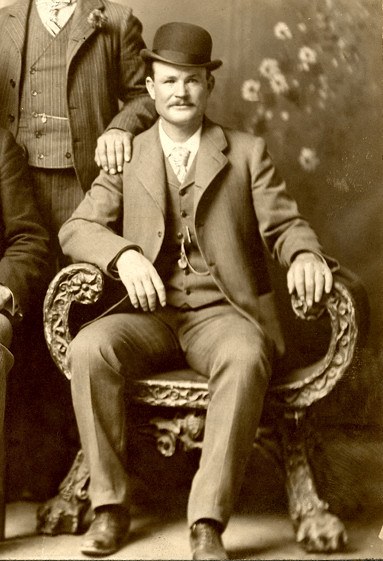
Robert LeRoy Parker was born on 13 April 1866 in Beaver, Utah, the eldest of thirteen children of Mormon immigrant parents. Harry Alonzo Longabaugh was born on 24 May 1867 in Mont Clare, Pennsylvania. Both became famous under borrowed names — Parker as Butch Cassidy, Longabaugh as the Sundance Kid — and together they became the best-known faces of the Wild Bunch, a loose gang that robbed banks and trains across the American West in the 1890s before fleeing to South America. Their story has been retold so often, most famously in the 1969 film Butch Cassidy and the Sundance Kid, that the legend now overshadows the record. The record itself is incomplete, and the ending is still disputed.
From Ranch Hand to Bank Robber
Parker grew up in Utah, worked as a ranch hand, and spent time in Telluride, Colorado, a mining town where he met men who would become his partners in crime. According to WyoHistory.org and History.com, his first bank robbery came on 24 June 1889, when he and several companions robbed the San Miguel Valley Bank in Telluride of more than $20,000. The exact membership of that robbery party varies between accounts, and contemporary newspapers did not name Parker at the time, so historians treat some details as probable rather than certain.
Longabaugh took his nickname from Sundance, Wyoming, where he was jailed in 1887 for horse theft. The two men are believed to have met in the early 1880s, though the date is not documented. By the mid-1890s they were working together, with associates that included Elzy Lay, Harvey Logan — known as Kid Curry — Ben Kilpatrick, and Will Carver.
The Only Prison Term
Cassidy’s criminal career was interrupted by his only known prison sentence. In 1894 he was convicted in Wyoming of horse theft, after a dispute over a horse valued at only a few dollars, and sentenced to two years at the Wyoming State Penitentiary in Laramie. He entered the prison on 15 July 1894 as inmate number 187, and after about eighteen months he was pardoned by Governor William Richards and released on 19 January 1896.
The pardon came with a reported understanding that Cassidy would leave Wyoming ranchers alone. Within months of his release, he was back at work, taking part in the robbery of a bank in Montpelier, Idaho, in August 1896 with Elzy Lay and Bub Meeks. Over the next five years the Wild Bunch carried out a series of bank and train robberies in Wyoming, Nevada, Utah, and New Mexico. The gang was not a fixed organisation with a hierarchy. It was a loose network of men who came together for particular jobs and then scattered, which is one reason the full list of its members and crimes remains uncertain.
The Photograph That Helped the Pinkertons
The Wild Bunch’s most famous mistake had nothing to do with a robbery. After the robbery of the First National Bank in Winnemucca, Nevada, on 19 September 1900, in which the gang took $32,640, several members travelled to Fort Worth, Texas. There, in November 1900, they posed for a studio portrait by photographer John Swartz: seated, Longabaugh, Kilpatrick, and Parker; standing, Carver and Logan.
Swartz displayed the portrait in his studio window. A detective recognised one of the men, and the photograph reached the Pinkerton National Detective Agency, which was leading the pursuit of the gang. The Pinkertons used cropped versions on wanted circulars issued on 15 May 1901. The original photograph is now held by the Smithsonian Institution’s National Portrait Gallery. It did not, by itself, end the gang, but it gave law enforcement clear likenesses of men who had previously been hard to identify.
Flight to South America
In 1901 Parker and Longabaugh left the United States with Longabaugh’s companion Etta Place. They travelled via New York to Buenos Aires, Argentina, and bought a ranch near Cholila, in Patagonia. For a time they lived as ranchers. Whether they also returned to robbery in Argentina is disputed; some accounts attribute bank robberies there and in Chile to them, while others note that the evidence is circumstantial.
The Pinkertons tracked them to Cholila by 1905, and the trio left the ranch, with Place returning to the United States in 1906. Parker and Longabaugh then moved on to Bolivia, where the record grows thinner still.
The Reported Deaths in San Vicente
The most widely accepted account runs as follows. On 3 November 1908, two men believed to be Cassidy and Longabaugh robbed a courier carrying the payroll of the Aramayo mining company near Tupiza, in southern Bolivia. On the evening of 6 November they arrived in the small town of San Vicente, seeking shelter. A mule in their possession was recognised as one taken in the robbery, and local officials summoned soldiers. A shootout followed during the night. When officials entered the house the next morning, they found two men dead. The local police report speculated that Cassidy had shot the mortally wounded Longabaugh and then himself. The two bodies were buried in the San Vicente cemetery.
That account is the one most historians accept. It is not, however, conclusively proved. The bodies were never formally identified by anyone who had known Parker or Longabaugh, and a 1991 exhumation failed to produce conclusive evidence. Claims that Cassidy survived circulated for decades, including a 1975 book by his younger sister Lula Parker Betenson, which stated that he lived in the American Northwest until 1937. No documentary evidence has established that claim.
What the record shows
Documented: Parker was born on 13 April 1866 in Beaver, Utah; Longabaugh on 24 May 1867 in Mont Clare, Pennsylvania. Parker took part in the 24 June 1889 robbery of the San Miguel Valley Bank in Telluride. He was convicted of horse theft in Wyoming in 1894, entered prison on 15 July 1894, and was pardoned and released on 19 January 1896. The Wild Bunch robbed the First National Bank in Winnemucca, Nevada, on 19 September 1900. The Fort Worth portrait was taken by John Swartz in late 1900 and used by the Pinkertons on wanted circulars from 15 May 1901. Parker and Longabaugh sailed to South America in 1901 with Etta Place and settled for a time near Cholila, Argentina. Two men believed to be them were found dead in San Vicente, Bolivia, after a shootout on the night of 6–7 November 1908, following a payroll robbery on 3 November 1908.
Disputed or unverified: The exact origin of the nickname “Butch Cassidy”; the date of Parker and Longabaugh’s first meeting; whether the pair committed specific robberies in Argentina and Chile; the claim in the San Vicente police report that Cassidy shot Longabaugh before killing himself, which is speculation based on the positions of the bodies; the positive identification of the two bodies buried at San Vicente; and all claims that either man survived 1908, including the account in Lula Parker Betenson’s 1975 book. The 1991 exhumation did not resolve the identification question.
Sources
- https://www.wyohistory.org/encyclopedia/outlaw-and-his-lawyer-butch-cassidy-and-douglas-preston
- https://www.wyohistory.org/encyclopedia/butch-cassidy-wyoming
- https://www.history.com/articles/6-things-you-might-not-know-about-butch-cassidy
- https://en.wikipedia.org/wiki/Butch_Cassidy
- https://wiki.poast.org/wiki/Harry_Longabaugh
- https://www.hmdb.org/m.asp?m=52284
- https://commons.wikimedia.org/wiki/File:Butch_Cassidy_with_bowler_hat.jpg