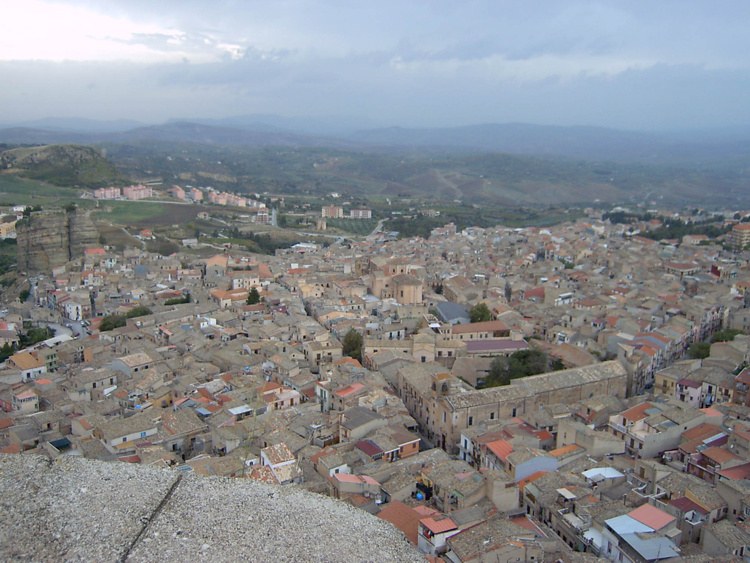
In the early hours of 11 April 2006, police officers moved quietly through the Sicilian countryside outside Corleone, a hill town about 60 kilometres south of Palermo. Their target was a run-down farmhouse at Montagna dei Cavalli, little more than a shepherd’s hut with a cheese dairy attached. Inside, they believed, lived the most wanted man in Italy — a man no police officer had seen in 43 years. When a hand reached out of the door to take in a bundle of freshly washed laundry, the officers moved in. The old man inside did not resist. He was 73 years old, frail, and dressed like a farm labourer. His name was Bernardo Provenzano, and he had run the Sicilian Mafia from hiding for more than a decade.
A farmer’s son from Corleone
Bernardo Provenzano was born on 31 January 1933 in Corleone, the third of seven children of the farmers Angelo Provenzano and Giovanna Rigoglioso. Corleone was then, and remains, a poor farming town in the Sicilian interior — and a place whose name became famous around the world through Mario Puzo’s novel The Godfather, which borrowed it for its fictional crime family. Provenzano’s own story was real, and it began in hardship: he left school at eight and worked the land with his family.
He is said to have joined the Mafia in his late teens. What is documented is that by the late 1950s he was part of the Corleonesi, the Mafia faction based in Corleone, and that he backed its boss, Luciano Leggio, in the ambush and murder of the town’s established Mafia chief, Michele Navarra. That killing opened the way for Leggio’s rise — and for Provenzano’s. He earned a reputation as a ruthless enforcer, and the nickname “Binnu u tratturi” — Binnu the Tractor — for the way he was said to mow down his enemies. Later, as he vanished from public view, he would gain a second nickname: “the Phantom of Corleone”.
The Corleonesi rise
On 10 September 1963, an arrest warrant was issued for Provenzano over the murder of one of Navarra’s men, following a failed hit. From that day he was a fugitive, and he would remain one for 43 years. Leggio went to prison for murder in 1974, and Salvatore Riina — known as Totò Riina — took charge of the Corleonesi, with Provenzano as his second-in-command and right-hand man.
Under Riina and Provenzano, the Corleonesi set out to take control of the whole of Cosa Nostra, the Sicilian Mafia. In 1981 they unleashed the so-called Second Mafia War, a campaign against rival bosses that left hundreds dead and established the Corleonesi as the dominant force in the Sicilian underworld. The war’s victims included not only rival mafiosi but their families.
The Italian state fought back. In the mid-1980s, the Maxi Trial in Palermo — built on the evidence of Mafia turncoats and the work of the prosecutors Giovanni Falcone and Paolo Borsellino — convicted hundreds of mafiosi. Riina, Provenzano and others were sentenced to life imprisonment in absentia in 1987. But the Corleonesi answered with worse. In 1992, the Corleonesi leadership ordered the bombings that killed Falcone at Capaci in May and Borsellino in Via D’Amelio in Palermo in July. Provenzano was later convicted in absentia for those murders, receiving life sentences in 1997 for Falcone and in 1999 for Borsellino.
Boss of bosses — in the shadows
In January 1993, Riina was arrested in Palermo after 23 years as a fugitive. Leoluca Bagarella, another Corleonesi leader, was arrested in June 1995. According to informants and investigators, Provenzano then took the reins of the Corleonesi and of Cosa Nostra as a whole — the de facto “boss of bosses”, though Cosa Nostra has no formal title of that kind.
His leadership was different from Riina’s. Where Riina had waged open war on the state, Provenzano favoured a strategy of submersion: less violence, more patience, and a return to the Mafia’s older ways of quiet infiltration — of business, politics and public contracts. Informants later said he re-established rules Riina had abolished and pushed for negotiation rather than confrontation. At a meeting at Villabate in 1993, Provenzano and Bagarella were reported to have taken joint charge of the Corleone district, but the two men disagreed: Bagarella wanted to continue the bombing campaign, while Provenzano wanted the killing to stop. After Bagarella’s arrest, Provenzano’s quieter line prevailed.
For years, many doubted he was even alive. He had not been publicly seen since 1963. When his wife Saveria and their two grown sons emerged from hiding in 1992, some investigators suspected Provenzano had died. But the notes and the orders kept coming, and the informants kept insisting that the old man from Corleone was still in charge.
The pizzini
Provenzano’s long survival depended on a single discipline: he never used a telephone. Instead, he communicated through small notes called pizzini — little slips of paper, typed on an old typewriter, folded tightly, and carried by hand from courier to courier across Sicily. He used them for everything, from orders to his lieutenants to requests for meals from his family.
The notes were also coded. Provenzano used a version of the Caesar cipher, the code Julius Caesar used for military messages, in which each letter is shifted forward in the alphabet. His version shifted each letter three places forward, then replaced the letters with numbers indicating their position in the alphabet — a system in which A became 4, B became 5, and so on. Names were replaced with numbers. The system was simple, and investigators eventually learned to read it. But the real security was not the code; it was the human chain. No phone call could be tapped, no signal could be traced, because there was no signal at all. Police later found five Bibles in his hideout, one of them heavily annotated with numbers and letters that investigators believed identified members of the organisation, and his pizzini were often headed with religious phrases.
The laundry trail and the arrest
The break in the case came not from technology but from watching his family. Police had Provenzano’s wife’s house in Corleone under surveillance, and they noticed a package of freshly washed clothes leaving the house, passing through a chain of couriers, and ending up at a farmhouse in the hills. They followed the laundry. When a hand came through the door to take the bundle in, they knew they had found their man.
On the morning of 11 April 2006, officers moved in on the farmhouse at Montagna dei Cavalli, about a mile from Corleone. They found Provenzano living in two ramshackle rooms with a shepherd who acted as his housekeeper. In the hut were two typewriters, a dictionary, a rough slab of wood that served as a desk, and about 350 pizzini. He did not resist arrest. According to the officers present, he told them: “You have no idea what you have done.” All he took with him from the farmhouse were his medicine and his rosary.
The arrest was the biggest police success against the Mafia in more than a decade. Two months later, on 20 June 2006, investigators used the seized pizzini to issue 52 arrest warrants against the top echelon of Cosa Nostra in Palermo, in an operation known as Gotha. The notes that had kept Provenzano hidden for 43 years had, in the end, mapped his entire organisation for the police.
Trial, prison and death
After his arrest, Provenzano was held at the maximum-security prison in Terni, in Umbria, under the stringent Article 41-bis prison regime — the hard-prison rules applied to Mafia bosses, which sharply limit contact with the outside world. In total, he received 20 life sentences, plus 49 years and one month, and solitary confinement for 33 years and six months, for Mafia association and multiple murders.
He spent his remaining decade in prison. His health declined, and he was moved to a hospital in Milan, where he died on 13 July 2016, aged 83. After his arrest, leadership of Cosa Nostra was thought to have passed to men including Salvatore Lo Piccolo and, later, Matteo Messina Denaro — who himself remained a fugitive for 30 years until his arrest in Palermo in January 2023.
The long shadow
Provenzano’s story is often told as a tale of cunning — the invisible boss, the coded notes, the laundry that betrayed him. But the measure of his career is not his escape. It is the cost of the organisation he helped to lead: the rival bosses and their families killed in the Second Mafia War, the prosecutors Falcone and Borsellino murdered in 1992, and the many others whose names never reached the newspapers. The pizzini show a man who ran an empire on scraps of paper. The court records show what that empire did. A year after the arrest, Corleone’s schoolchildren ran a “freedom run” to the farmhouse where he was caught, and the track leading to it was renamed Via 11 April 2006. The phantom was gone. The town remained.
What is documented — and what is not
Documented: Provenzano’s birth in Corleone on 31 January 1933; the arrest warrant of 10 September 1963 and his 43 years as a fugitive; his role as Riina’s second-in-command; the Second Mafia War of 1981; the Maxi Trial life sentences imposed in absentia in 1987; his convictions in absentia for the 1992 murders of Falcone (1997) and Borsellino (1999); his succession to the leadership of Cosa Nostra after the arrests of Riina in 1993 and Bagarella in 1995; the use of coded pizzini; his arrest on 11 April 2006 at a farmhouse near Corleone after police tracked a laundry delivery; the seizure of about 350 pizzini; Operation Gotha on 20 June 2006; his detention under the Article 41-bis regime; his 20 life sentences; and his death in Milan on 13 July 2016, aged 83.
Unverified or unproven: The exact number of murders Provenzano personally committed or ordered is not established — press reports have claimed figures such as 40 murders carried out himself and more than 120 ordered, but these are journalistic estimates, not court findings, and should not be repeated as fact. His precise words on arrest (“You have no idea what you have done”) are reported by the officers present but were not recorded. Claims that named politicians, businessmen or professionals protected him during his years as a fugitive are allegations made by prosecutors and informants, not proven findings. The title “boss of bosses” is a journalistic label; Cosa Nostra has no such formal office, and the exact extent of Provenzano’s authority over clans outside the Corleonesi rests on informant testimony and interpretation.
Sources
- https://en.wikipedia.org/wiki/Bernardo_Provenzano
- https://encyclopedia.thefreedictionary.com/Bernardo+Provenzano
- https://www.arabnews.com/world/jailed-cosa-nostra-boss-dies-decade-after-capture-in-sicily-953046
- https://www.mtpr.org/2006-04-12/fallout-continues-from-divisive-italian-election
- https://www.theregister.com/offbeat/2006/04/19/mafia-boss-undone-by-clumsy-crypto/1435477
- https://www.italymagazine.com/featured-story/corleone-exorcises-provenzano
- https://www.italymagazine.com/featured-story/italy-develops-provenzano-fixation