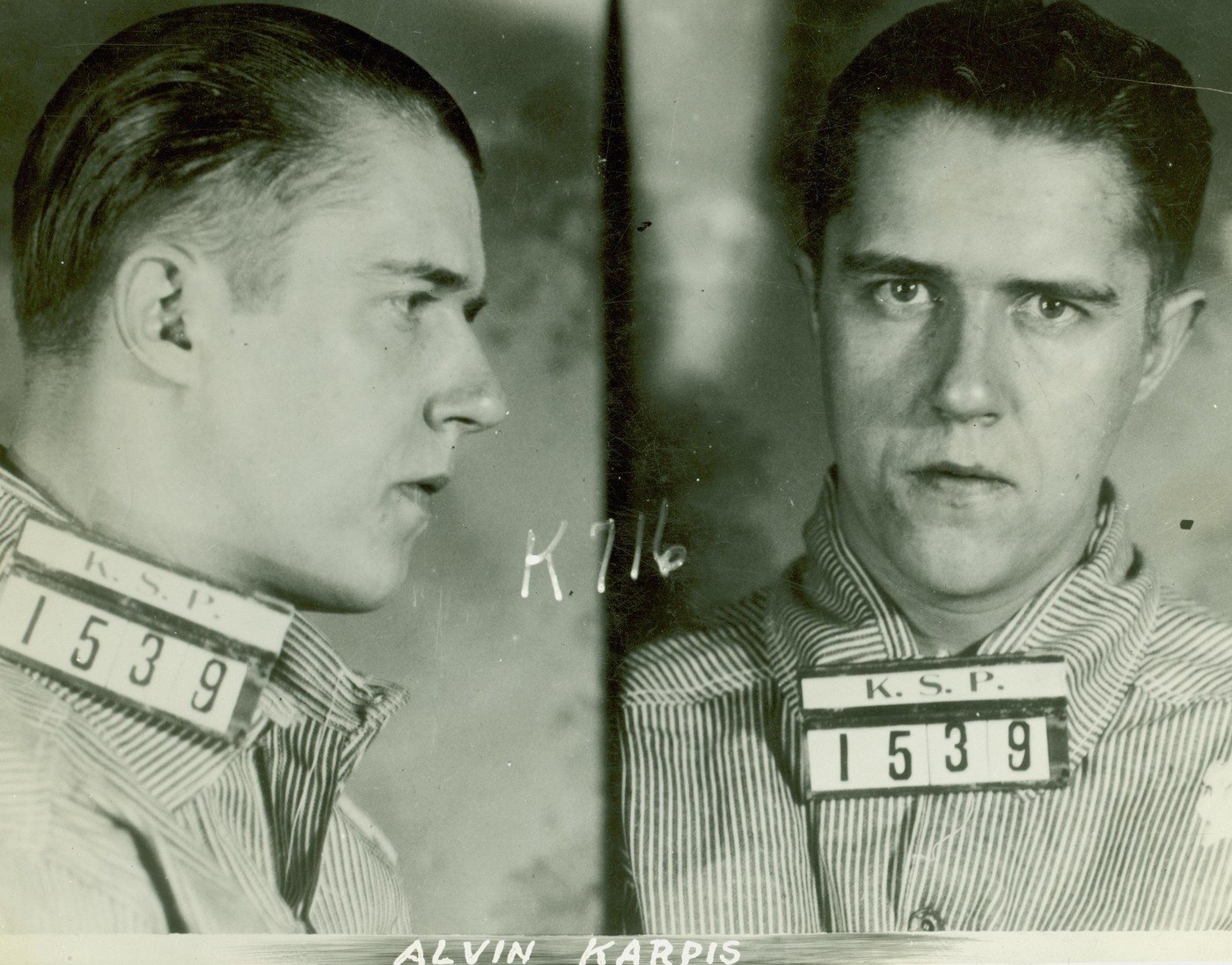
On 1 May 1936, in a quiet street in New Orleans, FBI agents surrounded a Plymouth coupe and took into custody the most wanted man in America. Alvin Karpis was 28, leader of the Barker-Karpis gang, and the last of the great Depression-era outlaws still at large. John Dillinger, Pretty Boy Floyd and Baby Face Nelson were all dead. Karpis was the only one of the FBI’s four Public Enemy No. 1s ever taken alive – and the price was twenty-six years on Alcatraz, the longest stay of any prisoner held on the Rock.
Karpis was not the most flamboyant of the 1930s gangsters. He did not court the newspapers the way Dillinger did, and he never became a folk hero. What made him dangerous was discipline: he planned carefully, chose his targets for their money rather than their fame, and kept his gang small and loyal. His crimes were nevertheless serious – bank robberies, a murdered sheriff, and two of the most lucrative kidnappings in American history. The men he held for ransom were the centre of the story, and their ordeal is what finally brought the full weight of the young FBI down on him.
A Montreal boy raised in Kansas
Alvin Francis Karpis was born Albin Francis Karpavičius on 10 August 1907 in Montreal, Canada, to Lithuanian immigrant parents. The family later moved to the United States, and he grew up in Kansas. Still a teenager when he began breaking the law, he was serving time in the Kansas State Penitentiary at Lansing for burglary by his early twenties.
Prison gave him his career. Inside Lansing he met Fred Barker, the son of Kate Ma Barker, and the two became close friends. When Karpis was released in 1931, he joined Barker in Tulsa, Oklahoma, and in March 1931 the two men put together the gang that would carry both their names. Fred’s brother Arthur Doc Barker joined later. The gang moved constantly – Missouri, Minnesota, Illinois, Florida – living under false names in rented houses paid for in cash.
Karpis was the gang’s planner: quiet, watchful and methodical, with a remarkable memory for detail. He was nicknamed Creepy – reportedly for a smile that other criminals found unsettling – and he was the one who chose the targets and divided the money.
The West Plains killing
The gang’s early crimes were bank and store robberies across the Midwest. On 19 December 1931, that pattern turned lethal: Karpis and Fred Barker were in West Plains, Missouri, after a store robbery, when Sheriff C. Roy Kelley began investigating them. Kelley was shot and killed, and the two men fled to St. Paul, Minnesota.
St. Paul in the early 1930s was known among criminals as a safe city, where police corruption let outlaws live openly if they kept quiet and paid the right people. The gang settled in, and Karpis began to think bigger than bank vaults. Banks were heavily guarded and the takings unpredictable; kidnapping a rich man, he reasoned, was a surer thing — pick a victim whose family could pay, name the price, and collect it.
The Hamm kidnapping
On 15 June 1933, the gang put that plan into action. Their victim was William A. Hamm Jr., president of the Hamm’s Brewing Company in St. Paul, seized outside his office in the evening and driven away. He was held for four days while the gang negotiated with his family, and released on 19 June after a ransom of $100,000 was paid — an enormous sum in the depths of the Depression.
Hamm survived, and his account showed investigators how professional the gang had become: he was blindfolded, moved between hiding places, and treated with cold, businesslike care. The gang wanted the money, not a murder charge, and released him once it was paid. But the kidnapping had crossed a line that bank robbery never had, making the gang a national priority for a Bureau of Investigation still building its reputation.
The Bremer kidnapping — and the fingerprint that ended the gang
The Hamm money did not last. On 17 January 1934, the gang kidnapped Edward George Bremer Jr., president of the Commercial State Bank of St. Paul, in daylight on a city street. He was held for three weeks and released on 7 February 1934, after his family paid $200,000 in ransom.
The Bremer kidnapping proved to be the gang’s undoing. Bremer’s father was a friend of President Franklin D. Roosevelt, and the White House put intense pressure on the FBI to solve the case. And FBI agents found Doc Barker’s fingerprint on a petrol can left near the ransom drop-off site; the Bureau’s laboratory could lift latent fingerprints from surfaces ordinary dusting could not reach. Working backwards from that single print, investigators pieced together the gang’s identity and movements.
One by one, the gang was broken apart. In January 1935, Doc Barker was captured in Chicago; a map found in his apartment led agents to a cottage on Lake Weir near Ocklawaha, Florida, where Fred Barker and his mother Ma Barker were hiding. On 16 January 1935, after a shootout lasting several hours, Fred and Ma Barker were killed by federal agents. Karpis, who had not been at the cottage, was suddenly alone at the top of the FBI’s most-wanted list, having already been declared Public Enemy No. 1 on 28 November 1934, after the killing of Baby Face Nelson.
The fugitive
Karpis spent the next fifteen months on the run with a small circle of associates, including Fred Hunter. He also took steps to erase his identity: in 1934, underworld doctor Joseph Moran surgically altered his fingerprints. The operation made it harder for police to match him to prints on file — and, decades later, it would make it difficult for him to obtain a passport.
Meanwhile, the pursuit became personal for FBI Director J. Edgar Hoover. In April 1936, he was humiliated at a Senate appropriations hearing, where Senator Kenneth McKellar of Tennessee questioned his budget and suggested Hoover had never personally made an arrest. Hoover needed a public victory, and Karpis was the man who could give him one.
On 30 March 1936, agents raided a house in Hot Springs, Arkansas, only to find Karpis had already slipped away to New Orleans. There, on 1 May 1936, the FBI closed in: Karpis and Hunter were leaving an apartment building and getting into a car when agents swarmed them. Hoover himself was present, having flown to New Orleans to direct the arrest.
The arrest — two versions
What exactly happened in those few seconds has been argued about ever since, because the two sides told it differently. The official FBI version holds that Hoover reached into the car and grabbed Karpis before he could reach a rifle in the back seat. Karpis, in his own account, said Hoover was nowhere near the car until the agents had already seized him, and that the director then stepped forward for the photographs. According to the FBI’s own account of the scene, no one had brought handcuffs, and an agent used his necktie to bind Karpis’s hands.
The dispute matters less than the result. Karpis was in custody, alive, and within hours Hoover was escorting him back to St. Paul. On 27 July 1936, he pleaded guilty to charges arising from the Hamm kidnapping and was sentenced to life imprisonment. He was sent first to Leavenworth, then in August 1936 to the newly built federal penitentiary on Alcatraz Island in San Francisco Bay.
Twenty-six years on the Rock
Karpis entered Alcatraz in August 1936 and did not leave until April 1962. His twenty-six years there were the longest served by any prisoner on the island. He worked in the prison industries, kept his head down, and survived a regime designed to break men. He later wrote that Alcatraz was escape-proof not only because of its walls and cold water, but because of its routine: the same days, the same walls, the same silence, year after year.
In April 1962 he was moved to McNeil Island Penitentiary in Washington State, where he served the remainder of his sentence. He had spent thirty-three years in prison in total — more than half his life.
Release, deportation and a second life
In 1969, Karpis was granted parole on condition that he be deported to Canada, the country of his birth. He settled in Montreal, but the fingerprint surgery of 1934 came back to haunt him: without usable fingerprints, he had great difficulty obtaining Canadian passport credentials before the paperwork was finally resolved.
He wrote about his life twice: The Alvin Karpis Story (1971, with Bill Trent), telling his version of the gang years and the arrest, and On the Rock: Twenty-Five Years in Alcatraz (1980, with Robert Livesey), describing his imprisonment. The books gave him an income, and with it he moved to Spain, settling in Torremolinos on the Costa del Sol. He died there on 26 August 1979, aged 72 — the last of the four Public Enemy No. 1s, and the only one who lived long enough to grow old, write his memoirs, and die in his own bed.
Why Karpis matters
Karpis’s career marks the end of an era. The Barker-Karpis gang was one of the longest-lived criminal gangs of the Depression, active from 1931 to 1935, and its two kidnappings were among the richest crimes of the decade. But those kidnappings also changed American law enforcement: they forced the FBI to develop forensic techniques — latent fingerprint work, in particular — that became standard practice, and they gave the young Bureau the public victories it needed to become the country’s chief crime-fighting agency. His capture in New Orleans, staged for the cameras with Hoover himself present, made the director a household name.
There is a temptation to romanticise the Depression-era outlaw, to remember the nicknames and the daring and forget the victims. The record does not allow it. A sheriff was killed in Missouri. Two men were seized from their own streets, held blindfolded for days and weeks, and returned to their families only after fortunes changed hands. Karpis’s intelligence and discipline made him the most successful of the outlaws — and the one who paid the longest price. He entered prison as a young man of 28 and came out as an old man of 61, with nothing left of the gang, the money or the life he had built. That, more than the legend of Public Enemy No. 1, is the real story of Alvin Karpis.
What is documented — and what is not
Documented: Karpis was born Albin Francis Karpavicius on 10 August 1907 in Montreal to Lithuanian immigrant parents, and died on 26 August 1979 in Torremolinos, Spain, aged 72. He met Fred Barker in the Kansas State Penitentiary and formed the Barker-Karpis gang with him in Tulsa in March 1931. Sheriff C. Roy Kelley was killed on 19 December 1931 at West Plains, Missouri. William A. Hamm Jr. was kidnapped on 15 June 1933 and released on 19 June after a $100,000 ransom; Edward George Bremer Jr. was kidnapped on 17 January 1934 and released on 7 February after a $200,000 ransom. Doc Barker’s fingerprint on a petrol can near the Bremer ransom drop-off led the FBI to the gang. Fred and Ma Barker were killed by federal agents at Lake Weir, Florida, on 16 January 1935. Karpis was declared Public Enemy No. 1 on 28 November 1934, captured in New Orleans on 1 May 1936 with J. Edgar Hoover present, and pleaded guilty to the Hamm kidnapping on 27 July 1936, receiving a life sentence. He was held at Alcatraz from August 1936 to April 1962 — twenty-six years, the longest of any Alcatraz prisoner — then at McNeil Island, and was paroled in 1969 and deported to Canada. He wrote The Alvin Karpis Story (1971, with Bill Trent) and On the Rock (1980, with Robert Livesey). He was the only one of the FBI’s four Public Enemy No. 1s — Dillinger, Floyd, Nelson and Karpis — to be taken alive.
Unverified or unproven: Hoover’s exact role in the 1 May 1936 arrest — the FBI’s version has Hoover seizing Karpis himself, while Karpis’s own account says Hoover arrived only after the arrest was made. The claim, sometimes repeated, that Karpis had a photographic memory is a description from secondary sources, not a tested fact. The sums the gang kept from the ransoms after dividing the money are not documented, and no reliable total exists for the gang’s overall takings. The nickname Creepy is widely reported as referring to his smile, but no contemporary source records who first used it or when. Any claim that Karpis personally fired the shot that killed Sheriff Kelley rests on the gang’s joint involvement in the West Plains incident, not on a proven account of who pulled the trigger.