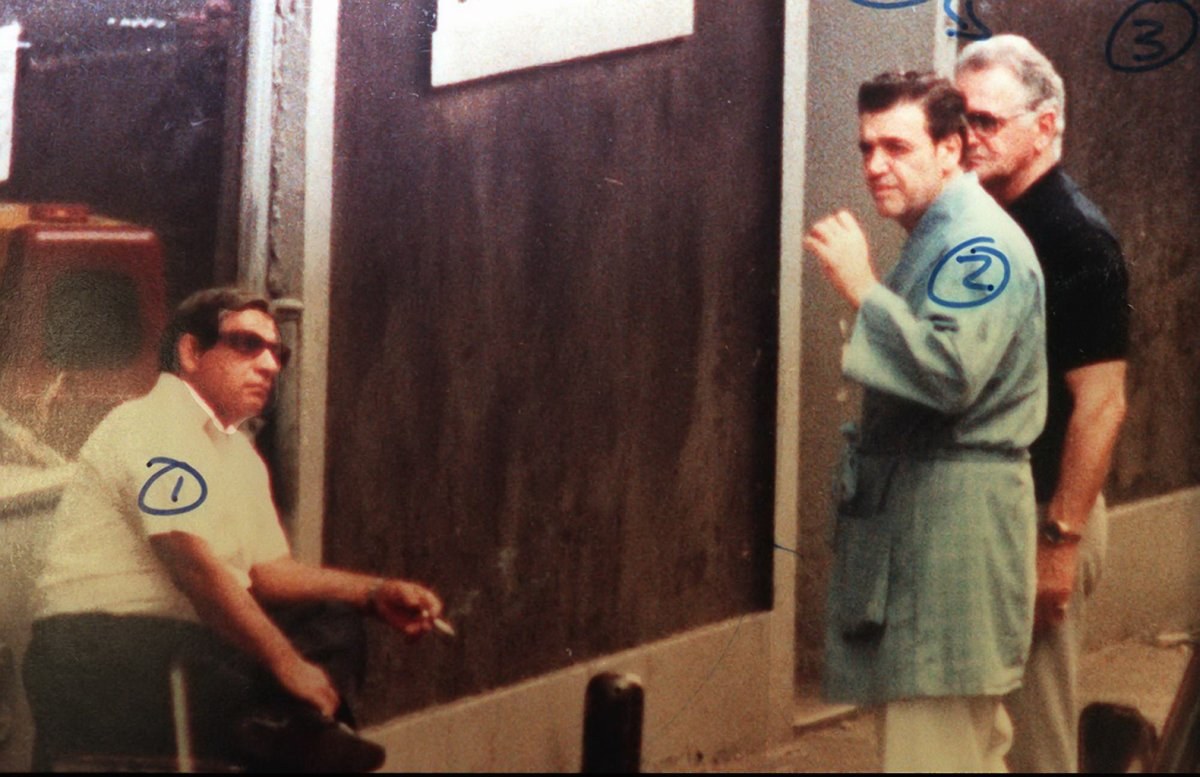
On a morning in Greenwich Village in the 1980s, neighbours on Sullivan Street might have seen a familiar figure shuffling past in a pale bathrobe, pyjamas and slippers, muttering to himself as he went. He stopped at his mother’s apartment, as he did most days, and then wandered on, seemingly lost in a world of his own. To the people who lived nearby, he was a sad, confused old man. To the FBI agents watching from across the street, he was Vincent “the Chin” Gigante, the boss of the Genovese crime family — and, they believed, one of the most disciplined actors in the history of American organised crime.
For almost thirty years, Gigante maintained that he was too mentally ill to stand trial. Psychiatrists hired by his family testified that he suffered from paranoid schizophrenia and heard voices, and charges against him were dropped after courts found him unfit. All the while, prosecutors later argued, he was directing one of New York’s most powerful crime families. The act held until 1997, when a federal jury convicted him of racketeering, and ended in 2003, when Gigante himself admitted in court that the illness had been a performance.
A boxer from Greenwich Village
Vincent Louis Gigante was born in New York City on March 29, 1928, the son of immigrants from Naples, Italy. He grew up in Greenwich Village, one of five brothers, several of whom later became involved in organised crime themselves. His nickname, “the Chin,” came from his mother, who pronounced his given name, Vincenzo, as “Vin-chen-zo” — a sound his childhood friends shortened to “Chin.”
As a young man, Gigante was a professional light-heavyweight boxer. He fought 25 bouts between 1944 and 1947, managed by a neighbour, Thomas Eboli, an associate of the influential mobster Vito Genovese. Boxing gave him a reputation on the streets of the Village as someone not to cross. By his late teens he had come under the protection of Genovese, then a captain in the Luciano crime family, the organisation that would later carry the Genovese name.
By the mid-1950s, Gigante had a criminal record that included arrests for receiving stolen goods, possessing an unlicensed handgun, car theft, arson and bookmaking. He had served one short jail sentence, of sixty days, on a gambling charge. He was, in the eyes of the police, a rising enforcer in a family that was about to fight a war for control of itself.
The Costello shooting and the first prison term
In early 1957, Vito Genovese decided to move against Frank Costello, the boss of the Luciano family. Costello, a polished gambling entrepreneur who had succeeded Charles “Lucky” Luciano, stood in Genovese’s way. Genovese chose Gigante as his gunman. On the evening of May 2, 1957, as Costello returned to his apartment building at 115 Central Park West, Gigante fired at him in the lobby. The bullet grazed the side of Costello’s head. Costello survived, and Gigante fled.
Gigante was arrested and tried for attempted murder in 1958, but he was acquitted after Costello told the court he could not identify his attacker. Costello stepped back from leadership soon afterwards, and Genovese took control of the family.
A year later, Gigante’s luck ran out in a different courtroom. In 1959, he was convicted with Genovese in federal court on heroin trafficking charges and sentenced to seven years in prison. He served five years, much of it at the federal penitentiary in Lewisburg, Pennsylvania, where he was held alongside Genovese. When he was paroled, he returned to Greenwich Village as a captain, or caporegime, running his own crew of soldiers and associates out of the neighbourhood he had grown up in. Genovese died in prison in 1969, the same year Gigante’s life took its strangest turn.
Becoming boss — and the man in the bathrobe
Gigante rose steadily through the family in the 1970s, and in 1981 he became its boss, succeeding Philip Lombardo. To the outside world, though, the family’s public face was someone else: Anthony “Fat Tony” Salerno, a senior member who absorbed the attention of the press and the FBI while Gigante, prosecutors later said, held the real power behind him.
The reason Gigante could stay in the shadows was the performance that began in 1969. That year, he was indicted in New Jersey on charges of bribing police officers in Old Tappan, who were accused of tipping him off about surveillance. His lawyers produced psychiatrists who testified that he was mentally unfit, and the charges were dropped. From then on, Gigante’s public behaviour changed. Almost every day, he would walk from his home to his mother’s apartment at 225 Sullivan Street and emerge in a bathrobe and pyjamas, or a windbreaker and shabby trousers, shuffling through the Village and mumbling incoherently. His family said he had been mentally disabled since the late 1960s, with a tested IQ reported as between 69 and 72, and he was hospitalised many times for psychiatric care.
Law enforcement took a different view. Agents, prosecutors and Mafia defectors later said the wandering, the mumbling and the hospital visits were a deliberate act, designed to make Gigante look incompetent to stand trial. The press gave him new nicknames: “the Oddfather” and “the Enigma in the Bathrobe.” An undercover detective who watched him later testified that Gigante behaved normally when he believed no one was looking.
The rackets prosecutors said he ran
The Genovese family under Gigante was, according to federal prosecutors, a business built on fear and quiet control. Its alleged income came from loansharking, illegal gambling, extortion and labour racketeering, along with the manipulation of contracts in construction and other industries. The victims were rarely the stuff of headlines: shopkeepers who paid for “protection” and honest contractors who lost work to rigged bids.
One of the schemes at the centre of the case involved contracts to install new windows in New York City public housing. Prosecutors alleged that the family and its associates rigged the bidding, inflating costs ultimately borne by the city — and by the tenants themselves.
He was also accused of conspiring to murder the Gambino boss John Gotti, though he was never convicted of murder. The racketeering case rested on a pattern, prosecutors said: a criminal enterprise Gigante had directed for years while pretending he could not understand the charges against him.
The 1990 indictment and the long road to trial
In 1990, federal prosecutors in Brooklyn indicted Gigante and fourteen co-defendants on racketeering charges tied to the public housing window scheme and other alleged crimes. It should have been the end of the act. Instead, it became its longest test. For years, Gigante’s lawyers argued that he was mentally and physically incapable of committing the crimes charged, or of helping in his own defence. Psychiatric evaluations and hearings dragged on while Gigante continued his daily walks in the bathrobe.
The turning point came from the people who had once worked alongside him. Mafia defectors who had agreed to cooperate with the government testified about how the Genovese family was actually run, and about Gigante’s role at its head. Prosecutors also played surveillance tapes and presented testimony that Gigante behaved lucidly in private. In 1996, the federal judge in the case, Jack B. Weinstein, ruled that Gigante was mentally competent to stand trial.
The trial opened in Brooklyn on June 25, 1997. A month later, on July 25, the jury convicted Gigante of racketeering and conspiracy to commit murder. On December 18, 1997, Judge Weinstein sentenced him to twelve years in prison and fined him $1.25 million — a sentence that, at the age of 69, was likely to keep him behind bars for the rest of his life. Prosecutors said he continued to direct the family’s affairs from inside prison.
The admission
Gigante might have served out his sentence in silence. But in 2003, facing new obstruction of justice charges tied to his decades of claimed incompetence, he made a different choice. In April 2003, in a Brooklyn federal courtroom, the 75-year-old Gigante pleaded guilty to obstruction of justice. As part of the plea, he admitted that his supposed mental illness had been an elaborate effort to avoid prosecution. He scratched an “X” on the plea document rather than signing his name. The court added three years to his sentence.
The admission settled the central question of his career — at least as a matter of law. His lawyers and relatives had maintained for decades that he was genuinely ill, and psychiatrists had supported them in court. But the man himself had now said otherwise. The plea brought to an end one of the most remarkable deceptions in the history of American organised crime, and it did so in the plainest possible terms: the bathrobe, the mumbling, the hospital stays — by his own account, they had been a strategy.
Gigante never left prison. On December 19, 2005, he died at the United States Medical Center for Federal Prisoners in Springfield, Missouri, at the age of 77. Prison officials did not announce a formal cause of death, but he had a long history of heart disease.
His story endures not because of the crimes he was convicted of, but because of the question it leaves behind. For thirty years, doctors, judges, journalists and neighbours looked at the same man and reached different conclusions. The courts eventually decided he had been acting. But the fact that the act worked for so long — through indictments, evaluations and hospitalisations — says as much about the limits of the justice system as it does about Vincent Gigante.
What is documented — and what is not
Documented: Gigante’s birth and death dates, his boxing career, the May 2, 1957 shooting of Frank Costello and his acquittal, his 1959 heroin trafficking conviction and seven-year sentence, his rise to boss of the Genovese family in 1981, the 1990 racketeering indictment, the 1997 conviction for racketeering and conspiracy to commit murder, the twelve-year sentence and $1.25 million fine, his April 2003 guilty plea to obstruction of justice — including his admission that he had feigned mental illness — and his death in federal prison custody on December 19, 2005 are all established by court records and contemporary reporting.
Unverified or unproven: The full extent of Gigante’s control over the family’s day-to-day operations, and whether he continued to run it from prison after 1997, rest on prosecutors’ claims and the testimony of cooperating witnesses, not on his own admissions. The precise number of his psychiatric hospitalisations is reported differently in different sources. He was never convicted of murder.
Sources
- https://en.wikipedia.org/wiki/Vincent_Gigante
- https://www.encyclopedia.com/humanities/encyclopedias-almanacs-transcripts-and-maps/gigante-vincent-chin
- https://www.encyclopedia.com/law/law-magazines/vincent-gigante-trial-1997
- https://allthatsinteresting.com/vincent-gigante
- https://nationalcrimesyndicate.com/vincent-gigante-the-chin-who-built-a-mob-dynasty/