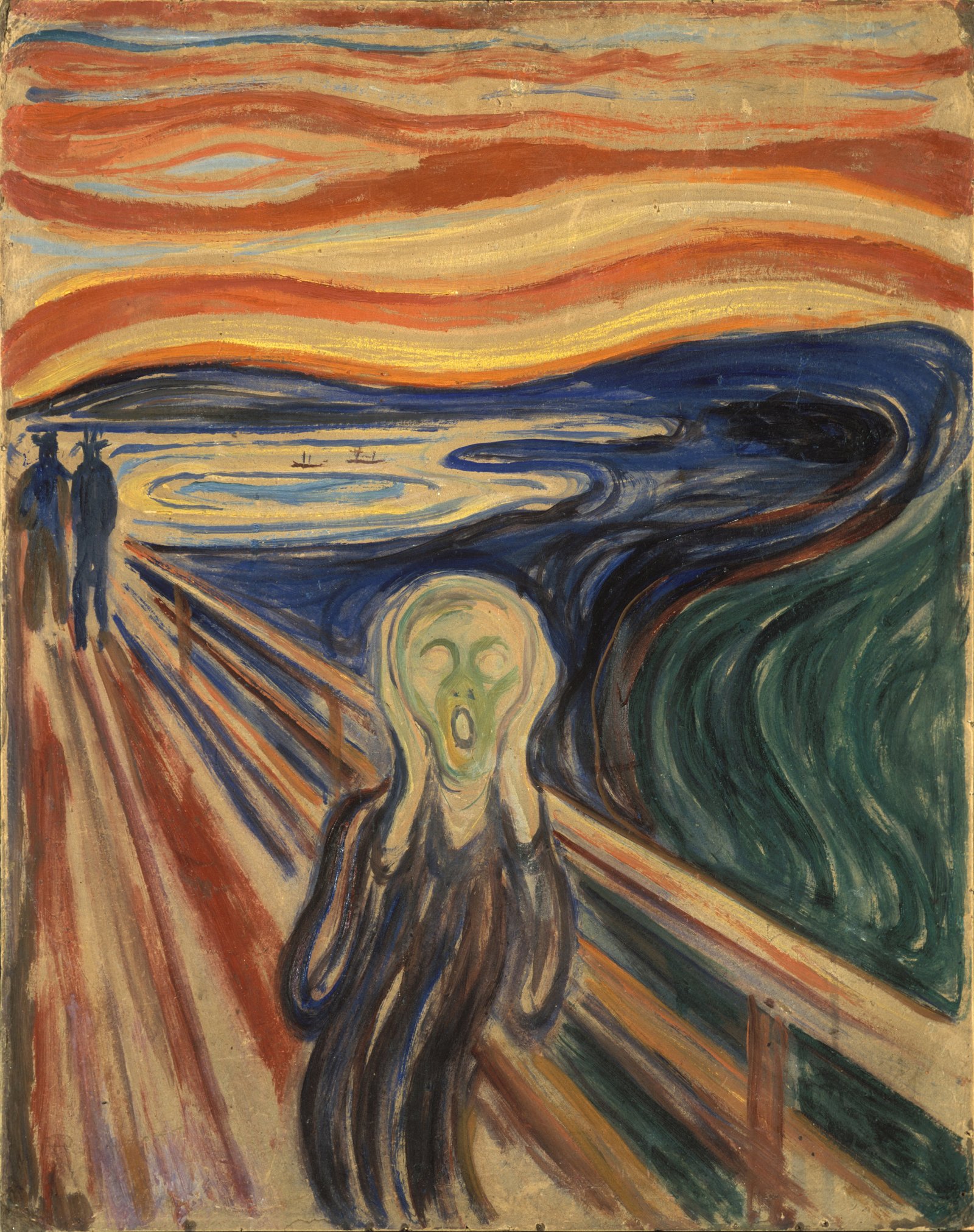
No painting in the world is more famous for being stolen than Edvard Munch’s The Scream. The Norwegian artist painted four versions of the work between 1893 and 1910 — a pale, skull-like figure holding its head on a bridge beneath a blood-red sky — and two of them have been taken from museums in daring, daylight raids. The first theft took 50 seconds. The second took place at gunpoint in front of dozens of visitors, including children. Both paintings were recovered. But the two thefts, ten years apart, tell very different stories about how art crime works — and how it fails.
The first theft: 50 seconds in Oslo
In the early hours of 12 February 1994, Oslo was preparing for the opening of the Winter Olympics in Lillehammer. The National Gallery, in the centre of the city, was the centrepiece of a Norwegian cultural festival staged for the Games, and its star exhibit was the 1893 version of The Scream, the most important of the four.
Two men drove up to the gallery with the engine running, leaned a ladder against the building, smashed a window, and climbed inside. The painting hung just inside. One of the men cut the wires holding it to the wall with wire cutters, carried it to the window, and slid it down the ladder. The whole operation took about 50 seconds. Before leaving, the thieves left a note on the wall: “Thanks for the poor security.”
The theft was an international sensation. The painting was one of the most recognisable images in the world, and it had been taken on the day the world’s press had gathered in Norway for the Olympics. The Norwegian police had one natural suspect: Pål Enger, a former professional footballer turned art thief, who had already served time for stealing another Munch painting, Love and Pain (also known as The Vampire), from the Munch Museum in 1988 — using a ladder.
But Enger and his accomplices had no buyer. A painting as famous as The Scream cannot be sold on the open market, and the thieves’ attempts to find one led them into a trap. In March 1994, the gallery received a ransom demand of £700,000. Meanwhile, Scotland Yard detective Charles Hill, who had spent fifteen years tracking art thieves, went undercover under the alias “Chris Roberts,” posing as an art dealer willing to buy the painting.
On 7 May 1994, less than three months after the theft, the undercover team met the thieves’ handlers at a hotel in Åsgårdstrand, the small seaside town where Munch himself had lived and worked. The painting was recovered undamaged from the hotel’s basement. Four men were arrested, Enger among them. In January 1996, Enger was sentenced to six years and three months in prison. The painting went back on the wall at the National Gallery — this time, the museum said, in a spot that was less vulnerable.
The second theft: gunpoint at the Munch Museum
Ten years later, on the morning of Sunday 22 August 2004, the Munch Museum in Oslo was busy with tourists. At about 11 a.m., two masked men armed with handguns burst in. While one held staff and visitors at bay, the other tore two paintings from the wall: the 1910 version of The Scream and Munch’s Madonna. They carried both out to a waiting van and drove away, in full view of dozens of witnesses.
The second theft was cruder and more violent than the first, and it was far harder to solve. There was no ransom demand and no undercover sting. For two years, the art world feared the worst — that the paintings had been destroyed, or hidden away for use as collateral in the criminal underworld. Three men were convicted in May 2006 of charges relating to the theft, but the paintings were still missing.
Then, on 31 August 2006, Norwegian police announced that both paintings had been recovered in a raid just outside Oslo. They had suffered some damage — the 1910 Scream had marks and a small tear — and conservators later found that the damage to it was more serious than first thought. But both works survived, and both were put back on display at the Munch Museum, this time behind heavy glass.
The man who stole it — twice, in a way
Pål Enger is the thread that runs through the story of The Scream. A talented footballer in his youth, he became Norway’s most notorious art thief, obsessed with Munch’s work. He stole Love and Pain in 1988, The Scream in 1994, and was charged again in 2015 with stealing more than a dozen paintings from a gallery in Oslo. In prison he took up painting himself, specialising in abstract art, and he has appeared in documentaries about the thefts he committed.
Enger was not involved in the 2004 theft — that was a different crew, and a different kind of crime. The 1994 theft was a quiet, almost elegant job, carried out in under a minute with a ladder and a pair of wire cutters. The 2004 theft was a smash-and-grab by armed men in front of a crowd. What the two thefts share is the motive that drives almost all art theft: not the hope of selling a famous painting, which is effectively impossible, but ransom, or leverage — a masterpiece held as a bargaining chip.
The 1895 pastel version of The Scream, the only one of the four in private hands, sold at auction in 2012 for $120 million, then a record for a work of art sold at auction. The two stolen versions, by contrast, were worth nothing to their thieves except as hostages. Both came home because, in the end, a stolen masterpiece is a liability: too famous to sell, too valuable to destroy, and too dangerous to keep.
What the thefts changed
The thefts of The Scream transformed museum security in Norway and beyond. The National Gallery moved the painting to a less vulnerable position and upgraded its alarms. The Munch Museum, after the 2004 raid, put its works behind heavy protective glass and redesigned its galleries. When the new Munch Museum opened on Oslo’s waterfront in 2021, security was built into the building from the start.
The paintings themselves are now among the most closely guarded works of art in the world — which is, in a sense, the point. The Scream depicts a moment of terror on a bridge outside Oslo. Twice, that terror was real, in the museums that held it. And twice, the painting came back, undamaged enough to be shown again. For all the drama of the two thefts, the lasting image is not the empty wall or the smashed window, but the painting itself, back where it belongs.
The painting behind the thefts
Munch painted four versions of The Scream between 1893 and 1910 — two in paint, two in pastel. The image came from a walk at sunset in Oslo, which Munch described in his diary: the sky had turned blood red, he felt exhausted and anxious, and he sensed “a scream passing through nature.” The figure on the bridge, hands pressed to its ears, is not screaming itself — it is hearing the scream of the world around it.
The 1893 version, the one stolen in 1994, is the most famous of the four and the centrepiece of the National Gallery’s Munch collection. The 1910 version, stolen in 2004, belongs to the Munch Museum. The 1895 pastel, the only version in private hands, sold at Sotheby’s in New York in 2012 for $120 million — then a record price for a work of art at auction.
The painting’s fame is precisely what makes it so hard to steal successfully. A work that every person in the world recognises cannot be hung on a wall, shown to a buyer, or sold at auction. The thieves who took it, in both 1994 and 2004, discovered what every art thief eventually discovers: the more famous the painting, the less it is worth to a thief. Its only value is as a hostage — and a hostage that famous is a dangerous thing to hold.
Pål Enger, the man who stole it in 1994, never really left the painting behind. After his release from prison he took up painting himself, specialising in abstract art, and became a willing subject for documentaries about the theft. In 2015, more than twenty years after the National Gallery raid, he was charged again — this time with stealing more than a dozen paintings from a gallery in Oslo. The obsession, it seems, never left him.
What is documented — and what is not
Documented: On 12 February 1994, two men stole the 1893 version of The Scream from the National Gallery in Oslo in about 50 seconds, leaving a note reading “Thanks for the poor security.” The painting was recovered undamaged on 7 May 1994 in Åsgårdstrand after an undercover operation involving Scotland Yard detective Charles Hill. Four men were convicted in January 1996; Pål Enger, one of the thieves, was sentenced to six years and three months. On 22 August 2004, masked gunmen stole the 1910 version of The Scream and Madonna from the Munch Museum in Oslo; both were recovered on 31 August 2006. Three men were convicted in May 2006 in connection with that theft. Munch painted four versions of The Scream between 1893 and 1910; the 1895 pastel sold for $120 million in 2012.
Unverified or unproven: Who ordered the 2004 theft and what the paintings were intended for during the two years they were missing — theories include use as collateral in organised crime, but no account has been proven. Whether Enger’s 1994 theft was motivated by ransom from the start, or whether the ransom demand came only after the thieves realised they could not sell the painting.
Sources
- https://kucera.news/2024/02/10/two-men-one-ladder-and-50-seconds-thats-all-it-took-to-steal-one-of-the-most-famous-paintings-in-history/
- https://macaudailytimes.com.mo/this-day-in-history-1994-art-thieves-snatch-scream.html
- https://eathealthy365.com/a-history-of-the-theft-of-the-scream/
- https://www.calendar-uk.co.uk/frequently-asked-questions/is-the-scream-still-missing