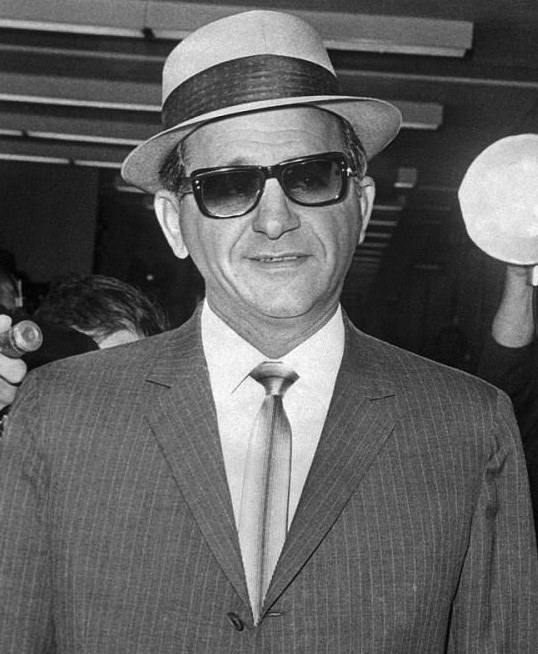
Salvatore “Sam” Giancana was the boss of the Chicago Outfit, the most powerful organised crime group in the American Midwest, from 1957 to 1966. He was a street thug who became a national figure, a man whose name was linked to Las Vegas casinos, to Frank Sinatra, to the CIA, and to the assassination of President John F. Kennedy. He ended his life as he had lived much of it: violently, and in a way that has never been explained.
Giancana was born in Chicago on 24 May 1908 — some sources give 15 June 1908, a date he himself preferred to celebrate — to Italian immigrant parents from Castelvetrano in Sicily. His birth name was Gilormo Giangana. He grew up in the Patch, the Italian neighbourhood around Taylor Street on Chicago’s Near West Side, in a household that was, by several accounts, harsh and poor. As a teenager he joined the 42 Gang, a violent juvenile street crew that worked for the political boss Joseph Esposito. He was first arrested at the age of seventeen for auto theft. Police believed he was responsible for several murders by the time he was twenty, but he was never tried for any of them. In 1926 he was arrested and charged with murder, but the charges were dropped after a key witness died violently.
Rise Through the Outfit
By the end of the 1930s Giancana had graduated from the 42 Gang into the Chicago Outfit, the organisation built by Al Capone. He became a driver for Paul “the Waiter” Ricca, one of Capone’s successors, and was eventually made a member. From the early 1940s through the 1950s he controlled illegal gambling, illegal liquor distribution and political rackets in Louisiana, and he took over Chicago’s policy racket — the Black community’s numbers lottery — by forcing out its existing operators. His crew was believed to have been behind the murder of Theodore Roe in 1952, the last major obstacle to the Outfit’s control of the South Side policy game.
In 1957 the Outfit’s top man, Tony “Joe Batters” Accardo, stepped aside and anointed Giancana as his successor, though Accardo and Ricca remained in the background as senior advisers whom Giancana was expected to consult on important matters. That same year Giancana represented the Outfit at the Apalachin meeting in upstate New York, the national summit of mob bosses that was raided by police and exposed the existence of a national crime syndicate to the American public.
Under Giancana the Outfit took a large cut of the skim from Las Vegas casinos, where its man Johnny Roselli looked after its interests, and kept its grip on Chicago’s gambling, unions and politicians. Giancana was a public figure in a way few mob bosses had been: he was photographed with Frank Sinatra, he was romantically involved with Phyllis McGuire of the McGuire Sisters, and his name appeared regularly in the newspapers. That visibility would prove to be part of his undoing.
The CIA and Castro
Giancana’s enduring notoriety comes from his dealings with the Central Intelligence Agency. During the Kennedy administration the CIA recruited Giancana, Roselli and the Florida mob boss Santo Trafficante Jr. in a plot to assassinate the Cuban leader Fidel Castro. The existence of the plot was later confirmed by the Senate’s Church Committee hearings in the 1970s, which examined the CIA’s efforts to kill Castro. Giancana’s role in it is documented; the wilder claims that grew up around it are not.
His name has also been tied, persistently, to the 1960 presidential election. Family members and later writers have claimed that Giancana used Outfit money and votes in Chicago and West Virginia to help John F. Kennedy win, at the request of Kennedy’s father Joseph. The claim has never been proven, and it should be treated as an allegation, not a fact. The same is true of the many theories that place Giancana and the mob at the centre of Kennedy’s assassination in 1963. No credible evidence has established that Giancana was involved in the assassination, and the theories remain theories.
Fall and Murder
Giancana’s downfall came from the law, not from a rival. In 1965 he was jailed for a year for refusing to testify before a Senate committee on organised crime. In 1966 or 1967 — accounts differ on the year — the national mob leadership, tired of his constant presence in the newspapers, stripped him of his control of the Outfit. He moved to Mexico, where he lived in exile for several years, and returned to the United States in 1974.
By then the CIA plots were becoming public knowledge, and Giancana was summoned to testify before the Church Committee. He never did. On the night of 19 June 1975, days before his scheduled appearance, he was shot dead in the basement kitchen of his home in Oak Park, Illinois. He had been cooking for a late visitor when he was shot in the back of the head with a silenced pistol, and then several more times. He was 67 years old. No one was ever charged with his murder. Most investigators believe the Outfit had him killed to prevent him from testifying, but that belief, however reasonable, has never been proven in court.
What Is Documented — and What Is Not
Documented: Salvatore Giancana, born Gilormo Giangana in Chicago in May 1908 to Sicilian immigrant parents, joined the 42 Gang as a teenager and was first arrested at seventeen for auto theft. He joined the Chicago Outfit in the late 1930s, controlled gambling and liquor rackets in Louisiana in the 1940s and 1950s, and became boss of the Outfit in 1957 after Tony Accardo stepped aside. He attended the Apalachin meeting in 1957. He was recruited by the CIA in a plot to assassinate Fidel Castro, a fact later confirmed by the Church Committee. In 1965 he was jailed for refusing to testify before a Senate committee. He lost control of the Outfit in the mid-1960s, lived in Mexico, and returned in 1974. He was murdered at his home in Oak Park, Illinois, on 19 June 1975, shortly before he was due to testify to the Church Committee. The murder is unsolved and no one was ever charged.
Not documented / unverified: Giancana’s birth date is given as 24 May 1908 by Wikipedia and the Mob Museum, but as 15 June 1908 in some other sources; the Mob Museum notes that Giancana himself preferred to celebrate his birthday on 15 June. Claims that Giancana helped John F. Kennedy win the 1960 election, and theories linking him to Kennedy’s assassination, are unproven allegations made by family members and later writers, not established facts. The claim that Giancana was romantically involved with Marilyn Monroe, and present on the night of her death, is likewise unproven. The identity of his killer, and the motive for his murder, have never been established; the belief that the Outfit ordered it is an inference by investigators, not a court finding.