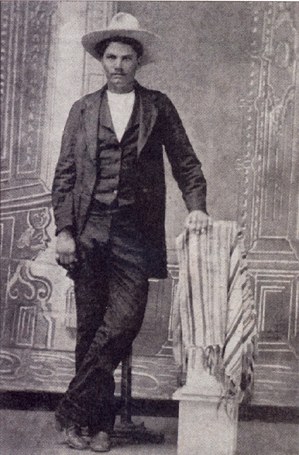
John Wesley Hardin was born in 1853 in Bonham, Texas, the son of a Methodist preacher. He was educated, well dressed, and polite — and he became one of the most feared killers in the history of the American West. By his own account, he killed his first man at the age of 15, in 1868, in a quarrel he said was self-defence. By the time he was captured, nine years later, he claimed to have killed more than two dozen men. Historians have never been able to confirm the full count, and Hardin himself admitted in later years that he had exaggerated some of his stories. What is not in doubt is that he killed, and killed often, and that his name became a byword for danger in Texas.
Hardin was a different kind of outlaw from Jesse James or Billy the Kid. He did not rob banks or trains, and he did not lead a gang. He killed in quarrels, in saloons, and on the road, often over small insults. The most famous of his killings, and the most often retold, took place in Abilene, Kansas, in 1871, when he shot a man through a hotel wall because the man was snoring too loudly in the next room. Hardin told the story himself, and it has been repeated ever since, though it is impossible to know how much of it is true.
The Fugitive Years
Hardin spent most of the 1870s on the run. He killed lawmen and civilians alike, and he moved constantly between Texas, Kansas, and Florida. He was arrested several times and escaped, once by shooting his way out of a jail in Comanche, Texas. The Texas Rangers made his capture a priority, and in 1877 a Ranger detachment under Lieutenant John B. Armstrong tracked him to Pensacola, Florida, where he was living under an assumed name. Armstrong arrested him on a train, and Hardin was brought back to Texas in chains.
He was tried in Comanche County for the murder of a deputy sheriff, Charles Webb, whom he had killed in 1874. The jury convicted him, and he was sentenced to 25 years in the state penitentiary at Huntsville. He was 24 years old.
Prison and Release
Hardin spent fifteen years in Huntsville. He was not a model prisoner — he tried to escape more than once — but he used the time to study. He read law books, and he wrote an autobiography, in which he presented himself as a man who had killed only when he had to, and who had been persecuted by the law. He was pardoned in 1894 by Governor Jim Hogg, who had been impressed by his behaviour in prison and by his claim that he had reformed.
Hardin was released in March 1894. He went to El Paso, Texas, passed the bar examination, and set up a law practice. He also went back to drinking and gambling, and to quarrelling. On 19 August 1895, less than eighteen months after his release, he was in the Acme Saloon in El Paso when John Selman Sr., a former constable, walked up behind him and shot him in the head. Hardin died instantly. He was 42. Selman was tried for the killing and acquitted, on the ground that Hardin had threatened him. A year later, Selman himself was shot dead by a US marshal, George Scarborough, in a quarrel in El Paso.
The Autobiography and the Legend
Hardin’s autobiography, The Life of John Wesley Hardin as Written by Himself, was published in 1896, the year after his death. It is the main source for his life, and it is also the main problem for historians, because Hardin was his own publicist and he had every reason to make himself look better — or more dangerous — than he was. He claimed 27 killings. Modern research has confirmed far fewer, though the exact number is still debated. Some of the men he claimed to have killed cannot be identified at all.
What the record does show is a man who killed repeatedly, who was convicted of murder, and who was pardoned and then killed within months of his release. His story has been told in books, films, and songs, and he remains one of the best-known gunfighters of the Old West — not because he was a folk hero, but because he was genuinely dangerous, and because he wrote his own legend.
What Is Documented — and What Is Not
Documented: John Wesley Hardin was born in 1853 in Bonham, Texas. He was captured in Pensacola, Florida, in 1877 by Texas Rangers under John B. Armstrong, convicted of the murder of Deputy Sheriff Charles Webb, and sentenced to 25 years at Huntsville. He was pardoned in 1894, passed the bar examination, and practised law in El Paso. He was shot dead on 19 August 1895 in the Acme Saloon in El Paso by John Selman Sr., who was tried and acquitted. Hardin’s autobiography was published in 1896.
Not documented / unverified: Hardin’s claim of 27 killings comes from his own autobiography and has not been confirmed by independent research; historians put the confirmed number lower, but no exact figure is settled. The story that he shot a man for snoring in Abilene in 1871 comes from Hardin’s own account and cannot be independently verified. His claim that his killings were self-defence is his own version of events, not a court finding.