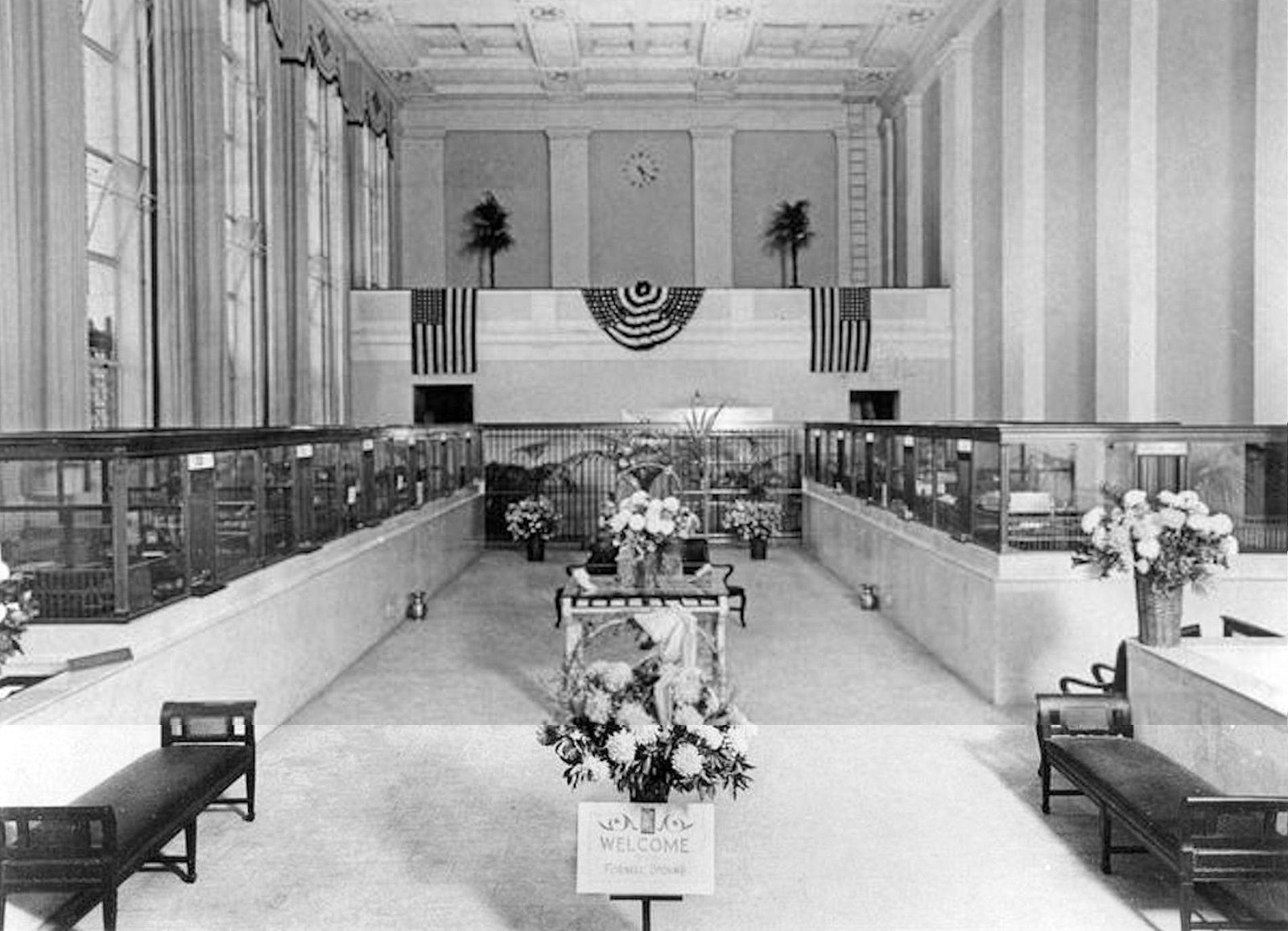
On 16 December 1930, a new Buick sedan pulled up outside the Citizens State Bank in Clinton, Indiana. Four men went inside, each to a position he had rehearsed. Minutes later they were gone with $15,567 — and within hours the whole plan had collapsed, a lawman was dead, and the man who had designed the robbery was dead too, in a field near Sidell, Illinois. His name was Herman Karl Lamm, known as “Baron” Lamm. He was forty years old, and he had spent more than a decade turning bank robbery from an improvised gamble into a planned operation. He is not as famous as the men who copied him, but almost every bank robbery in the films — the casing, the timetable, the getaway map — starts with him.
Lamm never sought fame, and for most of his career he barely had a fixed name. He used aliases the way other men used hats: Harry K. Lamb, Robert J. Masden, Thomas Bell. When he died, the newspapers first identified him as Thomas Bell. It took days before the authorities were sure who the dead man in Illinois really was.
From Kassel to the American Midwest
Herman Karl Lamm was born on 19 April 1890 in Kassel, in the German Empire. He served as a soldier in the Prussian Army, and according to the standard accounts of his life he was dismissed from his regiment after being caught cheating at cards. Whatever the precise circumstances — the detail comes to us second-hand, through crime histories rather than surviving service records — the military training stayed with him. He emigrated to the United States shortly before the First World War broke out in 1914, carrying a soldier’s habits into civilian life: study the ground, assign every man a task, rehearse, and always have a way out.
America gave him his trade quickly. He was arrested in San Francisco in December 1914, under his real name, on a charge of robbery; no outcome of that case is recorded. Bank robberies in the United States at the time were largely improvised — a gang would pick a bank, walk in with guns, and hope. Lamm set out to remove the hoping.
In 1917, after a botched holdup, he was arrested and served a brief term in a Utah prison. It was there, with time to think and nothing else to do, that he developed what became known as the Lamm Technique. The prison term was short. The system he built inside it would shape American bank robbery for the next two decades.
The Lamm Technique
The Lamm Technique began long before anyone entered a bank. Lamm would study a target for many hours, sometimes over days, watching who came and went and when the guards changed. This was “casing” — a practice Lamm is credited with pioneering. He drew a detailed floor plan, noted the position of the vault and every safe, and sometimes sent a man inside posing as a journalist to get a proper look at the interior. Before the robbery, Lamm wanted to know the bank better than the people who worked in it.
Every member of the gang was then given a specific job, a specific zone of the bank, and a strict timetable. The roles were fixed: the lookout, the getaway driver, the lobby man, and the vault man. Lamm drilled his men through rehearsals, sometimes using a full-scale mock-up of the bank’s interior, and timed every stage with stopwatches. He set a hard limit on how long the gang would stay inside, regardless of how much money was still there to take.
The escape mattered as much as the robbery, and here Lamm made his most original contribution: the first detailed bank robbery getaway maps, which he called “gits,” mapping the back roads around a target bank — roads he called “cat roads” — to within a tenth of a mile. Before every job he obtained a nondescript car with a powerful engine, often with a driver who had experience in motor racing. He pasted a chart on the dashboard with block-by-block markings of the escape routes, alternative turns and speedometer readings, and he and the driver clocked each route to the second, in different weather conditions.
Using this system, Lamm and his gang carried out dozens of successful bank robberies between the end of the First World War and 1930, taking more than $1 million in total, and they were considered the most efficient gang of bank robbers of the era. But the record was never as clean as the legend. Lamm was arrested repeatedly: in Superior, Wisconsin, in June 1918; as Harry K. Lamb in Kansas City in July 1918; as Thomas Bell in St. Joseph, Missouri, in December 1920; as Robert J. Masden in February 1927; and in Benton, Illinois, in May 1929, as a suspect in the robbery of the Northwestern National Bank of Milwaukee. A full-length biography published in 2012, drawing on arrest records, argues that Lamm’s reputation as a criminal mastermind was considerably overrated — that the system was real, but so were the failures. Both things can be true.
The last robbery
Lamm’s final year was busy. His 2012 biography records a robbery at Frankfort, Indiana, on 3 December 1930, less than two weeks before his death. Then came Clinton.
On the morning of 16 December 1930, Lamm and four men — getaway driver W. H. Hunter, a former rum-runner; James “Oklahoma Jack” Clark; Walter Dietrich; and 71-year-old G. W. “Dad” Landy — drove to the Citizens State Bank in Clinton, Indiana, in a new Buick sedan. Hunter double-parked outside while the other four went in, each to his preassigned position. They took $15,567 and walked out to the car.
Then the plan fell apart in the ordinary, unlucky way that no amount of rehearsal can prevent. Hunter, waiting at the wheel, noticed a local barber approaching the car with a shotgun. He panicked, pulled a fast U-turn, and hit the curb hard enough to blow out a tyre. The gang fled north in the damaged car, but the escape — the part of the job Lamm had planned most carefully — was already unravelling.
What followed was a chain of bad luck. The gang seized a second car, only to find it could go no faster than 35 miles per hour because its owner had fitted it with a governor to stop his elderly father driving recklessly. They seized a truck with very little water in its radiator, then a fourth car with only a gallon of petrol in the tank. Meanwhile the pursuit closed in. Clinton’s police chief, Everett “Pete” Helms, and patrolman Walter Burnsides gave chase; Burnsides was wounded, but not before he shot a hole in the getaway car’s rear tyre. Three miles south of Dana, Indiana, 35-year-old former deputy sheriff Joe Walker picked up the chase. He was shot and killed in the crossfire — the one death of the day that no account disputes, and the loss at the centre of the story.
The gang’s last car ran out of petrol at a farm near Sidell, Illinois, owned by Leo Moody. There, surrounded by about 200 police officers and armed citizens, the final gun battle took place. Hunter was wounded and later died. Lamm and the elderly Landy died there too. Two of the gang survived: Dietrich and Clark were captured.
How did Lamm die?
The manner of Lamm’s death remains genuinely disputed. The most widely repeated account is that Lamm and Landy, vowing never to return to prison, shot themselves rather than surrender as the posse closed in. But contemporary newspaper accounts told a different story, crediting a posse member, Ernest Boetto, with killing Lamm from some 400 yards. The scene was chaotic and the men who could have settled the question were dead or in custody. What is certain is that Herman Lamm died on 16 December 1930, aged forty, near Sidell, Illinois, after the Clinton robbery. Whether the fatal shot was his own or a posse member’s, the record does not resolve. He was reportedly given a pauper’s burial, in an unmarked grave in Songer Cemetery in Tilton, Illinois — an unremarkable end for a man who had once planned everything to the second.
Dietrich and Clark were tried for the killing of Joe Walker and sentenced to life imprisonment in the Indiana state prison at Michigan City. That sentence is where Lamm’s story connects to the most famous bank robber in American history.
The pupil: John Dillinger
In Michigan City prison, Dietrich and Clark met a young inmate serving time for a strong-arm robbery: John Dillinger. Dillinger was inexperienced but an eager pupil, and the two older men knew the Lamm Technique inside out. According to the widely told account, the pair were allowed to join Dillinger’s gang after his release on the condition that they teach him everything they knew about Lamm’s system. Whether or not there was any formal condition, the teaching plainly happened: Dillinger studied the system and used it extensively throughout his criminal career in 1933 and 1934 — the casing, the assigned roles, the getaway maps, the timed rehearsals. The Baron died in 1930. His technique was still being used four years later, by a man who became far more famous than he ever was.
That is Lamm’s real legacy. He is widely described as the father of modern bank robbery, and the description is fair: the casing, the floor plans, the roles, the rehearsals and the getaway maps were all his, and they became the standard practice of American bank robbery. But he is also a reminder that a system is only as good as its weakest moment. On the last day of his life, every part of his plan that depended on other people and other people’s cars failed at once — a nervous driver, a blown tyre, a governed engine, an empty tank.
One popular story should not be attached to him. The phrase “on the lam” — meaning on the run from the law — predates Herman Lamm, and there is no evidence he inspired it. It is a coincidence of names, and a tempting one. Lamm needs no borrowed mythology. He left a real one behind: a method, written in notes and maps and stopwatch timings, that outlived him and taught the next generation of bank robbers their trade.
What is documented — and what is not
Documented: Herman Karl Lamm was born on 19 April 1890 in Kassel, Germany, and died on 16 December 1930, aged 40, near Sidell, Illinois. He was a former Prussian Army soldier who emigrated to the United States shortly before the First World War. Arrested after a botched holdup in 1917, he served a brief term in a Utah prison, where he developed the Lamm Technique: casing banks, drawing floor plans, noting vault and safe positions, assigning fixed roles (lookout, getaway driver, lobby man, vault man) with strict timetables, rehearsing with stopwatches, and drawing getaway maps he called “gits” of back roads he called “cat roads”. His gang carried out dozens of bank robberies between the end of the First World War and 1930, taking more than $1 million in total, and he was arrested repeatedly under aliases including Harry K. Lamb, Robert J. Masden and Thomas Bell. On 16 December 1930 his gang took $15,567 from the Citizens State Bank in Clinton, Indiana; the getaway failed after the Buick blew a tyre, and the gang was cornered near Sidell, Illinois, by about 200 officers and armed citizens. Hunter was wounded and later died; former deputy sheriff Joe Walker, aged 35, was shot and killed during the pursuit. Walter Dietrich and James “Oklahoma Jack” Clark were captured and sentenced to life imprisonment in Indiana for Walker’s killing. In prison they met John Dillinger, who studied and used the Lamm Technique throughout his bank-robbing career in 1933–1934.
Unverified or unproven: That Lamm was dismissed from the Prussian Army specifically for cheating at cards — this is the standard account in crime histories, but it rests on second-hand sources rather than surviving service records. That Lamm and G. W. “Dad” Landy shot themselves rather than surrender — the most widely repeated account, but contemporary newspaper reports credited posse members with killing them, and the record does not settle the question. That Dietrich and Clark were permitted to join Dillinger’s gang on the condition they teach him the Lamm Technique — widely told, but the exact terms of their arrangement with Dillinger are not documented. That Lamm is buried in an unmarked grave in Songer Cemetery, Tilton, Illinois, after a pauper’s burial — reported in later accounts, not confirmed by an official burial record cited here. That the phrase “on the lam” comes from Herman Lamm — it predates him, and there is no evidence connecting the two.
Sources
- https://en.wikipedia.org/wiki/Herman_Lamm
- https://weeklyview.net/2022/12/15/john-dillingers-tutor-the-baron/
- https://dustyoldthing.com/herman-lamm-bank-robber/
- https://mcfarlandbooks.com/product/herman-baron-lamm-the-father-of-modern-bank-robbery/
- https://en.wikipedia.org/wiki/John_Dillinger
- https://en.wikipedia.org/wiki/Dillinger_Gang
- https://commons.wikimedia.org/wiki/File:1921_-_Interior_Merchants_National_Bank_-_Allentown_PA.jpg