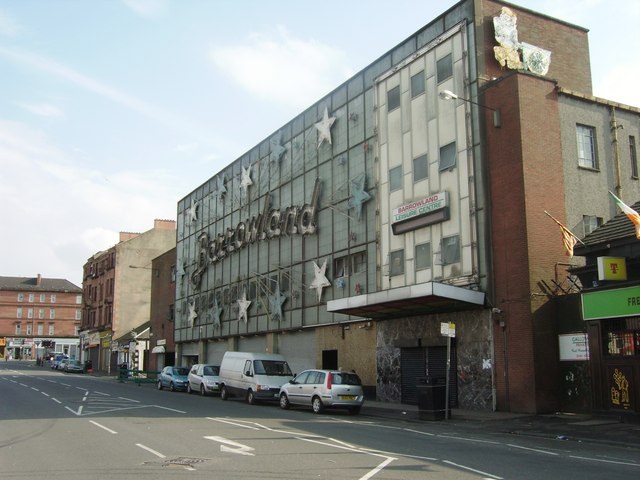
In the late 1960s, the Barrowland Ballroom in Glasgow’s East End was one of the city’s great dance halls. On Thursday nights it filled with working people looking for a few hours of music and company. Three young women who went there to dance never came home. The man who killed them was never identified. He became known as Bible John — a name that came not from the police, but from the words of a witness who sat beside him in a taxi on the last night of his life as a free man, if he was ever caught at all.
Patricia Docker: February 1968
The first of the three killings took place in February 1968. Patricia Docker, 25, was an auxiliary nurse and a mother. She was married but estranged from her husband, and she had one young son. On the evening of 22 February 1968, she left her son with her parents and went dancing at the Barrowland.
The next morning, 23 February, her body was found in the doorway of a lock-up garage in an alley behind Carmichael Place, in the Battlefield district of Glasgow, close to her home. She had been strangled. A post-mortem found no signs of sexual assault, but confirmed strangulation as the cause of death. She was the first victim in the series as it came to be understood — though at the time, there was no series, only a single terrible death.
Jemima MacDonald: August 1969
Eighteen months passed before the second killing. Jemima MacDonald, 31, was a mother of three who loved to dance and attended the Barrowland regularly. On Saturday 16 August 1969, she spent the evening there. At around 12:30 a.m. she was seen with a man walking towards her home.
Her body was found the following morning in a derelict building on Mackeith Street, about half a mile from the dance hall. She too had been strangled. The similarities to Patricia Docker’s death — a young mother, a night at the Barrowland, strangulation — began to suggest a pattern, but the gap of a year and a half between the two deaths made the connection uncertain.
Helen Puttock: October 1969
The third killing, two and a half months later, gave the case its name. Helen Puttock, 29, was a mother of two and a widow who worked in a warehouse. On the evening of 30 October 1969, she went to the Barrowland with her sister, Jean. The two sisters danced with two men, both of whom were called John.
Helen and Jean shared a taxi home with one of the men. During the ride, he said his name was John, quoted scripture, and spoke about religion and religious duties. Jean later gave police a detailed description: a well-spoken man in his late twenties to early thirties, about six feet tall, with short reddish-brown hair, neat clothing, and a courteous manner. Helen was found strangled the next morning near her home in Scotstoun.
It was Jean Puttock’s account of that taxi ride that gave the unknown killer his name. “Bible John” was the press name for a man who quoted the Bible to a woman he had just met, hours before she was killed. The case also made legal history: it was the first time in Scotland that the Crown Office authorised the publication of a composite drawing of a person suspected of murder, based on Jean’s description.
The Investigation
The investigation never produced a charge. Two people in particular have been discussed publicly for decades.
The first was John Irvine McInnes, a former private in the Scots Guards who had been a furniture salesman. He resembled the composite drawing and had faced four identity parades. He died by suicide in 1980. In 1996, as DNA testing advanced, McInnes was exhumed so that genetic testing could be compared with a stain on Helen Puttock’s clothing. The result was inconclusive. In June 1996, the Lord Advocate said the forensic evidence was not enough to link McInnes to Helen Puttock’s murder. No court has ever ruled that McInnes, or anyone else, was responsible for any of the three deaths.
The second was Peter Tobin, a convicted serial killer and rapist who was convicted of three murders in the late 2000s. His known movements and methods gave rise to speculation that he might be Bible John. Police later eliminated him as a suspect: the only forensic clue, a semen stain on one of the victims’ tights, did not match his DNA.
Was It One Man?
One of the most important facts about the Bible John case is also one of the least appreciated: the police have never confirmed that the same person killed all three women. In 2010, Detective Superintendent David Swindle of Strathclyde Police told The Scotsman that officers were not completely convinced all three women had been killed by the same person, and that a copycat or a different killer was one theory. Former senior detectives who reviewed the paperwork in the 1990s have said the same.
The three victims were all brunettes between the ages of 25 and 31, all mothers, and all had been to the Barrowland on the night they died. Those similarities are striking. But the long gaps between the killings, the differences in the circumstances, and the absence of forensic evidence linking the three scenes to one person mean that the “single killer” theory, while widely assumed, has never been proven.
The case was revisited in the mid-1990s when DNA testing prompted a new look at the files, and again in 2013, when Police Scotland formed a cold-case unit to review unresolved homicides. Police Scotland says such cases are never closed.
What Is Documented — and What Is Not
Documented: Three women — Patricia Docker, 25, found on 23 February 1968; Jemima MacDonald, 31, found on 17 August 1969; and Helen Puttock, 29, found on 31 October 1969 — were strangled in Glasgow after attending the Barrowland Ballroom. Helen Puttock’s sister Jean described a taxi companion who called himself John and quoted scripture, and her description led to the first composite drawing of a murder suspect published in Scotland. John Irvine McInnes was exhumed in 1996 for DNA comparison; the result was inconclusive and the Lord Advocate said the evidence was not enough to link him to the murder. Peter Tobin was considered and eliminated as a suspect on DNA evidence. No one has ever been charged.
Not documented: Whether one man killed all three women, and the identity of the killer or killers. The name “Bible John” describes a suspect in one taxi ride, as described by one witness; it is not proof that the same man was present at the other two killings. Claims that any named individual was Bible John are unproven, and in the cases of McInnes and Tobin, the available evidence does not support the claim.
More than half a century later, the Barrowland still stands, and Glasgow still remembers the three women. Patricia Docker, Jemima MacDonald, and Helen Puttock were mothers who went out dancing on ordinary nights.