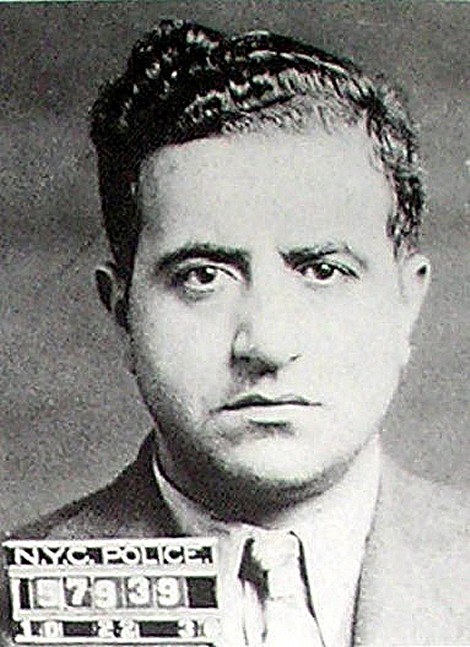
Albert Anastasia was the most feared enforcer in the American Mafia, the man who ran the killing squad the newspapers called Murder, Inc., and the boss of the Brooklyn crime family that would later carry the Gambino name. He survived a death sentence and built his power on the Brooklyn waterfront, where he controlled the docks and the unions that worked them. His end came in a barber’s chair in a Midtown Manhattan hotel, in front of eleven witnesses, in one of the most famous gangland murders in American history. No one was ever charged with killing him.
Anastasia was born Umberto Anastasio on 26 September 1902 in Calabria, in southern Italy — most accounts give the town of Tropea, though some give nearby Parghelia, and the date itself is variously reported. He emigrated to the United States as a teenager and settled in Brooklyn, where he fell quickly into the criminal underworld of the docks. He was a big, violent man, and he made his reputation early. In 1921 he was convicted of murdering a longshoreman and sentenced to death in the electric chair at Sing Sing. The conviction was overturned on appeal in 1922, and he was acquitted when the case was retried. It was the first of several occasions on which the law came close to Anastasia and failed to hold him.
Murder, Inc.
By the 1930s Anastasia was the operational head of the enforcement arm of the American Mafia, the loose network of killers that the press named Murder, Inc. Working with Louis “Lepke” Buchalter, he directed contract killings across the country. The number of murders attributed to the organisation is usually given as between four hundred and one thousand between 1929 and 1941, though those figures are estimates drawn from police and press accounts, not a proven count. What is certain is that Anastasia’s name became a byword for murder for hire, and that his nicknames — “the Lord High Executioner” and “the Mad Hatter” — reflected the terror he inspired even among other criminals.
He also controlled the Brooklyn waterfront, mainly through the dockworker unions, and that control was the foundation of his wealth and his power. The docks gave him money, men and leverage, and they made him a figure the other bosses had to deal with rather than simply obey. When the federal government finally broke Murder, Inc. in the early 1940s, Anastasia escaped the fate of Buchalter, who went to the electric chair in 1944. The chief witness against Anastasia, the informer Abe Reles, fell to his death from a sixth-floor window of a Coney Island hotel in 1941 while under police guard. The circumstances of Reles’s death were never explained, and Anastasia was never tried.
Boss of the Family
In 1951 Vincent Mangano, the boss of the Brooklyn family, vanished, along with his brother Philip. Anastasia took over the family, which would later be renamed for his successor, Carlo Gambino. He ruled it for six years, and by 1957 his position was under threat from two directions. Vito Genovese, who had returned from exile in Italy, wanted the power Anastasia held, and Gambino himself was manoeuvring for the succession. In June 1957 Anastasia’s ally Frank Scalice was murdered, and the pressure on Anastasia grew. He was also under investigation by the federal government, and he had recently been ordered deported — a case that was still working its way through the courts when he was killed.
On the morning of 25 October 1957 Anastasia left his home in Fort Lee, New Jersey, and was driven into Manhattan by his chauffeur and bodyguard, Anthony Coppola. He entered the barber shop of the Park Sheraton Hotel, at Seventh Avenue and 55th Street, at about a quarter past ten, and took his usual seat — chair number four — for a haircut and a shave. Coppola had parked the car in an underground garage and stepped outside for a walk, leaving Anastasia unprotected. Two men with scarves covering their faces entered from the hotel lobby, pushed the barber aside and opened fire. Ten shots were fired. Anastasia was hit several times and fell dead between the chairs. His killers walked out of the hotel and were never identified.
The Unsolved Murder
No one was ever charged. The killing is generally believed to have been arranged by Vito Genovese and Carlo Gambino, who divided the spoils between them — Gambino took over the family, and Genovese took the wider power he had been seeking. The theory that the gunmen were members of the Gallo crew is widely repeated but has never been proven. One detail has passed into legend: that Anastasia, startled by the first shots, lunged at his own reflection in the mirror, mistaking it for an attacker. The story is told in many accounts but cannot be verified.
The aftermath of the murder was as theatrical as the killing itself. The barber chairs at the Park Sheraton were repositioned so that they faced away from the mirror. Anastasia’s chair was later auctioned for seven thousand dollars, and in 2012 it became an exhibit at the Mob Museum in Las Vegas. Anastasia himself was buried at Green-Wood Cemetery in Brooklyn. He had ruled the waterfront, run the most feared killing squad in the country, and survived a death sentence — and in the end he died in a barber’s chair, unprotected, in front of eleven witnesses, and nobody ever paid for it.
What Is Documented — and What Is Not
Documented: Albert Anastasia was born Umberto Anastasio on 26 September 1902 in Calabria, Italy, and emigrated to the United States as a teenager, settling in Brooklyn. In 1921 he was convicted of murder and sentenced to death; the conviction was overturned on appeal in 1922 and he was acquitted at retrial. He became the operational head of the Mafia enforcement network known as Murder, Inc., and controlled the Brooklyn waterfront through the dockworker unions. He became boss of the Mangano crime family in 1951 after Vincent Mangano vanished. On the morning of 25 October 1957 he was shot dead in chair number four of the barber shop at the Park Sheraton Hotel in Manhattan; two masked gunmen fired ten shots, and no one was ever charged with the murder. Carlo Gambino succeeded him as boss of the family.
Not documented / unverified: The number of killings attributed to Murder, Inc. is usually given as between four hundred and one thousand, but those are estimates, not proven counts. The circumstances of Abe Reles’s fatal fall from a hotel window in 1941, while he was under police guard and due to testify against Anastasia, were never explained. The claim that Genovese and Gambino ordered the murder, and that the Gallo crew carried it out, is the standard theory but has never been proven. The story that Anastasia lunged at his own reflection in the mirror is legend, not established fact. Sources disagree on Anastasia’s exact birthplace — Tropea or Parghelia — and on the date of his birth.
Sources
https://en.wikipedia.org/wiki/Albert_Anastasia
https://nationalcrimesyndicate.com/albert-anastasia-death/
https://nationalcrimesyndicate.com/albert-anastasia-the-lord-high-executioner-of-murder-incorporated-2/
https://mafiahistory.us/a009/f_albertanastasia.html
http://www.writersofwrongs.com/search/label/Gambino