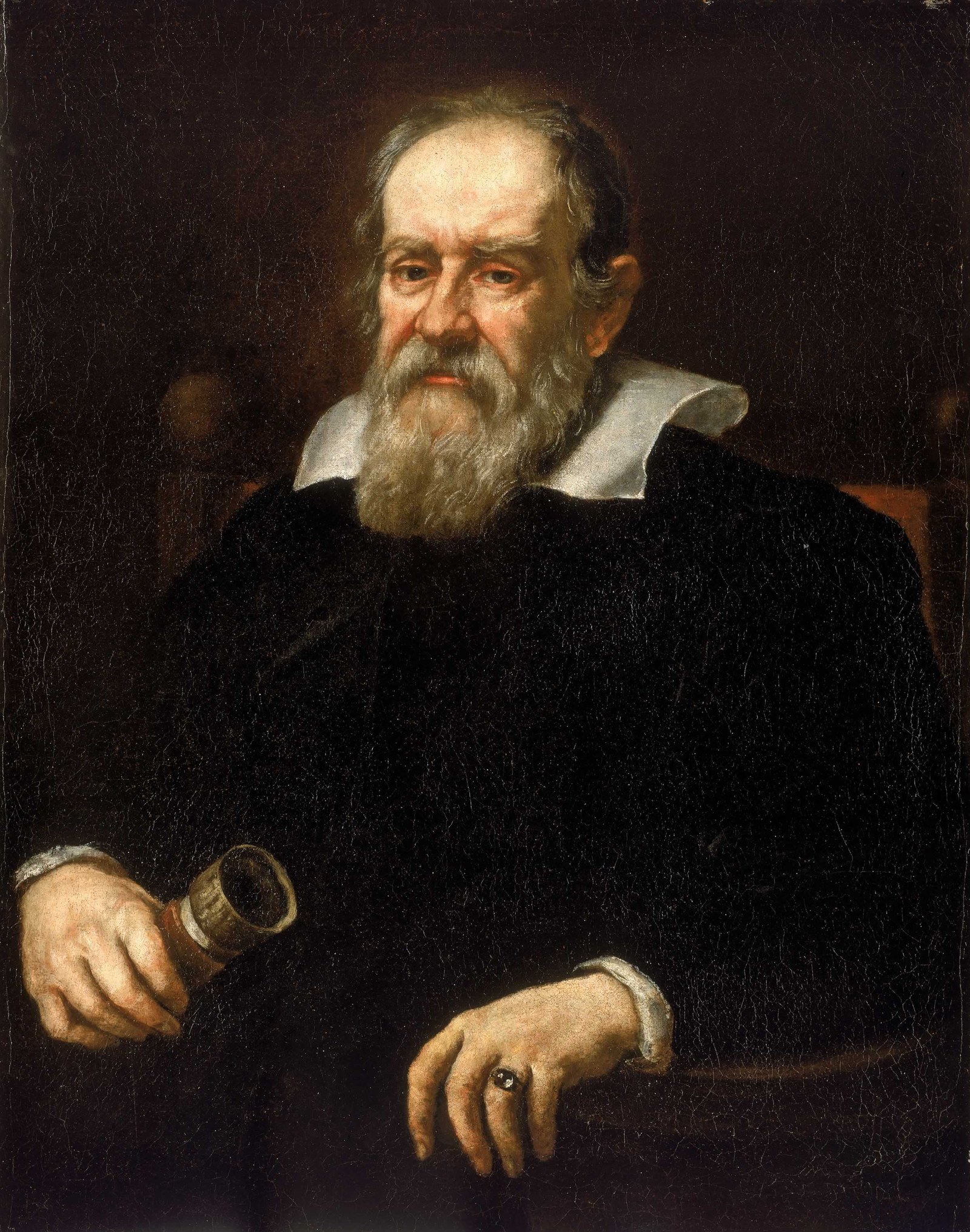
On 22 June 1633, in the convent of Santa Maria sopra Minerva in Rome, a 69-year-old astronomer knelt before the cardinals of the Roman Inquisition and read out a formal abjuration. Galileo Galilei renounced the doctrine that the Sun stands at the centre of the world and that the Earth moves. His book was banned, he was sentenced to imprisonment, and the sentence was at once commuted to house arrest, under which he remained until his death in 1642. The trial is often retold as a simple clash between science and religion. The record is more complicated, and more interesting, than that.
The astronomer and the new sky
Galileo Galilei was born in Pisa on 15 February 1564 and became one of the most influential figures in the history of science. He improved the telescope, observed the moons of Jupiter, the phases of Venus and the spots on the Sun, and argued that the evidence supported the heliocentric model associated with Nicolaus Copernicus: the Earth and the other planets orbit the Sun, rather than the Sun and planets orbiting a stationary Earth.
That claim collided with the prevailing view, which combined the astronomy of Aristotle and Ptolemy with a literal reading of Scripture. In 1616, the Congregation of the Index declared heliocentrism false and contrary to Scripture, and Cardinal Robert Bellarmine warned Galileo personally not to teach or defend Copernican theory. The exact form of that warning later became central to the 1633 trial. The Inquisition’s files contained a record of a stricter injunction, ordering Galileo not to hold, teach or defend the opinion “in any way whatever”. Whether that stricter order was properly issued and communicated to him has been debated by historians ever since.
The Dialogue
In 1632 Galileo published the Dialogue Concerning the Two Chief World Systems, a book written in Italian, in dialogue form, in which three characters debate the geocentric and heliocentric systems. Galileo presented the work as a hypothetical discussion, but the character who defended the geocentric view was widely read as a fool, and the Copernican arguments were presented with far greater force. The book also appeared to have received permission to print under circumstances that his enemies in Rome questioned.
The publication provoked a sharp reaction. In late 1632 Galileo was ordered to appear in Rome before the Congregation of the Holy Office, the Inquisition. Although ill and in his late sixties, he made the arduous winter journey, arriving in February 1633.
The interrogations
Galileo was called to four hearings between April and June 1633, the last on 21 June. He maintained that the Dialogue had treated Copernicanism hypothetically and that he had not intended to disobey the order of 1616. Under interrogation, and under threat of torture, he admitted that he had argued the Copernican case more persuasively than he should have, attributing this to vanity.
The historical record is clear on one point that popular retellings often get wrong: Galileo was not physically tortured. The Inquisition’s documents show that he was threatened with torture, as the procedure of the time allowed, but Pope Urban VIII ordered that the examination stop short of its actual application, and there is no evidence in the surviving records that torture was inflicted on a frail man of 69. That does not make the interrogations gentle. A threat of torture, made by a tribunal with the power to carry it out, is itself a form of coercion, and it shaped what Galileo was willing to say.
The sentence of 22 June 1633
On 22 June 1633, Galileo was taken to the church of Santa Maria sopra Minerva and ordered to kneel while his condemnation was read. He was declared guilty of “vehement suspicion of heresy” — a formal category one step below actual heresy — for having held and believed the doctrine that the Sun is the centre of the world and does not move from east to west, and that the Earth moves and is not the centre of the world, and for holding that such an opinion could be defended after it had been declared contrary to Scripture.
The sentence had three essential parts. First, Galileo was required to abjure, curse and detest those opinions, kneeling with his hands on the Gospels, and to swear never to say or write anything that could bring similar suspicion upon him. Second, he was sentenced to formal imprisonment at the pleasure of the Inquisition. Third, his Dialogue was banned, and he was ordered to recite the seven penitential psalms once a week for three years. Seven of the ten cardinal judges signed the sentence.
The imprisonment was commuted the following day to house arrest. Galileo was first held in the residence of the Archbishop of Siena, and from December 1633 he was allowed to return to his own villa, Il Gioiello, at Arcetri outside Florence. There he remained for the rest of his life. He could not leave his property without special permission, and the publication of any of his works was forbidden, including any he might write in the future.
The years at Arcetri
House arrest did not end Galileo’s work. His Discourses and Mathematical Demonstrations Relating to Two New Sciences was published in Leiden in 1638, outside the reach of the Roman censors. He went blind in his later years and died at Arcetri on 8 January 1642, still under the sentence imposed in 1633. He was 77.
The Church’s later reckoning
In 1981 Pope John Paul II established a commission to re-examine the case. On 31 October 1992, its findings were presented to the Pope, who acknowledged that the theologians who condemned Galileo had erred and spoke of a “tragic mutual incomprehension”. It was a recognition of error rather than a formal annulment of the 1633 sentence.
The trial remains instructive because it was not a simple contest between truth and ignorance. Galileo’s judges were learned men working within a system that treated Scripture as a guide to the natural world. Galileo himself was a devout Catholic who believed Scripture and nature could not contradict each other. The tribunal had the power, and Galileo did not, and that imbalance is what decided the case in 1633.
What the record shows
Documented: Galileo was warned in 1616 not to teach or defend Copernican theory; he published the Dialogue in 1632; he was interrogated in April–June 1633 and sentenced on 22 June 1633; the verdict was “vehement suspicion of heresy”, with abjuration, a ban on the Dialogue, and imprisonment commuted to house arrest; he lived at Arcetri from December 1633 until his death on 8 January 1642; in 1992 Pope John Paul II acknowledged that the theologians who condemned him had erred.
Disputed or unverified: “Eppur si muove” is almost certainly apocryphal; it appears in no contemporary record. The precise form of the 1616 injunction is disputed. Claims that he was physically tortured or held in a dungeon are not supported by the Inquisition’s records.
Sources
- https://plato.stanford.edu/archives/spr2025/entries/galileo/
- https://en.wikipedia.org/wiki/Trial_of_Galileo
- https://grokipedia.com/page/Galileo_affair
- https://codexoffaiths.com/en/strange-history/galileo-trial/
- https://commons.wikimedia.org/wiki/File:Justus_Sustermans_-_Portrait_of_Galileo_Galilei,_1636.jpg