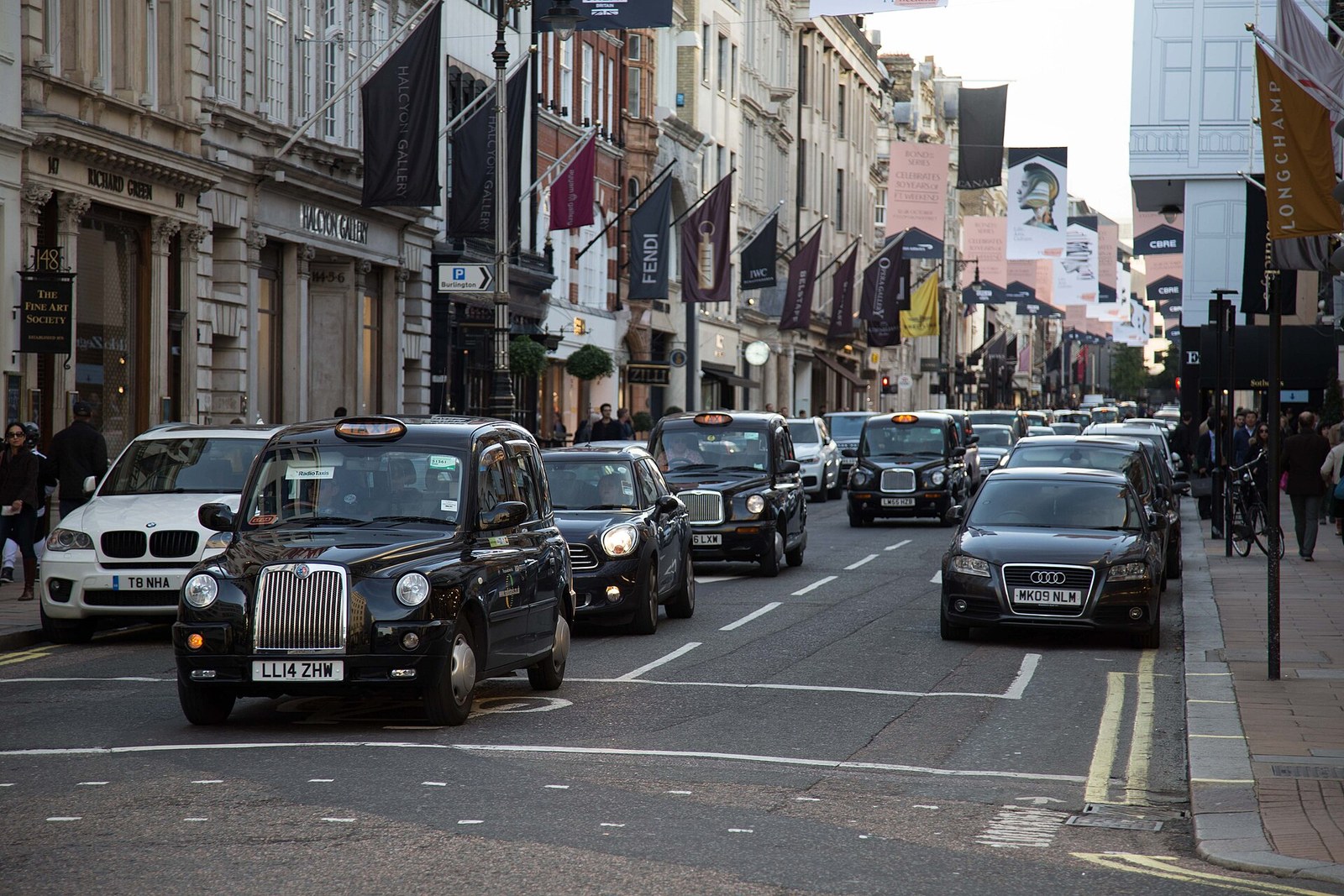
At 4:40 p.m. on Thursday 6 August 2009, two sharply dressed men arrived by taxi at Graff Diamonds on New Bond Street in Mayfair, London, and were admitted to the jeweller’s showroom as customers. Within half an hour they had left with forty-three pieces of jewellery worth nearly £40 million — about $65 million at the time — in what was believed to be the largest gems heist in British history, and the second-largest British robbery of any kind after the £53 million raid on a Securitas depot in Tonbridge, Kent, in 2006.
The robbery was remarkable for its preparation. The two men had spent four hours that day being transformed by a professional make-up artist, fitted with latex prosthetics, wigs and altered skin tones so that they appeared years older than they were. On the closed-circuit television footage released by the Metropolitan Police, their faces were unrecognisable. It was the small, ordinary mistakes of the getaway — a collision with a black cab, a mobile phone left behind in a car — that undid them.
The disguises
The make-up artist was a theatrical professional working in Covent Garden, who was booked by two men who said they needed to look much older. He spent four hours fitting the pair with liquid latex masks and wigs and changing their skin tone. The men told him the disguise was for a film or a performance. He had no reason, at the time, to doubt them.
The artist was later publicly identified as Chris Dennis, the drag performer known as La Voix, who spoke about his unwitting part in the robbery years afterwards, in 2021 and again in 2025. He was not named at the time, for his own safety, and was placed under police protection after he came forward. He gave evidence at the trial. He was a witness, not a suspect, and he was never charged.
Looking at the results in the mirror, one of the men — Aman Kassaye — is reported to have remarked that his own mother would not recognise him. The remark, repeated in court reporting, captured the point of the exercise: the disguises were designed to defeat the cameras that cover every luxury shop in Mayfair.
The robbery
Kassaye and Craig Calderwood entered the store posing as wealthy customers. Once inside, they produced two handguns and ordered the staff to the floor. They forced an employee to open the display cases and fill a bag with jewellery: rings, bracelets, necklaces and wristwatches, forty-three pieces in all. One necklace alone was reported to be worth more than £3.5 million.
The robbery took about twenty-five minutes. No one was injured. The men then left the store and fled in a car, as part of a planned escape involving more than one vehicle and a pre-arranged route.
The investigation was led by the Metropolitan Police’s Flying Squad, under Detective Chief Inspector Pam Mace. The CCTV images of the two men entering the store were released to the public, but the disguises meant that no one recognised them from the footage.
The getaway — and the phone
The escape did not go to plan. The gang’s car collided with a black cab, forcing them to abandon the vehicle and switch to another. In the car they left behind, police found a pay-as-you-go mobile phone. It belonged to Kassaye, and its contacts and call records gave investigators the thread they needed to unravel the gang.
A loaded sawn-off shotgun was also recovered from the boot of a vehicle linked to the gang, according to later reporting. Forensic traces from the make-up studio — brushes, gowns and masks taken by detectives — also helped to build the case.
Arrests followed within two weeks. On 20 August 2009, Calderwood, then twenty-six, and Solomun Beyene, then twenty-four, were charged in connection with the robbery. More arrests followed, and seven men in total stood trial.
The trial
The trial at Woolwich Crown Court lasted three months. Kassaye, who the prosecution said had planned and executed the heist, was found guilty of conspiracy to rob, kidnap and possession of a firearm. On 7 August 2010, he was sentenced to twenty-three years in prison. Calderwood was jailed for twenty-one years. Three other men — Beyene, Clinton Mogg and Thomas Thomas — were each jailed for sixteen years after being convicted of conspiracy to rob.
The sentences reflected the scale of the crime and the use of firearms, as well as the kidnapping charge, which related to the detention of staff during the robbery. The court heard that Graff Diamonds, owned by the billionaire Laurence Graff, had lost more than £6.6 million — about $10 million — as a result of the robbery, after insurance and other recoveries were taken into account.
Graff was no stranger to robbery: the New Bond Street store had been robbed in 2003 of an estimated £23 million in gems.
The missing jewels
As of March 2011, none of the stolen jewellery from the 2009 robbery had been recovered. Experts believed the most likely fate of the pieces was that they had been broken up, so that the stones could be recut and resold anonymously — a process that would erase the laser inscriptions Graff placed on its diamonds. Police were reported to believe the jewellery had been flown abroad to waiting buyers within hours of the robbery.
That remains the position in the sources consulted for this article: the forty-three pieces have not been recovered, and the men convicted of the robbery have not revealed where they went. The case is, in that sense, only half solved — the robbers were caught and imprisoned, but the loot vanished.
What Is Documented — and What Is Not
Documented: The date, time and place of the robbery; the haul of forty-three items worth nearly £40 million, including a necklace worth more than £3.5 million; the four hours spent on latex disguises and the make-up artist’s role as a witness; the collision with a black cab and the recovery of the pay-as-you-go phone; the charges on 20 August 2009; the three-month trial at Woolwich Crown Court; the sentences — Kassaye twenty-three years on 7 August 2010, Calderwood twenty-one years, Beyene, Mogg and Thomas sixteen years each; Graff’s loss of more than £6.6 million; and the fact that none of the jewellery had been recovered as of March 2011.
Unverified or uncertain: Some reports spell Beyene’s first name as “Solomon” rather than “Solomun”; this article uses “Solomun”, as in the principal sources, and notes the variant. A widely repeated claim that a single diamond from the robbery turned up in a Hong Kong pawn shop in 2012 is not counted here as a recovery from the 2009 heist: the reporting on that diamond links it to a separate Graff robbery in July 2007, not to the August 2009 raid. Whether the 2009 jewels were in fact broken up and recut is an expert assessment, not an established fact, and is presented as such. The exact wording of Kassaye’s remark on seeing his disguise is reported second-hand and should be treated as reported speech, not as a verified quotation.
Sources
- https://en.wikipedia.org/wiki/2009_Graff_Diamonds_robbery
- https://www.professionaljeweller.com/man-guilty-of-uks-biggest-jewellery-robbery/
- https://www.idexonline.com/IE9/FullArticle?Id=34183
- https://www.thenaturalsapphirecompany.com/blog/the-great-jewel-heist/the-graff-diamond-heist-the-most-expensive-in-londons-history/
- https://www.lccsa.org.uk/graff-robbery-diamond-turns-up-in-hong-kong-pawn-shop/
- https://www.1fakt.com/2025/10/thats-drag-how-strictly-star-la-voix.html