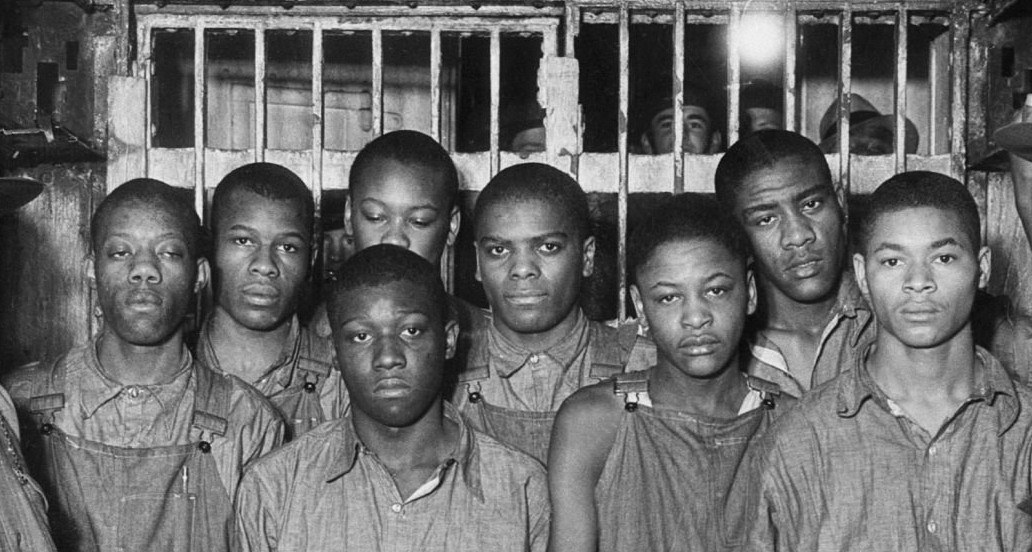
On 25 March 1931, nine Black teenagers were pulled off a freight train near Paint Rock, Alabama. They were Haywood Patterson, Clarence Norris, Olen Montgomery, Willie Roberson, Charles Weems, Andy Wright, Roy Wright, Ozie Powell, and Eugene Williams. They had been riding the train looking for work, as thousands of young people did during the Great Depression. Two white women on the same train, Victoria Price and Ruby Bates, accused them of rape.
Within three weeks, all nine had been tried in Scottsboro. Eight were convicted and sentenced to death. The youngest was spared the death sentence only because of his age. There was no medical evidence that a rape had taken place. The trials lasted days. The case that followed would last for decades — and would change American law.
A train, an accusation, and a mob
The nine young people, aged roughly 12 to 20, were travelling on a Southern Railway freight train from Chattanooga, Tennessee, toward Memphis. A fight broke out on the train between Black and white riders, and some white riders were forced off. When the train stopped at Paint Rock, a posse was waiting. The nine were arrested, along with the two women.
Price and Bates told the posse they had been raped. The nine were taken to the county jail in Scottsboro, where a crowd gathered outside — a lynch mob in all but name. The National Guard was called in to protect the prisoners. That protection was real, but it was also the only part of the process that resembled fairness.
The charge was capital rape. In Alabama at the time, that carried the death penalty, and the death penalty was the expected sentence for a Black man convicted of raping a white woman. The defendants were not given lawyers until the first day of trial. The two men appointed to represent them were volunteers: one was a real-estate attorney, the other a local lawyer who had not tried a case in decades. One of them, according to later accounts, appeared in court drunk. The trials were divided into groups, and the whole process — indictment on 30 March, trials beginning 6 April — was over within days. Two convictions came on 7 April; the rest followed by 9 April. Execution dates were set for July.
The first reversal: Powell v. Alabama
The case drew national attention. The Communist Party USA, through its legal arm, and later the NAACP, took up the defence. Appeals reached the United States Supreme Court, which decided Powell v. Alabama on 7 November 1932. By a 7–2 majority, the Court overturned the convictions. Justice George Sutherland, writing for the majority, held that the defendants had been denied effective legal counsel in a capital case, in violation of the due-process clause of the Fourteenth Amendment. For the first time, the Court recognised a constitutional right to competent counsel for defendants facing the death penalty.
The state of Alabama retried the cases, this time in Decatur, after a change of venue. The defence was now led by Samuel Leibowitz, one of the country’s most prominent criminal lawyers. The retrials produced the case’s most dramatic moment: on 6 April 1933, Ruby Bates took the stand for the defence and recanted her entire testimony. She swore that Price had invented the rape story, saying Price had warned that they might have to stay in jail if they did not “frame up a story” after crossing a state line with men. Bates said plainly that none of the defendants had touched either woman. Victoria Price never wavered, and maintained her account through every trial.
Medical evidence also pointed away from the accusation. Doctors who examined the women found no evidence consistent with the violent assault described. Yet on the retrial, an all-white jury convicted Haywood Patterson again and sentenced him to death.
Then something remarkable happened. On 22 June 1933, Judge James E. Horton, who had presided over the retrial, set aside the verdict on his own authority, ruling that the conviction was against the weight of the evidence. He ordered a new trial. The decision cost Horton his judicial career: the Alabama Supreme Court removed him from the case, and he lost his seat when he next stood for re-election.
The second reversal: Norris v. Alabama
Under the new judge, William Callahan, Patterson and Norris were again convicted and sentenced to death. The defence appealed once more to the Supreme Court. In 1935, in Norris v. Alabama and the companion case Patterson v. Alabama, the Court reversed the convictions a second time. Chief Justice Charles Evans Hughes held that the systematic exclusion of Black citizens from jury service — from both grand juries and trial juries — violated the equal-protection clause of the Fourteenth Amendment. A defendant could prove discrimination by showing a substantial Black population in the community and the absence of Black jurors. It was a landmark ruling on jury discrimination, and it remains a foundation of American jury law.
Even after two Supreme Court reversals, Alabama pressed on. In the third round of trials, Patterson was convicted again — this time sentenced to 75 years in prison rather than death, the first time a Black man in Alabama had received a sentence other than death for the rape of a white woman. The other defendants received sentences ranging from long prison terms to death.
The end came slowly. In July 1937, four of the nine — Olen Montgomery, Willie Roberson, Eugene Williams, and Roy Wright — were freed, their charges dropped. The other five remained in prison. Clarence Norris was eventually paroled and, in 1976, pardoned by Alabama Governor George Wallace. The last three men whose convictions had never been overturned — Charlie Weems, Andy Wright, and Haywood Patterson — received posthumous pardons from the Alabama Board of Pardons and Paroles on 21 November 2013. In April 2013, Governor Robert Bentley had signed legislation posthumously exonerating all nine.
The human cost
The legal landmarks are real, and they matter: Powell v. Alabama established the right to counsel in capital cases, a principle later extended to all criminal cases in Gideon v. Wainwright in 1963; Norris v. Alabama struck at the exclusion of Black jurors. But the nine young people at the centre of the case paid for those landmarks with their youth. Together, they spent more than a hundred years in prison for a crime the evidence did not support. Patterson died in prison in 1952. Norris lived to see his pardon, but decades of his life had already been taken.
The Scottsboro case is often described as the first great civil-rights case of the twentieth century. That description is fair, but it risks making the nine defendants into symbols and forgetting that they were teenagers looking for work on a freight train. Their names — Patterson, Norris, Montgomery, Roberson, Weems, Andy Wright, Roy Wright, Powell, and Williams — deserve to be remembered as people, not only as the title of a court case.
What Is Documented, and What Is Not
Documented: Nine Black teenagers were arrested on 25 March 1931 after an accusation of rape by Victoria Price and Ruby Bates aboard a freight train in Alabama. Trials in Scottsboro in April 1931 convicted eight and sentenced them to death; the youngest received a hung jury or mistrial because of his age. The Supreme Court overturned the convictions in Powell v. Alabama (1932) for denial of effective counsel, and again in Norris v. Alabama (1935) for systematic exclusion of Black jurors. Ruby Bates recanted in April 1933 and testified that no rape had occurred; Price maintained her account. Judge Horton set aside Patterson’s 1933 conviction on 22 June 1933 and was removed from the case. Four defendants were freed in 1937; the remaining five were convicted and sentenced. Posthumous pardons for the last three were granted in 2013, and Alabama legislation exonerated all nine that year.
Unverified or disputed: Flag — ages: sources give the defendants’ ages as 12 to 19, 12 to 20, or 13 to 20, and Roy Wright’s age variously as 12, 13, or 14. The range “roughly 12 to 20” is used here. Flag — trial outcome wording: some sources say all nine were convicted; others say eight were sentenced to death and Roy Wright’s jury hung. Both are consistent if the hung jury is counted separately, and that is how it is presented here. The exact words of the accusers’ private conversations, and the precise reason Price maintained her account, are matters of testimony and later reporting, not independently verified fact.
Sources
- https://www.britannica.com/event/Scottsboro-case
- https://en.wikipedia.org/wiki/Scottsboro_Boys
- https://legalclarity.org/why-the-supreme-court-reversed-the-scottsboro-nine-verdicts/
- https://legalclarity.org/when-was-the-scottsboro-case-from-arrest-to-pardon/
- https://www.commonlit.org/texts/the-scottsboro-boys
- https://www.sbcmuseum.org/copy-of-the-story-1
- http://law2.umkc.edu/faculty/projects/ftrials/trialheroes/HEROSEARCH6.html