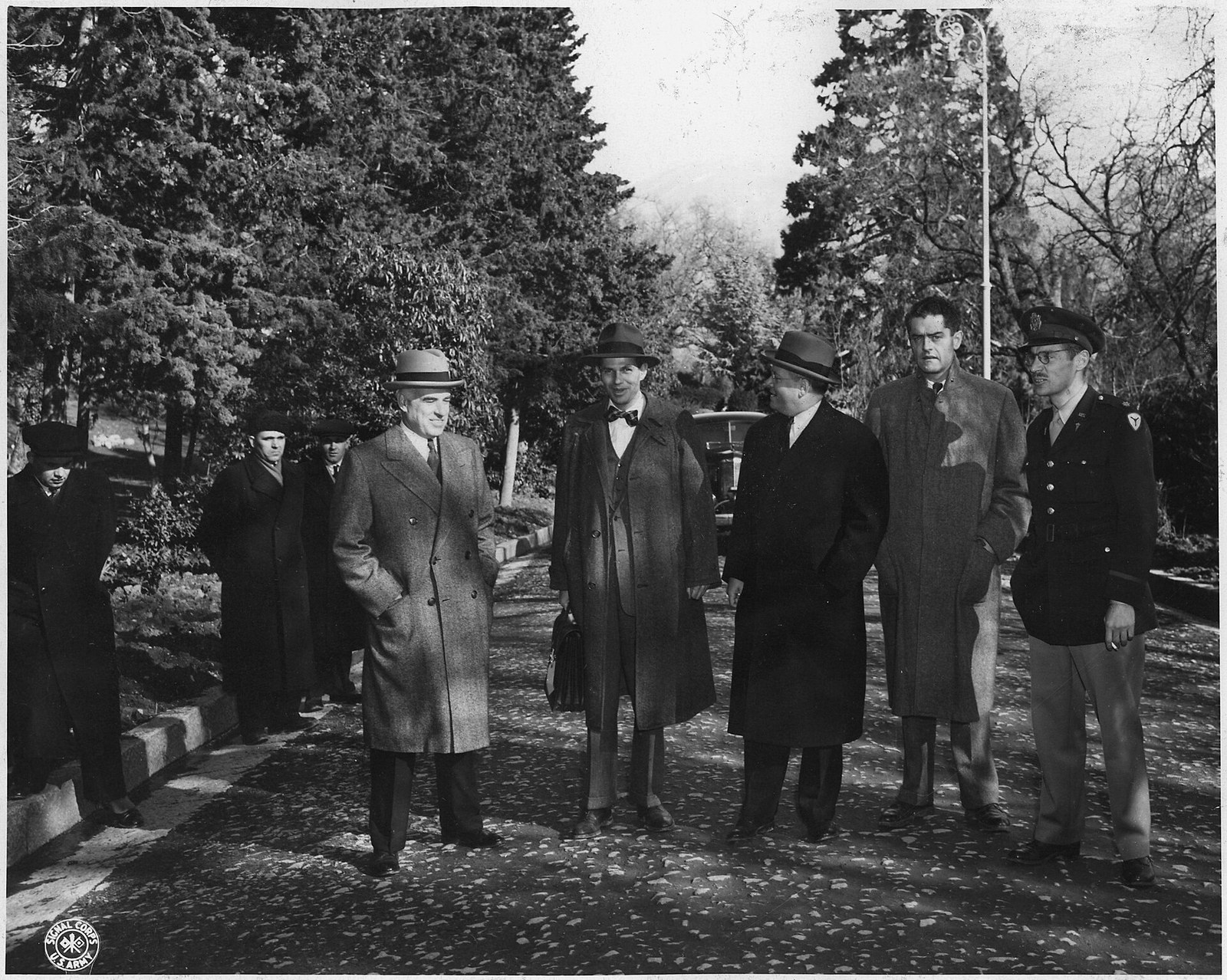
In August 1948, a senior editor at Time magazine walked into a congressional hearing room and accused one of the most respected officials in Washington of being a Soviet spy. The accused man was Alger Hiss, a Harvard-educated lawyer who had worked at the State Department, attended the Yalta Conference, and helped found the United Nations. He called the charge “a complete fabrication” and sued his accuser for libel. What followed — microfilm hidden in a pumpkin, a typewriter traced by its flaws, and two trials — became the most famous espionage case of the early Cold War. Hiss was never tried for spying. He was tried for lying about it, and in January 1950 a jury found him guilty of perjury.
The accusation
Alger Hiss was born in Baltimore on 11 November 1904. After Harvard Law School, he clerked for a Supreme Court justice, worked for the Justice Department, and joined the State Department in 1936. By 1945 he was a senior official: he accompanied President Roosevelt to Yalta, and he served as secretary-general of the conference in San Francisco that founded the United Nations. In 1947 he became president of the Carnegie Endowment for International Peace.
His accuser, Whittaker Chambers, was a former Communist who had become a senior editor at Time. On 3 August 1948, Chambers told the House Committee on Un-American Activities that Hiss had been a member of a secret Communist cell inside the federal government in the 1930s, and that he had passed classified documents to Soviet handlers. Hiss denied ever knowing Chambers, then admitted he might have known him under another name — a man he recalled as “George Crosley”, a freelance writer to whom he had once sublet a flat. He insisted he had never given anyone a government document.
The committee, led in part by a young California congressman named Richard Nixon, pressed Chambers for proof. In November 1948, Chambers produced it: a packet of 65 pages of retyped State Department cables and four notes handwritten in Hiss’s own hand, which he said Hiss had given him in 1938. Then, on 2 December 1948, he led investigators to his farm in Maryland, where, from inside a hollowed-out pumpkin, he retrieved five rolls of microfilm. Two of the rolls contained photographs of classified State Department documents. The press called them the Pumpkin Papers.
The evidence
The government’s case rested on the documents and on the machines that had made them. The FBI traced a Woodstock typewriter, serial number N230099, that had once belonged to the Hiss family, and found that its typeface matched the retyped cables. Investigators also located the camera Chambers said he had used to photograph the documents. Chambers testified that Hiss had given him the material in 1938 to pass to a Soviet agent.
Hiss’s defence argued that the evidence had been manufactured. His supporters noted that Chambers had hidden the film in the pumpkin only on the morning of the day he produced it, and that Chambers himself had a record of deception, having used several aliases over the years. But the documents were real State Department papers, and the typewriter link was difficult to explain away.
Hiss could not be charged with espionage. The ten-year statute of limitations had expired. Instead, on 15 December 1948, a federal grand jury indicted him on two counts of perjury: that he had lied when he denied giving documents to Chambers, and that he had lied when he said he had not seen Chambers after 1 January 1937.
Two trials
The first trial opened in New York on 31 May 1949, before Judge Samuel Kaufman. It ended on 7 July with a hung jury, divided eight to four in favour of conviction.
The second trial opened on 17 November 1949, before Judge Henry Goddard. The prosecution added a new witness: Hede Massing, an Austrian-born former Soviet agent, who testified that she had met Hiss at a party in 1935 and that he had tried to recruit one of her agents. On 21 January 1950, the jury found Hiss guilty on both counts of perjury. Judge Goddard sentenced him to five years on each count, to run concurrently. He served his sentence at the federal penitentiary in Lewisburg, Pennsylvania, and was released in November 1954, after three years and eight months.
Hiss maintained his innocence for the rest of his life. He wrote a book about the case, campaigned for years to clear his name, and died in New York on 15 November 1996, aged 92.
A case that never closed
Whether Alger Hiss was a spy has never been settled to everyone’s satisfaction. In the 1990s, the release of the Venona decrypts — wartime Soviet cables intercepted by American intelligence — added a new layer: one cable refers to a Soviet agent codenamed “Ales” who worked in the State Department and attended Yalta, which many historians read as a reference to Hiss. Others argue the identification is not conclusive. In 1992, a Russian official said a search of Soviet archives had found no evidence of Hiss’s involvement in a spy ring.
What is certain is what the trial did to American politics. It made Richard Nixon a national figure, it convinced millions of Americans that Communists had infiltrated their government, and it helped launch the era of suspicion that became McCarthyism. Hiss himself became a symbol — to some, of a traitor who escaped the charge he deserved; to others, of a man framed by the politics of the Cold War. The verdict settled the question of perjury. The question of espionage is still argued today.
What is documented — and what is not
Documented: Whittaker Chambers accused Alger Hiss before the House Committee on Un-American Activities on 3 August 1948. On 2 December 1948, Chambers produced five rolls of microfilm from a pumpkin on his Maryland farm; two developed rolls contained photographs of classified State Department documents. Hiss was indicted on 15 December 1948 on two counts of perjury. His first trial ended in a hung jury on 7 July 1949; his second trial ended in a guilty verdict on 21 January 1950, and he was sentenced to five years in prison. He was released in November 1954 and died on 15 November 1996, still asserting his innocence.
Unverified or unproven: That Hiss passed documents to the Soviet Union — the jury convicted him of lying about it, not of espionage, and the question remains contested. That the agent “Ales” in the Venona decrypts was Hiss — many historians accept the identification, but it is not conclusively proven. That Chambers fabricated the evidence — Hiss’s defenders have argued this for decades, but no proof of fabrication has been established.