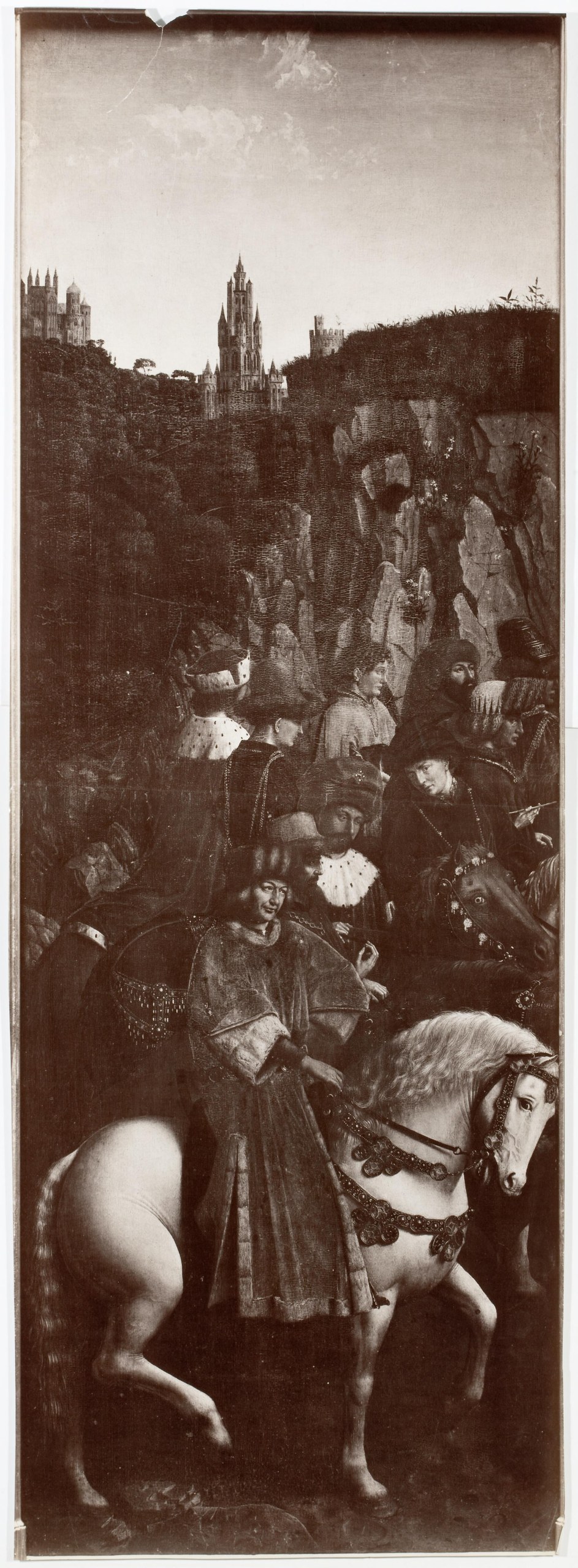
On the morning of 11 April 1934, the sexton of St Bavo’s Cathedral in Ghent stopped in front of the city’s greatest treasure. The Ghent Altarpiece, the Adoration of the Mystic Lamb, had stood in the cathedral for five centuries. That morning, a panel was missing from the great polyptych, lifted cleanly from its oak frame while the rest stood undamaged. In its place, the thief had left a note, written in French: “Taken from Germany by the Treaty of Versailles.”
The missing panel was The Just Judges, the lower-left wing of the altarpiece, showing a procession of robed judges and rulers on horseback. Painted by Jan van Eyck and his brother Hubert and completed in 1432, the altarpiece is regarded as the most important painting of the Northern Renaissance. It is also the most stolen artwork in history, seized in whole or in part at least six times. But the theft of 1934 was different from all the others. This time, the painting was not taken by an army. It was taken by a thief who wrote letters, demanded a ransom, and then died with the secret still in his head.
A masterpiece with a history of theft
To understand why the theft mattered so much, it helps to understand what was stolen. The Ghent Altarpiece is a vast hinged polyptych of twelve panels, weighing more than two tons, painted for the merchant Joos Vijd and his wife Elisabeth Borluut for their chapel in St Bavo’s. When opened, it shows the Adoration of the Mystic Lamb: ranks of angels, prophets, apostles and martyrs gathered around the Lamb of God. The Just Judges occupied the lower left of the open altarpiece, facing the Knights of Christ on the lower right. On the reverse of the same wooden panel was a grisaille painting of St John the Baptist, visible when the altarpiece was closed.
By 1934 the altarpiece had already survived five centuries of war, iconoclasm and theft. French troops had carried panels to Paris in the 1790s, German forces had taken panels during the First World War, and the Treaty of Versailles had ordered their return to Belgium — which is what the thief’s note referred to. The altarpiece had only been fully reassembled in 1920, fourteen years before the theft. It was, in every sense, a national treasure, and its loss was felt across Belgium as a wound to the country itself.
The thief had worked with care: the panel was removed from its frame without damaging the neighbouring panels, suggesting someone who knew the altarpiece or had studied it closely. The theft was discovered on the morning of 11 April, but it had taken place during the night of 10 April. No alarm had sounded. No guard had seen anything. The cathedral was locked, and the thief had come and gone like a ghost.
The letters of D.U.A.
Twenty days after the theft, on 30 April 1934, the Bishop of Ghent received the first ransom demand: one million Belgian francs — roughly $33,000 at the time — for the safe return of the panels. The letters were typewritten, signed with the initials “D.U.A.”, and promised the return of the St John the Baptist side as proof the thief held the more valuable Just Judges; the bishop was asked to signal agreement by placing a newspaper advertisement.
The bishop agreed, and the thief kept his word: a left-luggage ticket led police to a railway station, where they found the St John the Baptist panel wrapped in black oilcloth and brown paper, undamaged. But the Belgian government, which claimed the altarpiece was national property rather than the diocese’s, refused to pay the million francs. The negotiations continued anyway. Through the summer and into the autumn of 1934, at least eleven more letters passed between the thief and the authorities, and the tone of the correspondence grew angrier. The man calling himself D.U.A. chided the bishop for the government’s refusal and warned that the panel would never be seen again.
The exchange continued until October. Then, suddenly, the letters stopped. For seven months, the police had chased a correspondent who existed only on paper. Now even the paper had gone silent.
The deathbed confession
On 25 November 1934, a 57-year-old stockbroker from the town of Dendermonde collapsed with a heart attack at a Catholic political rally. His name was Arsène Goedertier, a stockbroker, inventor and aspiring politician. That night, as he lay dying, he summoned his lawyer, Georges de Vos, for a secret meeting that lasted about fifteen minutes.
What Goedertier told de Vos has become one of the most famous deathbed confessions in criminal history. He said that he alone knew where the Mystic Lamb was hidden, and that he would take the secret to his grave. He told his lawyer that the information was in the right-hand drawer of his writing table, in an envelope marked “mutualité”, the French word for a health insurance fund. When de Vos opened the drawer, he found carbon copies of the ransom notes, and an unsent letter that contained a final clue. The panel, the note said, “rests in a place where neither I, nor anybody else, can take it away without arousing the attention of the public.”
De Vos did not tell the police at once. He waited a month. When he finally did, investigators searched Goedertier’s home and office and found the copies of the letters, confirming that he had, at the very least, written them. The police concluded that Goedertier had been the thief. But the panel was not in his house, and the clue in the unsent letter pointed nowhere the police could follow.
The official investigation lasted until 1937 and then closed, unsolved. But the search never really stopped. It became a cottage industry of amateur detectives, historians and treasure hunters, and it has continued for more than ninety years.
The search that never ended
The theories about where the panel went are almost as famous as the theft itself. Some believe it is buried beneath a square in Ghent, or hidden in a church wall. Some believe it was destroyed, perhaps burned or damaged beyond recognition. Others believe it hangs, unrecognised, in a private collection, its owners unwilling to admit what they own.
The searchers have included some determined figures. Karl Mortier, a former chief of the Ghent police, dedicated himself to the hunt from 1956 onwards, and with the journalist Noël Kerkhaert wrote a book about the case, The Dossier on the Mystic Lamb. Gaston de Roeck, a retired taxi driver who styled himself a detective in the manner of Hercule Poirot, spent years following the clues in the ransom notes under the same pen name, “D.U.A.”, that the thief had used. In 2002, de Roeck led police to St Gertrude’s church in Wetteren, convinced the panel was hidden behind the altar. They found nothing.
Even the Nazis joined the hunt: during the Second World War, Joseph Goebbels sent an art detective to Belgium to find the panel as a birthday gift for Adolf Hitler. He failed, as everyone else had. To this day, a detective at the Ghent police station is assigned to the case.
In 1945, the Belgian copyist Jef Van der Veken painted a replacement copy of The Just Judges, which still hangs in St Bavo’s today beside the eleven original panels. In Van der Veken’s version, one of the judges has the face of King Leopold III, a detail the copyist added as a quiet signature.
Why the case still matters
The theft endures because it is, at heart, a story about a secret that died with a man. Goedertier’s confession solved the question of who wrote the ransom notes, but it answered nothing about where the panel went. His final note, that the panel rests where no one can take it without arousing public attention, has been read a thousand ways — as a hint that it is hidden in a public place, a church, a building everyone passes every day. No reading has ever led to the painting.
There are also doubts about Goedertier himself. Some later investigators have suggested that he may not have been the thief at all, but a man who knew the thief, or who inserted himself into the story. The carbon copies prove he wrote the letters, but writing a ransom note is not the same as stealing a painting, and the panel was heavy and the work careful. Yet no other suspect has ever been named, and no other explanation has ever been offered.
What is certain is that the panel has never been found, and that most experts now believe it was destroyed long ago. If it still exists, it is the most valuable missing painting in the world. If it does not, then the greatest art theft of the twentieth century ended as it began: in the dark, in silence, with a note left behind and a secret carried to the grave.
What is documented — and what is not
Documented: The Just Judges panel of the Ghent Altarpiece, painted by Hubert and Jan van Eyck and completed in 1432, was stolen from St Bavo’s Cathedral in Ghent on the night of 10 April 1934, with the St John the Baptist painting on its reverse. A note in French reading “Taken from Germany by the Treaty of Versailles” was left behind. On 30 April 1934 the Bishop of Ghent received a ransom demand for one million Belgian francs, signed “D.U.A.”; at least eleven further letters followed through October 1934. The St John the Baptist side of the panel was returned via a left-luggage ticket and recovered undamaged. On 25 November 1934 Arsène Goedertier, a 57-year-old stockbroker, died of a heart attack after telling his lawyer Georges de Vos that he alone knew where the panel was hidden; carbon copies of the ransom notes and an unsent letter were found in an envelope marked “mutualité” in his writing desk. The panel has never been recovered. A replacement copy by Jef Van der Veken was installed in 1945.
Unverified or unproven: That Goedertier personally stole the panel — the carbon copies prove he wrote the ransom letters, but later investigators have questioned whether he carried out the theft alone, or at all. The meaning of the final clue, that the panel “rests in a place where neither I, nor anybody else, can take it away without arousing the attention of the public”, has never been resolved. Theories placing the panel under a Ghent square, inside a church wall, or in a private collection are speculation; no hiding place has ever been confirmed, and the panel is now generally believed to have been destroyed.
Sources
https://en.wikipedia.org/wiki/The_Just_Judges
https://en.wikipedia.org/wiki/Ars%C3%A8ne_Goedertier
https://news.artnet.com/art-world/the-hunt-missing-panel-ghent-altarpiece-2447194
https://www.catholicculture.org/news/features/index.cfm?recnum=20647
https://rehs.com/eng/2024/02/still-missing-the-just-judges/