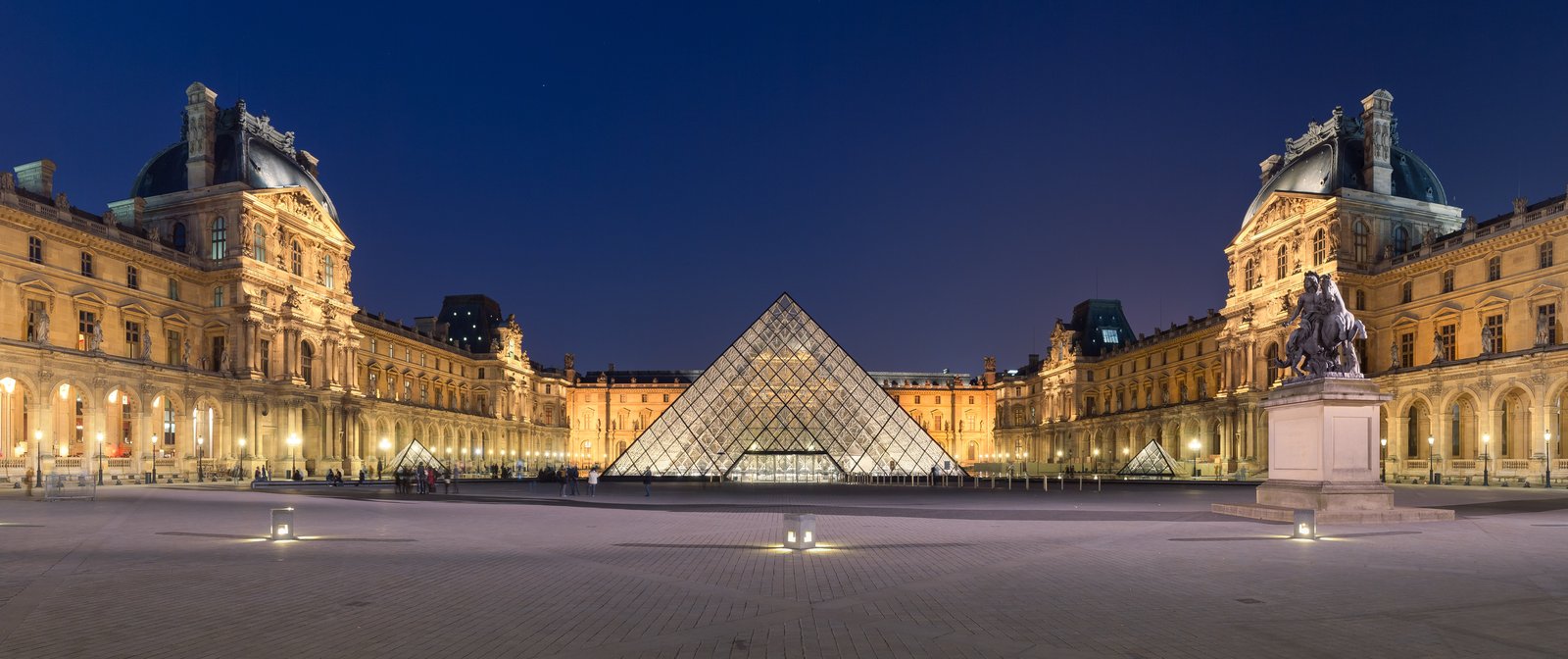
On the morning of Sunday 19 October 2025, the Louvre in Paris was open as usual, its galleries full of visitors. At about 9:30 a.m., half an hour after the doors had opened, four men arrived at the museum’s Seine-side facade on scooters and in a truck. They were dressed as construction workers. Within eight minutes they were gone — and with them, nine pieces of the French Crown Jewels, valued at €88 million.
It was the most brazen museum theft in France in living memory, carried out in daylight, in front of hundreds of people, at the most visited museum in the world. A year later, eight of the nine pieces are still missing, four men are in jail awaiting trial, and no one has been convicted. The case has become a national reckoning over how one of the world’s great museums could be robbed so easily.
Seven minutes in the Galerie d’Apollon
The thieves’ target was the Galerie d’Apollon, the 16th-century Apollo Gallery, a gilded ceremonial hall that displayed what remained of the French Crown Jewels — the collection of the kings and emperors of France, including pieces that had belonged to Marie-Louise, Marie-Amélie, Hortense and Empress Eugénie.
The plan was simple and, in retrospect, shockingly effective. The gang drove a truck fitted with a mechanical furniture-lift ladder to the Seine side of the palace and raised the platform to a first-floor balcony. Two men climbed up, used a disc cutter to cut through a window, and entered the gallery, triggering the alarms. They threatened the guards with their power tools, smashed two glass display cases, and took nine pieces: a sapphire tiara, necklace and earring from the set of Queen Marie-Amélie and Queen Hortense; an emerald necklace and earrings that had belonged to Empress Marie-Louise; the tiara of Empress Eugénie; a large corsage bow brooch; and a reliquary brooch. The other two men waited outside as lookouts.
They spent about four minutes inside the museum. By 9:38 a.m. they were out, riding away towards the A6 motorway. As they fled, they dropped one piece — the Crown of Empress Eugénie. It was found in the street outside the museum, badly damaged, crushed and bent after being pulled through an opening in the display case too small for it. It was missing a golden eagle and ten diamonds. The other eight pieces vanished with them.
The investigation
The French police response was fast. Within a week, two men in their 30s from Seine-Saint-Denis, outside Paris, had been arrested. More suspects were detained over the following months. DNA and CCTV evidence led investigators to the gang, and by late 2026 four men had been charged and were being held in jail awaiting trial. Two of them were reported to have partially admitted involvement; two denied any role. No trial date had been set, and no one had been convicted. Under French law, all of them are presumed innocent until proven guilty.
INTERPOL added the stolen jewels to its Stolen Works of Art database on 20 October, the day after the theft, circulating descriptions and photographs of all eight missing pieces to police forces around the world. But the jewels have not surfaced — not in a sale, not in a seizure, not in any intelligence report made public. Experts have warned that the most likely fate for the pieces is to be broken up, the stones removed from their historic settings and sold separately. Once that happens, the jewels as objects of history are gone for good.
The one recovered piece tells its own story. In February 2026, the Louvre said the Crown of Empress Eugénie had been crushed and badly bent, but that most of its components had survived, making a full restoration possible. The museum began the process of hiring a restorer for the crown that same month.
A museum’s security, on trial
If the theft was shocking, what followed was worse for the Louvre. Inquiries by the French Senate, the museum’s own administrative inspectorate and the Cour des comptes, the national audit court, laid bare a series of security failures. The Apollo Gallery’s windows could be reached from the street by a ladder. The display cases, though alarmed, could be smashed open in seconds. The thieves had arrived in a truck in broad daylight and no one had stopped them.
The Galerie d’Apollon stayed closed for months. It reopened to visitors on 22 July 2026 — nine months after the theft — but without its crown jewels display, and with the room returned to its role as a ceremonial state gallery. The remaining pieces of the Crown Jewels that the thieves did not take, including the Crown of Louis XV and the Hortensia diamond, are to be moved to a secure, windowless room elsewhere in the museum, and will no longer be displayed in the Apollo Gallery.
There was a further blow: the stolen jewels were not covered by private insurance. The Louvre, a state institution, absorbs the full financial loss itself — €88 million, on the Paris prosecutor’s valuation.
A collection with a long history
The French Crown Jewels are the surviving remnant of a collection assembled over centuries by the kings of France — crowns, tiaras, necklaces and brooches worn at coronations and state occasions. Much of the original collection was lost during the Revolution, and in 1887 the Third Republic sold off most of what remained, arguing that a republic had no need of a king’s jewels. What survived — the pieces considered of historic rather than merely monetary value — was put on display in the Galerie d’Apollon, the Louvre’s gilded 16th-century ceremonial hall.
Among the pieces the thieves did not take were the Crown of Louis XV, made for the coronation of 1722, and the Hortensia diamond, a peach-coloured stone with a history of its own. The pieces they did take — the sapphire set of Marie-Amélie and Hortense, the emeralds of Marie-Louise, the tiara and crown of Eugénie — were the most portable, and the most saleable, of the collection. They were also, in a sense, the most vulnerable: kept in glass cases in a room whose windows could be reached from the street.
The inquiries that followed the theft made uncomfortable reading for the Louvre. The Senate hearings and the report of the Cour des comptes, published in November 2025, described a gallery that could be entered from a balcony with a ladder, display cases that could be smashed open in seconds, and alarms that sounded but could not stop men who knew they had only minutes. The museum’s president acknowledged the failures. The Galerie d’Apollon, the inquiries found, had been protected as a historic room, not as a vault — and the thieves had understood the difference.
An unfinished case
The Louvre heist invites comparison with the last great European jewel theft, the 2019 raid on the Green Vault in Dresden. There, too, thieves struck a famous collection in minutes, and there, too, most of the loot only came back years later, after a deal with the suspects’ lawyers. In Dresden, the most famous piece — the Dresden White Diamond — never came back at all. In Paris, eight pieces are still missing, and the same fear hangs over them.
A year after the theft, the questions remain open. Who planned the raid, and how did they know the gallery’s weaknesses so precisely? Where are the jewels now? And how did a museum that receives millions of visitors a year leave its most precious room so exposed? The answers, if they come, will come in a courtroom — and until then, the Galerie d’Apollon stands open and empty, its cases gone, its treasure still missing.
What is documented — and what is not
Documented: On 19 October 2025, at about 9:30 a.m., four men using a truck-mounted mechanical ladder entered the Galerie d’Apollon at the Louvre and stole nine pieces of the French Crown Jewels, valued at approximately €88 million, in under eight minutes. The Crown of Empress Eugénie was dropped during the escape and recovered, badly damaged; eight pieces remain missing as of October 2026. INTERPOL added the jewels to its Stolen Works of Art database on 20 October 2025. Arrests followed within a week; by late 2026 four men had been charged and were held awaiting trial, with no trial date set and no convictions. The Galerie d’Apollon reopened on 22 July 2026 without its crown jewels display. The jewels were not privately insured.
Unverified or unproven: The location of the eight missing pieces, and whether they have been broken up. Who planned the raid and how the gang obtained its knowledge of the gallery. The final outcome of the criminal proceedings — all suspects are presumed innocent until proven guilty, and the two reported partial admissions have not been tested in court. The exact number of pieces taken was initially reported as eight by the Louvre and nine by INTERPOL; the nine-piece account, with the crown dropped during the escape, is the one now generally used.
Sources
- https://en.wikipedia.org/wiki/2025_Louvre_robbery
- https://www.interpol.int/News-and-Events/News/2025/Louvre-Museum-theft-Stolen-jewels-added-to-INTERPOL-s-Stolen-Works-of-Art-database
- https://econotimes.com/Louvre-Jewels-Remain-Missing-a-Year-After-88-Million-Heist-1756236
- https://en.yenisafak.com/world/louvre-apollo-gallery-reopens-after-crown-jewels-heist-3721079