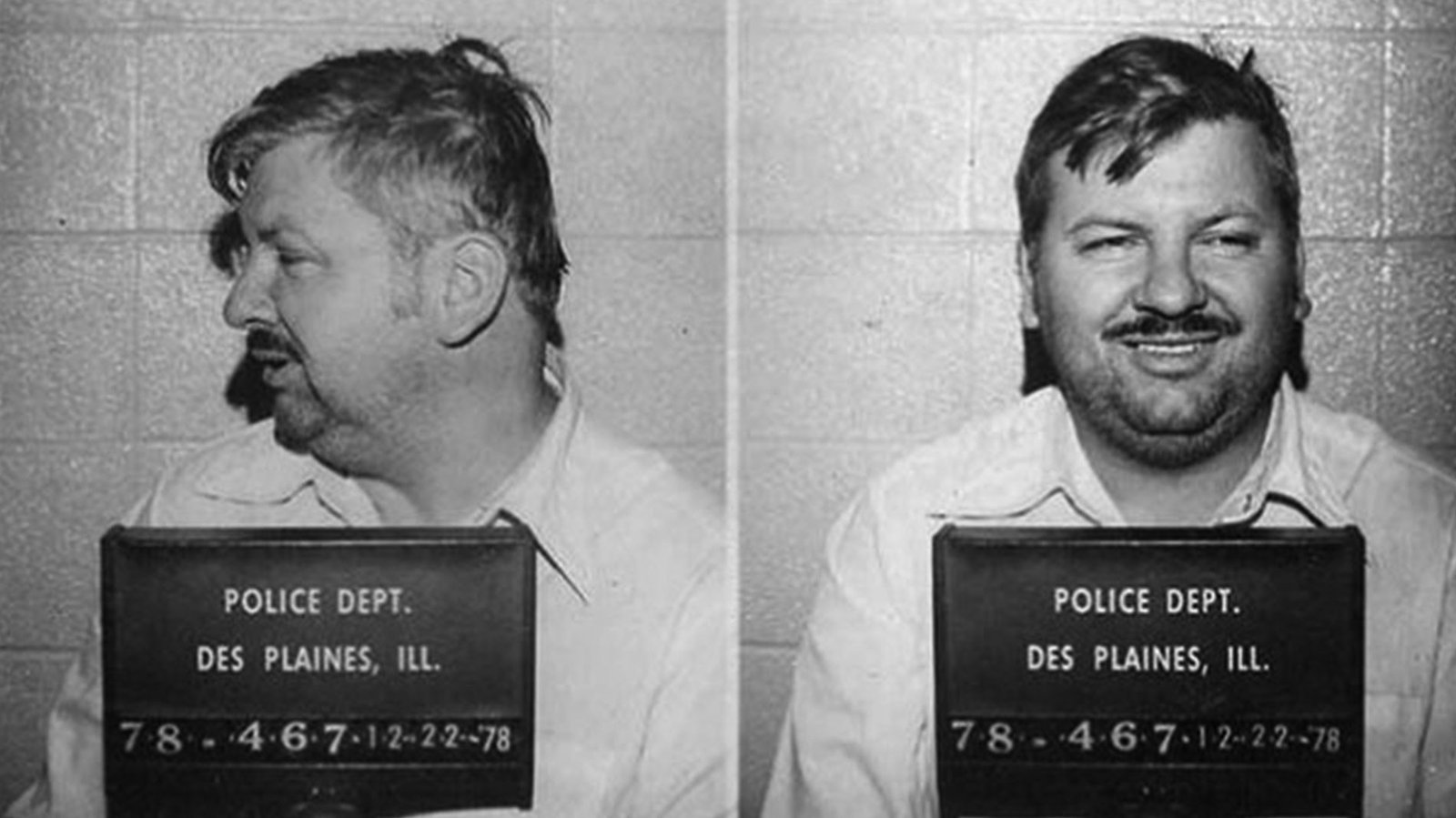
John Wayne Gacy was, to his neighbours in Norwood Park Township, outside Chicago, a model citizen. He was a successful building contractor, an active member of the local Democratic Party, and a volunteer who dressed as “Pogo the Clown” at children’s parties and hospital visits. Between 1972 and 1978, he murdered thirty-three young men and boys. Twenty-six of them were found buried in the crawl space beneath his house.
This article does not describe his crimes in detail. The record is established; the focus here is on how he was caught, tried and punished.
The double life
Gacy was born in 1942 in Chicago and raised in a working-class household. He had a troubled youth, including a difficult relationship with his father, and a history of trouble with the law: in 1968, in Iowa, he was convicted of sexually assaulting a teenage boy and served eighteen months in prison. After his release, he moved back to Chicago, remarried, and built a contracting business that employed young men — the same young men who would become his victims.
His victims were mostly teenage boys and young men, many of them runaways or young workers he had hired or lured to his home with offers of work. For years, their disappearances drew little attention. Many were estranged from their families, and the police did not connect the cases.
The disappearance of Robert Piest
The case broke in December 1978, when fifteen-year-old Robert Piest disappeared after leaving his job at a pharmacy in Des Plaines, Illinois. Piest had told his mother he was going to meet a contractor about a summer job. Police traced the contractor to Gacy, and a search of Gacy’s home revealed items belonging to other missing young men, and a smell that investigators recognised.
Gacy was placed under surveillance, and on 20 December 1978, he confessed to police that he had buried bodies in the crawl space of his house. Over the following weeks, investigators recovered twenty-six bodies from beneath the house and three more from the Des Plaines River. In total, thirty-three victims were identified — though the last of them was not identified until 2021, when DNA testing finally gave a name to a young man known for decades only as Victim No. 5.
Trial and execution
Gacy’s trial opened in Chicago in February 1980. His lawyers argued that he was insane, presenting psychiatrists who testified that he suffered from a personality disorder. The prosecution argued that Gacy was a calculating killer who had planned his crimes and concealed them for years. On 13 March 1980, the jury convicted him of thirty-three counts of murder. He was sentenced to death.
Gacy spent fourteen years on death row, filing appeals and giving interviews. He maintained his innocence in some of the killings, claiming that his employees had committed some of the murders without his knowledge — a claim that was never supported by evidence. He was executed by lethal injection at Stateville Correctional Center on 10 May 1994, aged 52.
Identifying the victims took decades. When the bodies were recovered in 1978 and 1979, investigators worked from dental records, fingerprints and personal effects, but eight of the victims remained unidentified for years. The Cook County Sheriff’s Office continued the work long after Gacy’s execution, using DNA testing and genealogical research. In 2011, the sheriff’s office exhumed the remains of the eight unidentified victims to obtain DNA samples, and appealed to the public for help. The effort paid off slowly: one victim was identified in 2017, and in October 2021, the last of them — Francis Wayne Alexander, a 21-year-old from North Carolina who had moved to Chicago — was finally given his name back, more than forty years after his death.
The clown
Gacy’s work as a clown has become the most famous detail of his story, and it is worth stating plainly: there is no evidence that Gacy committed any of his crimes while dressed as a clown. He performed as “Pogo” at parties and charity events, and the image of a killer clown has haunted popular culture ever since — but the clown was a costume he wore in public, not a part of his crimes. The distinction matters, because the victims deserve to be remembered as people, not as props in a horror story.
What the record shows
- John Wayne Gacy was born in Chicago in 1942. In 1968, in Iowa, he was convicted of sexually assaulting a teenage boy and served eighteen months in prison. He later built a contracting business in the Chicago suburbs.
- Between 1972 and 1978, he murdered thirty-three young men and boys. Twenty-six were buried in the crawl space beneath his house in Norwood Park Township; others were disposed of in the Des Plaines River.
- The case broke in December 1978 after the disappearance of fifteen-year-old Robert Piest. Gacy confessed on 20 December 1978.
- On 13 March 1980, he was convicted of thirty-three counts of murder and sentenced to death. He was executed by lethal injection on 10 May 1994, aged 52.
- The last of his victims was identified by DNA testing in 2021, having been known only as Victim No. 5 for more than forty years.
- Disputed/unverified: Gacy’s claim that his employees committed some of the murders was never supported by evidence. There is no evidence he committed any crime while dressed as a clown.
- Unresolved: The identification of all of Gacy’s victims took more than forty years; the final victim was named only in 2021.