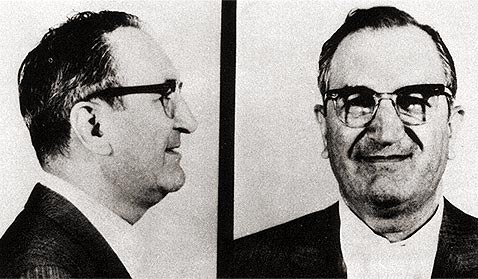
On May 17, 1966, a 61-year-old man walked into the federal courthouse at Foley Square in Manhattan and surrendered to the authorities. He had not been seen for nineteen months. He said he had been kidnapped, held captive by his own cousin, and had only just escaped. The FBI agents who took him into custody listened politely. Most of them did not believe him.
The man was Joseph Bonanno, known as “Joe Bananas,” the boss of the crime family that still carries his name. He had disappeared on the night of October 21, 1964, the evening before he was due to appear before a grand jury, and in his absence his family had torn itself apart in a conflict the newspapers called the “Banana War.” Now he was back, claiming to be a victim. Within two years he would be retired in Arizona. Within seventeen, he would do something no Mafia boss had ever done before: publish his autobiography.
From Castellammare to Brooklyn
Giuseppe Carlo Bonanno was born on January 18, 1905, in Castellammare del Golfo, a fishing town on the north-west coast of Sicily. His father, Salvatore Bonanno, was involved in organised crime, and the boy grew up inside a world where loyalty to family and silence towards outsiders were rules for survival. In 1924, at the age of 19, Bonanno entered the United States illegally and settled in Brooklyn, where a large community of immigrants from Castellammare had already put down roots. He joined the Castellammarese faction in New York, first under Nicolò Schirò and then under Salvatore Maranzano, a well-educated Sicilian who wanted to unite the scattered Sicilian gangs of New York under a single banner.
The Castellammarese War
The Castellammarese War broke out in 1930, pitting Maranzano’s Sicilian faction against a rival group based in Brooklyn, led by Giuseppe “Joe the Boss” Masseria and Giuseppe Morello. It was a war over bootlegging territory, gambling and the rackets that Prohibition had made enormously profitable, but it was also a war about who would speak for organised crime in America: the old Sicilian “Mustache Petes” or a younger, more American generation.
Bonanno fought on Maranzano’s side. The war ended in 1931 with the murder of Masseria in April — arranged by Charles “Lucky” Luciano, Masseria’s own lieutenant — and then, five months later, with the murder of Maranzano himself, on September 10, 1931, by gunmen working for Luciano. Bonanno, at 26, was chosen to lead what had been Maranzano’s family, reorganising it as the Bonanno family, and became one of the youngest members of the Commission, the governing council Luciano established to settle disputes between the Five Families of New York.
He would hold the job for more than thirty years. Under Bonanno, the family expanded beyond Brooklyn, building interests in gambling, loansharking and other rackets. Bonanno cultivated the image of a traditionalist — a man of honour, in his own phrase, who believed the Mafia was a brotherhood governed by rules, not a gang of thieves. It was an image that served him well.
The 1963 plot
By the early 1960s, Bonanno’s position was weakening. Alliances on the Commission had shifted, and the rival bosses Carlo Gambino and Thomas Lucchese had grown stronger. In 1963, he and Joseph Magliocco, the boss of the Profaci family, made plans to assassinate several of their rivals on the Commission, including Gambino, Lucchese and Stefano Magaddino, the Buffalo boss. The plot collapsed before anyone was harmed. Magliocco confessed to the Commission, was fined, and died soon afterwards. Bonanno refused to appear before the Commission to answer for the conspiracy, and he was also facing a grand jury subpoena. In October 1964, he returned briefly to New York — and then, on the night of October 21, the day before he was due before the grand jury, he was bundled into a car on Park Avenue and disappeared.
He reappeared nineteen months later, on May 17, 1966, at the federal courthouse in Manhattan, claiming he had been kidnapped and held by his cousin Magaddino in Buffalo. Many investigators believed he had staged his own disappearance to avoid the Commission hearing and the grand jury. No one was ever charged with kidnapping him, and no evidence of a genuine abduction was ever produced. The truth of those nineteen months has never been established.
The Banana War
During Bonanno’s absence, Gaspar DiGregorio, a senior member of the family, took advantage of discontent over the role of Bonanno’s son, Salvatore “Bill” Bonanno, whom his father had promoted to consigliere over more senior men. The Commission named DiGregorio as the new boss, and the family split into loyalists to Bill Bonanno and loyalists to DiGregorio. The newspapers called the four-year conflict that followed the “Banana War,” a play on the boss’s nickname.
The war’s most notorious episode came on January 28, 1966, when DiGregorio invited Bill Bonanno to a supposed peace meeting at his grand-uncle’s house on Troutman Street in Bushwick, Brooklyn. As Bill and his loyalists approached the house, gunfire broke out from doorways and windows. No one was wounded; the shooting became known as the Troutman Street ambush.
In 1968, the war finally ended. DiGregorio was wounded by gunfire outside his home and later suffered a heart attack, and Bonanno himself suffered a heart attack that year. The two sides negotiated a settlement: Bonanno would retire as boss and move to Arizona, giving up the family for good. Paul Sciacca succeeded him.
Arizona, prison, and the memoir
Bonanno settled in Tucson, Arizona, where he lived under close FBI watch. Retirement did not end his legal troubles. In September 1980, he was convicted in federal court in San Jose of conspiracy to obstruct justice, for interfering with a grand jury investigation into alleged money laundering involving companies run by his sons. On January 12, 1981, he was sentenced to five years in prison and fined $10,000 — the first prison sentence of his underworld career. The sentence was later reduced because of his ill health, and he served eight months in prison in 1983.
Then, in 1983, Bonanno did what no American Mafia boss had ever done: he published his autobiography. A Man of Honor: The Autobiography of Joseph Bonanno, written with Sergio Lalli, described the Commission, the traditions of the Mafia, and Bonanno’s own version of his life. Many in organised crime saw the book as a breach of omertà, the code of silence. Bonanno argued that it was not: he had not testified to law enforcement, he said, and his words had not been given under duress. The federal prosecutor Rudolph Giuliani later said the book helped give him the idea for the Mafia Commission Trial, which in 1986 put the heads of New York’s Five Families in prison.
The book also brought Bonanno back into court. In 1985, he was imprisoned for fourteen months for contempt of court after refusing to testify in a federal racketeering case about some of the claims in his book. He was released on November 1, 1986, and returned to Tucson.
The memoir problem
A Man of Honor is the only genuine autobiography ever published by an American Mafia boss, and that alone makes it a remarkable document. But it is also deeply self-serving. Bonanno presents himself as a man of principle, the guardian of an old Sicilian tradition of honour that, in his telling, had been corrupted by younger, greedier men. What he does not dwell on is the violence that built and sustained his power, or the victims of the rackets his family ran — the shopkeepers, gamblers and workers whose money flowed upward to men like him.
Historians have also questioned many of the book’s specific claims. His account of the origins of the Mafia, his role in the Castellammarese War, and his version of the 1963 plot and his disappearance all reflect a man writing his own legend, decades after the events, with every reason to cast himself as a statesman rather than a criminal. His son Bill’s story had already been told, in a form Bonanno disliked, in Gay Talese’s 1971 book Honor Thy Father — a book that angered Bonanno so much he refused to speak to his son for a year. A Man of Honor can fairly be read as Bonanno’s answer: his own version, on his own terms. It is a primary source of great value, and a reliable history of nothing on its own.
The last don
Joseph Bonanno died of heart failure in Tucson on May 11, 2002, at the age of 97. He had outlived nearly all of his contemporaries, and he was reported to be the last surviving original member of the Commission. He was buried at Holy Hope Cemetery and Mausoleum in Tucson.
He was, in the end, an exception among Mafia bosses twice over: he retired from leadership rather than dying in prison or by violence, and he lived long enough to write his own story. That story made him famous, and it also made him, in the eyes of many former associates, a traitor to the code he claimed to uphold. The contradiction was the man himself: a boss who believed in honour and practised extortion, who valued silence and published a book.
What is documented — and what is not
Documented: Bonanno’s birth in Castellammare del Golfo on January 18, 1905, his entry into the United States in 1924, his role in the Castellammarese War of 1930–31, his becoming boss at 26 in 1931, the 1963 plot with Joseph Magliocco, his disappearance on October 21, 1964 and reappearance on May 17, 1966, the Banana War of 1964–68 including the Troutman Street ambush of January 28, 1966, his retirement to Arizona in 1968, his 1980 conviction for conspiracy to obstruct justice and the eight months he served in 1983, the 1983 publication of A Man of Honor, his fourteen months’ imprisonment in 1985–86 for contempt of court, and his death from heart failure in Tucson on May 11, 2002 at 97, are all established by court records, contemporary reporting and reference sources.
Unverified or unproven: Whether Bonanno’s 1964–66 disappearance was a genuine kidnapping, as he claimed, or staged by Bonanno himself, as many investigators believed, was never established, and no one was ever charged with abducting him. The extent of the violence during the Banana War is reported differently in different sources. Claims in A Man of Honor about the origins of the Mafia, Bonanno’s own motives, and the conduct of his rivals are Bonanno’s own account, are disputed by historians, and should not be treated as established history.
Sources
- https://en.wikipedia.org/wiki/Joe_Bonanno
- https://www.britannica.com/biography/Joseph-Bonanno
- https://en.wikipedia.org/wiki/Bonanno_Crime_Family
- https://en.wikipedia.org/wiki/Gaspar_DiGregorio
- https://nationalcrimesyndicate.com/joseph-bonanno-the-godfather-who-built-a-dynasty/