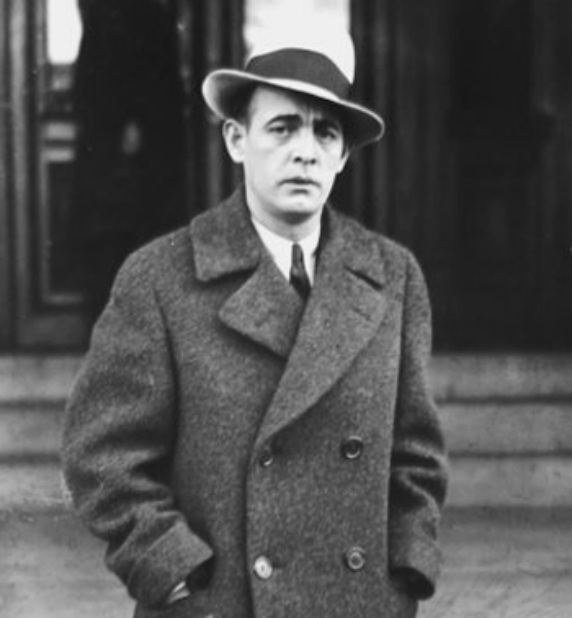
Jack “Legs” Diamond was shot at, stabbed at, and hunted for more than a decade — and he kept surviving. Between 1924 and 1931, he survived at least four serious assassination attempts, taking more than 70 buckshot pellets and nearly a dozen pistol slugs, according to contemporary accounts. The press, marvelling at his escapes, called him the “clay pigeon of the underworld”: a target that kept being shot at and somehow kept flying.
On the morning of 18 December 1931, in a boarding house at 67 Dove Street in Albany, New York, the clay pigeon finally fell. Two gunmen entered his bedroom while he slept and shot him three times in the head. He died instantly. He was 34. No one was ever convicted of his murder.
A Philadelphia childhood, a New York gangster
Diamond was born in Philadelphia to working-class Irish American parents. His birth name and even his birth date are disputed — sources give his name as John Thomas Diamond or John Moran, and his birth as 10 July 1897 or 11 July 1898. What is not disputed is that he grew up poor, joined the Hudson Dusters, a Manhattan street gang, in his teens, and by the early 1920s had become a bootlegger and enforcer in New York’s underworld.
He was known as “Legs” — some said for his speed as a dancer, others for his speed in running from the police — and as “Gentleman Jack,” for his polished manners and expensive clothes. He was charming, well-dressed, and fond of showgirls and nightclubs. He was also, by every account, a violent man. He became a close associate of the gambler Arnold Rothstein, one of the most powerful figures in New York organised crime, and built his own bootlegging operation during Prohibition, fighting a series of “bootleg wars” for control of beer and liquor distribution in Manhattan.
His rivalry with Dutch Schultz — the Bronx beer baron — was one of the fiercest in the underworld. The two men fought over the same territory, the same speakeasies, and the same profits. Schultz, after yet another failed attempt to kill Diamond, is said to have complained to his own men that Diamond seemed impossible to kill.
The man who would not die
Diamond’s reputation was built on survival. He was accused in some of the most shocking underworld cases of the era, including the murder of Rothstein in 1928, the murder of “Fatty” Walsh in 1929, and a double murder inside the Hotsy-Totsy nightclub in 1929 — in which Diamond and an associate shot three men during an argument, and two died. He was never convicted of any of these killings.
The attempts on his own life became legend. On 16 October 1927, while acting as bodyguard for his brother Eddie, Diamond was shot twice during the murder of Jacob “Little Augie” Orgen on Manhattan’s Lower East Side. On 12 October 1930, two gunmen forced their way into his room at the Hotel Monticello on Manhattan’s West Side and shot him five times at close range. He survived. On 27 April 1931, barely five days after being released on bond on kidnapping charges, he was shot again at the Aratoga Inn, a roadhouse near Cairo, New York. He survived that too.
Each time, he recovered in hospital, gave wry comments to reporters, and went back to his life. The New York Daily News wrote that he appeared “constructed of material not available to ordinary men.” The nickname stuck: the clay pigeon of the underworld.
Trials, Europe, and the end
Diamond’s legal troubles were as persistent as the gunmen. He was charged with kidnapping in 1930 and sentenced to four years; the conviction was overturned, and he was twice acquitted on retrial. In December 1931, he was tried in Troy, New York, again on kidnapping charges, and was once again acquitted — on 17 December.
That night, Diamond and his wife Alice celebrated the acquittal. He drank heavily at a roadhouse, then took a cab back to the boarding house at 67 Dove Street in Albany, alone, and fell into a drunken sleep. In the early hours of 18 December, two gunmen entered his room. One held him down; the other shot him three times in the back of the head at close range. The coroner found that two bullets had lodged in his head and the third had passed through his neck. He was buried on 23 December 1931 at Mount Olivet Cemetery in Maspeth, Queens.
Who ordered the killing has never been proved. The list of likely candidates is long: Dutch Schultz, the Oley brothers (local Albany criminals), the Albany police, and relatives of Red Cassidy, another Irish American gangster. The writer William Kennedy, in his book O Albany, argued that Dan O’Connell, who ran Albany’s Democratic political machine, ordered Diamond’s execution and that it was carried out by Albany police. That account is widely repeated but has never been proved in court, and other theories — including that Schultz ordered it as the final move in their long rivalry — remain possible.
The legend, and the reality
Diamond has been romanticised more than most gangsters of his era. William Kennedy’s novel Legs (1975), the first in his Albany cycle, turned him into a literary figure: charming, doomed, and almost mythical. The image of the “Gentleman Jack” who danced with death and kept surviving is a powerful one.
The reality was less charming. Diamond was a bootlegger, an enforcer, and a killer. The Hotsy-Totsy shooting alone left two men dead. The people he terrorised — speakeasy owners forced to buy his beer, rivals, witnesses — do not appear in the romantic version of his story. His survival was not a miracle; it was luck, and the medical care available to a wealthy gangster, and the fact that his would-be killers were often as incompetent as they were determined.
His death, too, was not romantic. He was not killed in a gunfight or a last stand. He was shot in his sleep, drunk, in a cheap boarding house, hours after celebrating an acquittal. The man who had survived so many attempts on his life died because, for once, he was too drunk to wake up.
Diamond’s story endures because it captures something about Prohibition-era New York: a city in which a bootlegger could become a celebrity, in which the newspapers treated gangsters as folk heroes, and in which the line between the underworld and respectable society was thin. But the folk hero was also a criminal, and his victims — the men killed at the Hotsy-Totsy, the people caught in the bootleg wars — deserve to be remembered alongside the legend.
What Is Documented, and What Is Not
Documented: Jack “Legs” Diamond was an Irish American Prohibition-era gangster in New York, a bootlegger and associate of Arnold Rothstein. He survived multiple assassination attempts between 1924 and 1931, including being shot five times at the Hotel Monticello on 12 October 1930 and again at the Aratoga Inn on 27 April 1931. He was tried for kidnapping in Troy, New York, and acquitted on 17 December 1931. In the early hours of 18 December 1931, he was shot three times in the head in a boarding house at 67 Dove Street, Albany, and died. He was buried on 23 December 1931 at Mount Olivet Cemetery, Queens. No one was convicted of his murder.
Unverified or disputed: Flag — birth name and date: sources dispute whether he was born John Thomas Diamond or John Moran, and whether his birth date was 10 July 1897 or 11 July 1898; the Mob Museum gives 11 July 1898 in Philadelphia, Wikipedia gives 10 July 1897. No single date is stated as certain here. Flag — who killed him: the identity of Diamond’s killers and who ordered the murder are unresolved; candidates named in sources include Dutch Schultz, the Oley brothers, Albany police, and relatives of Red Cassidy, and William Kennedy’s claim that Dan O’Connell ordered it is an author’s argument, not a court finding. Flag — origin of “Legs”: whether the nickname came from dancing or from running is anecdotal and unverified. The claim that he survived “more than 70 buckshot pellets and nearly a dozen pistol slugs” is a contemporary press tally, not a medical count.
Sources
- https://en.wikipedia.org/wiki/Legs_Diamond
- https://themobmuseum.org/blog/jack-legs-diamond-the-clay-pigeon-of-the-underworld/
- https://www.utterlyinteresting.com/post/jack-legs-diamond-and-the-myth-of-the-man-who-would-not-die
- http://www.writersofwrongs.com/search/label/France