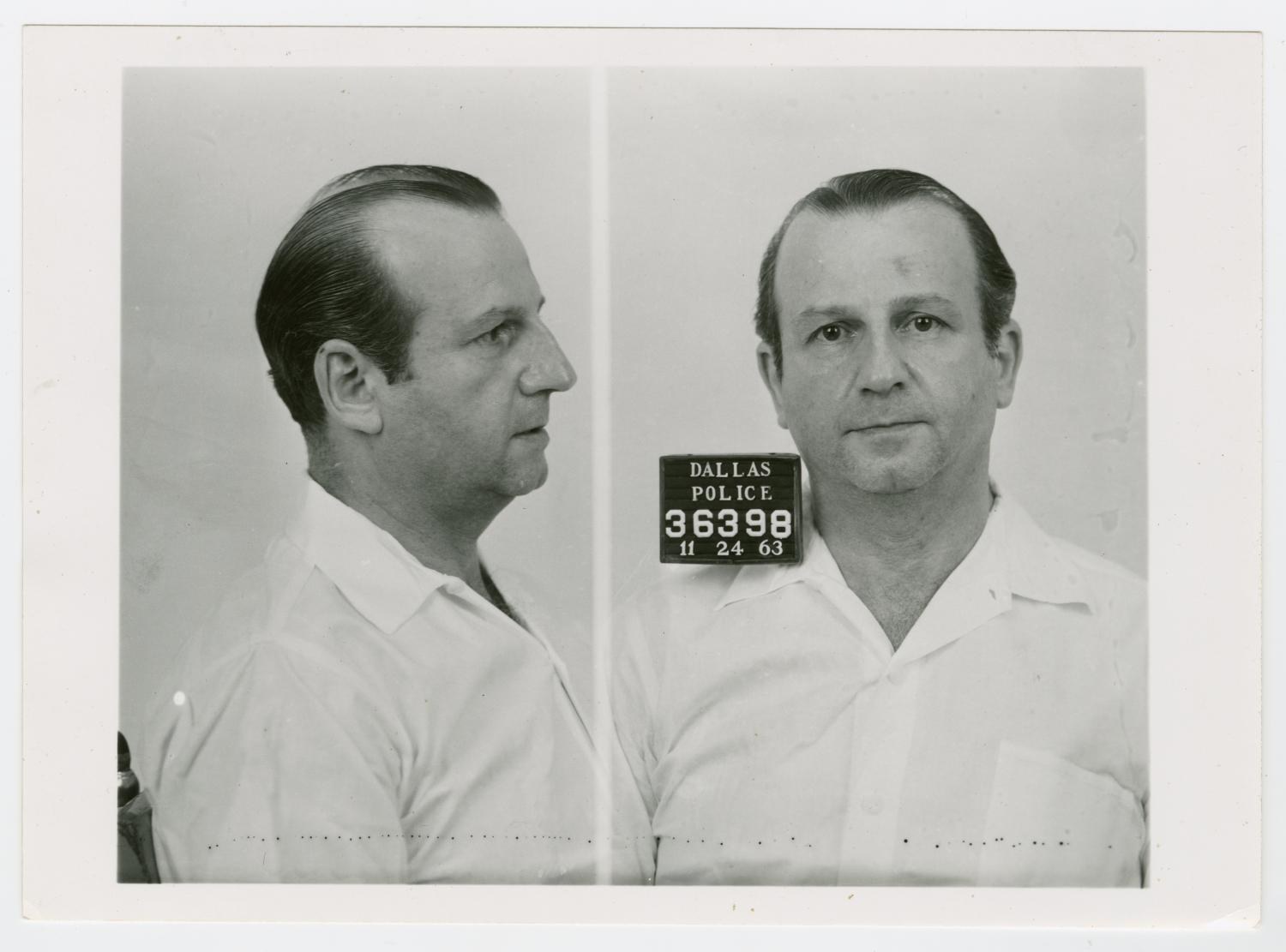
On the morning of 24 November 1963, two days after President John F. Kennedy was assassinated in Dallas, Texas, Lee Harvey Oswald was being moved through the basement of Dallas police headquarters to a county jail. Millions of people were watching on live television. As detectives escorted Oswald toward a car, Dallas nightclub owner Jack Ruby stepped forward from the crowd of reporters and officers and fired a single shot from a concealed .38 revolver into Oswald’s chest. Oswald died later that day, at 1:07 p.m.
Ruby had killed, on camera, the man accused of killing the president. The question that followed was not only what punishment Ruby deserved, but whether any jury in Dallas, in that moment, could give him a fair trial at all.
The man in the basement
Jack Ruby, born Jacob Rubenstein, operated strip clubs and dance halls in Dallas, including the Carousel Club. He was a familiar figure around police headquarters and local reporters, a man who knew officers by name and often turned up where news was happening. That familiarity later became part of the mystery of the shooting: how had a civilian got so close to a heavily guarded prisoner transfer?
Ruby told investigators and, later, the Warren Commission that he had acted on impulse, distraught over Kennedy’s death. He said he wanted to spare Jacqueline Kennedy the ordeal of returning to Dallas to testify at Oswald’s trial. That explanation — grief, impulse, and a wish to protect the president’s widow — became the heart of his defence. Prosecutors saw something else: a deliberate killing, carried out in public, of a man in police custody.
Oswald himself never stood trial for the assassination. His death meant that the central question of the Kennedy assassination — his guilt or innocence in a court of law — would never be tested before a jury. Ruby’s trial, in a strange way, became the only courtroom reckoning connected to those three days in Dallas.
A trial under the cameras
Ruby was indicted for murder four days after the shooting. His first lawyer, Tom Howard, prepared a defence based on the idea that the killing was a crime of passion by an unstable man, without malice or premeditation. The celebrated San Francisco lawyer Melvin Belli later took over as chief defence counsel.
The defence argued that Ruby had suffered from “psychomotor epilepsy” and had shot Oswald in a kind of unconscious, grief-stricken state — in effect, that he was not legally responsible for the act. Prosecutors rejected that account and presented the shooting as murder with malice: Ruby had brought a gun, waited for his moment, and fired at close range.
The proceedings began with a change-of-venue hearing on 10 February 1964. Ruby’s lawyers argued that he could not receive a fair trial in Dallas, where the assassination and the televised shooting had saturated public feeling. Judge Joe Brantley Brown refused to move the trial. Jury selection began on 17 February and was completed on 3 March. Ten of the jurors selected had themselves watched the shooting of Oswald on television.
The trial itself ran from 4 to 14 March 1964. It was, according to HISTORY, the first courtroom verdict to be televised in United States history. The eyes of the country were on a Dallas courtroom for the second time in four months, and the pressure on everyone inside it — judge, lawyers, witnesses, and jurors — was extraordinary.
The verdict
Closing arguments ran past 1:00 a.m. on Saturday 14 March. That afternoon, after deliberating for two hours and 19 minutes, the jury — eight men and four women — found Ruby “guilty of murder with malice, as charged in the indictment,” and assessed his punishment at death. Belli immediately denounced the verdict. Ruby, then 52, was sentenced to die in the electric chair.
The speed of the deliberation surprised many observers, given the complexity of the mental-state evidence. But the core fact was simple and had been seen by millions: Ruby had walked up to a handcuffed prisoner surrounded by police and shot him. For the jury, that act spoke louder than the psychiatric testimony about epilepsy and unconscious impulse.
The appeal — and the ending no one expected
Ruby never faced execution. In October 1966, the Texas Court of Criminal Appeals reversed his conviction. The court, in Rubenstein v. State, gave two main reasons: testimony from a psychiatrist about Ruby’s mental state had been improperly admitted, and Ruby could not have received a fair trial in Dallas at the time, given the publicity surrounding the case and the assassination. The court ordered a new trial, with the venue changed to a county other than Dallas. A retrial was arranged for Wichita Falls, to begin in February 1967.
It never happened. On 9 December 1966, Ruby was admitted to Parkland Hospital in Dallas, apparently suffering from pneumonia. Tests revealed terminal lung cancer. He died on 3 January 1967 of a pulmonary embolism, a complication of the cancer. He was never retried, and his conviction was never reinstated.
What the trial settled — and what it did not
The Warren Commission, whose report was published in September 1964, concluded that there was no evidence that either Oswald or Ruby was part of a larger conspiracy, domestic or international, to assassinate President Kennedy. It concluded that Ruby had acted alone. A later congressional inquiry, the House Select Committee on Assassinations, reached a different, more qualified conclusion about the Kennedy assassination itself, but the official record of Ruby’s trial remains what it was: a conviction for murder with malice, overturned on appeal, with no retrial ever held.
The Ruby trial matters for reasons beyond its famous defendant. It was an early test of how the justice system copes when a crime is broadcast live to the nation, when every prospective juror has already seen the act, and when grief and anger are still raw. The appeals court answered that test plainly: a fair trial requires more than a courtroom and a jury. It requires a setting in which jurors can judge the evidence rather than the images they have already seen.
For the victims at the centre of this story, the trial offered no resolution. Jacqueline Kennedy was spared a return to Dallas, as Ruby said he had intended, but she was also denied the public trial of the man accused of killing her husband. Oswald’s family, and the family of Dallas police officer J. D. Tippit — killed as Oswald was being pursued — were left with questions that no court ever answered. Ruby’s death in 1967 closed the case without a final verdict, leaving the shooting in the basement as one of the most-watched, least-resolved moments in American legal history.
What Is Documented, and What Is Not
Documented: Ruby shot Oswald on 24 November 1963 in the basement of Dallas police headquarters; Oswald died at 1:07 p.m. that day. Ruby was tried in Dallas from 4 to 14 March 1964 before Judge Joe Brantley Brown, defended principally by Melvin Belli; the jury deliberated two hours and 19 minutes and found him guilty of murder with malice, sentencing him to death. The Texas Court of Criminal Appeals reversed the conviction on 5 October 1966, citing improper admission of psychiatric testimony and the impossibility of a fair trial in Dallas, and ordered a retrial in another county. Ruby died of a pulmonary embolism secondary to lung cancer on 3 January 1967, while awaiting that retrial. The Warren Commission concluded in 1964 that there was no evidence Ruby was part of a conspiracy.
Unverified or disputed: Ruby’s stated motive — grief and a wish to spare Jacqueline Kennedy — is what Ruby himself said; it cannot be independently confirmed as his true motive, and other explanations have been suggested. The defence claim of “psychomotor epilepsy” was contested psychiatric evidence, not an established medical fact, and the appeals court found related testimony improperly admitted. Claims that Ruby acted on behalf of organised crime or any conspiracy have not been proved; the Warren Commission found no evidence to support them. Flag: one secondary source gives the conviction date as 16 March 1964; the Sixth Floor Museum, HISTORY, and the court record support 14 March, which is used here.
Sources
- https://en.wikipedia.org/wiki/Murder_of_Lee_Harvey_Oswald
- https://www.history.com/this-day-in-history/march-14/jack-ruby-sentenced-to-death
- https://www.jfk.org/timeline-events/jack-ruby-found-guilty-of-murder-with-malice/
- https://www.encyclopedia.com/law/law-magazines/jack-ruby-trial-1964
- https://law.justia.com/cases/texas/court-of-criminal-appeals/1966/37900-3.html
- https://www.tshaonline.org/handbook/entries/ruby-jack