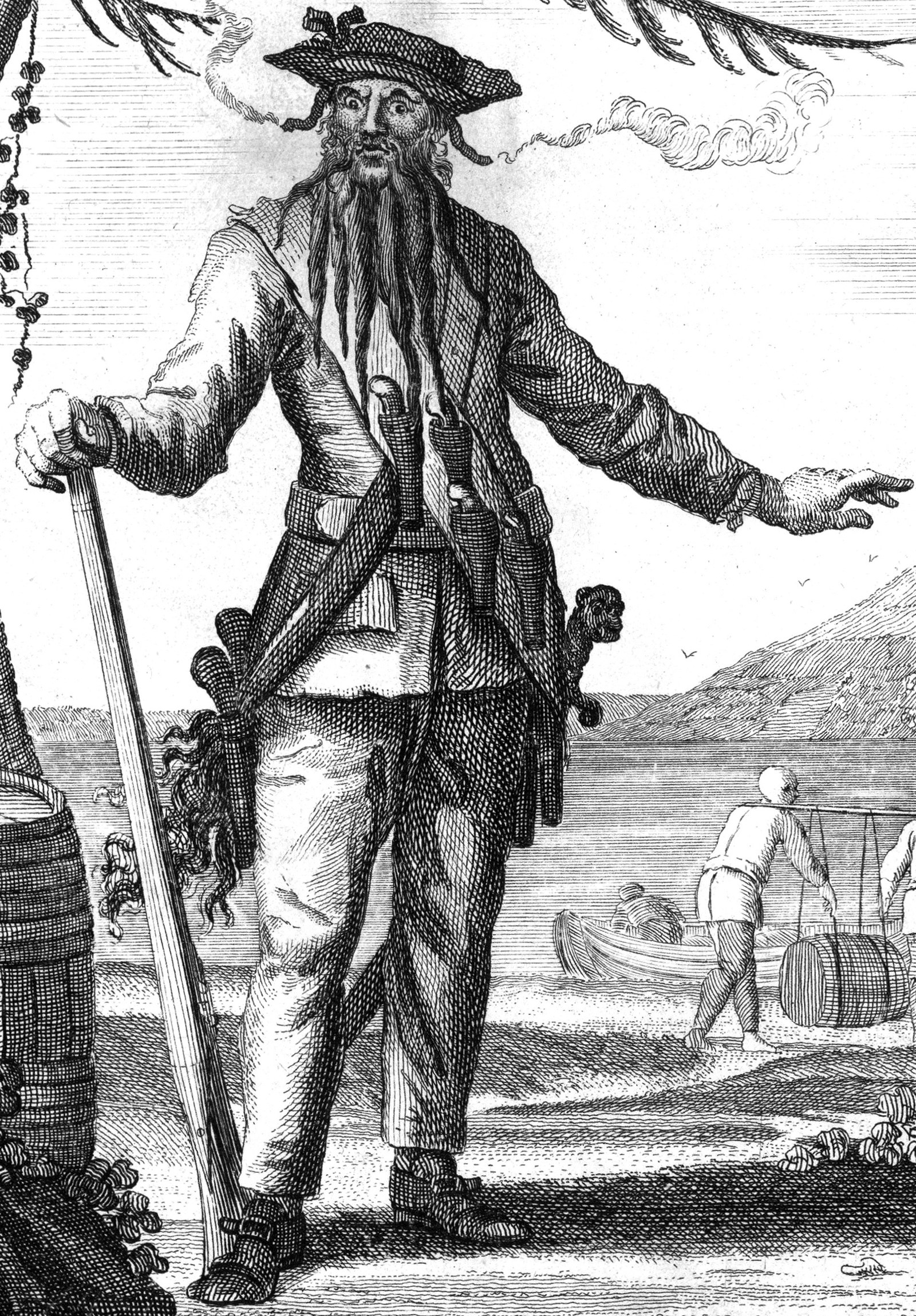
Edward Teach — the spelling “Thatch” also appears in contemporary records — is the most famous pirate of the early eighteenth century, and one of the least documented. He was probably born in Bristol, England, in about 1680, though even that is uncertain. Almost nothing is known about his life before 1716, when he appears in the Caribbean as a member of the crew of the pirate Benjamin Hornigold. His active career as a pirate captain lasted only about two years, from 1716 to 1718. In that short time he built a reputation that has lasted three centuries, much of it resting on a single book published six years after his death.
From Privateer to Pirate
Teach may have served as a sailor or privateer during the War of the Spanish Succession, which ended in 1713; when the war ended, many privateers found themselves without work, and some turned to piracy. Whether Teach followed that path is not documented. The first firm record of him is in 1716, when he joined Hornigold’s crew, operating from New Providence in the Bahamas, a base that had become a haven for pirates.
Hornigold soon gave Teach command of a captured ship. In November 1717, near Martinique, he captured a large French ship, La Concorde, which had been used in the slave trade. He renamed her Queen Anne’s Revenge, fitted her with forty guns, and crewed her with more than three hundred men at her peak.
The Blockade of Charleston
Blackbeard’s most audacious act came in May 1718, when his fleet blockaded the port of Charleston, South Carolina, then one of the busiest ports in the southern colonies. For nearly a week his ships stopped vessels entering or leaving the harbour, seizing several of them. Among the captives were prominent Charleston citizens, including a member of the colonial council.
His ransom demand was unusual: not gold, but a chest of medicine, needed for his crew, many of whom were suffering from syphilis — and a deliberate humiliation of the colonial government. Governor Robert Johnson had no Royal Navy vessel in the area capable of challenging Blackbeard’s force, so the medicine was sent, the captives were released, and the blockade ended. No one was killed in the blockade, as far as the records show: Blackbeard’s reputation for cruelty rests largely on his appearance and on later retellings, rather than on a documented record of murder.
The wreck of Queen Anne’s Revenge, discovered in 1996 in Beaufort Inlet, off North Carolina, has added material evidence: archaeologists found a syringe containing traces of mercury, used at the time to treat syphilis — consistent with the Charleston medicine demand.
Pardon and Return to Piracy
Shortly after Charleston, Teach ran Queen Anne’s Revenge aground on a sandbar at Beaufort Inlet, in June 1718. Whether he did so deliberately, to reduce his crew and increase his own share, has been argued ever since; his own crew accused him of it, and historians are divided. He stripped the ships, left most of his men behind, and sailed to Bath, North Carolina, with a small crew in the sloop Adventure.
At Bath he accepted a royal pardon under the Act of Grace, granted by Governor Charles Eden, and settled in the town for a time. The pardon was part of a general effort by the Crown to end piracy by offering amnesty. Teach’s pardon did not hold. By late 1718 he had returned to raiding off the North Carolina coast, and planters complained to the Governor of Virginia, Alexander Spotswood, who decided to act against him.
The Battle of Ocracoke
Spotswood sent Lieutenant Robert Maynard of the Royal Navy, with two small sloops, Jane and Ranger, and about sixty men, to find Teach. On the evening of 21 November 1718 Maynard found Teach’s sloop Adventure anchored at Ocracoke Inlet, and the battle took place the next morning, 22 November 1718.
Maynard kept most of his men below deck, so Teach, believing the sloops lightly crewed, boarded Maynard’s vessel. Maynard’s men then came up from below, and a close fight followed in which Teach was killed. Later accounts record five gunshot wounds and about twenty sword cuts, though those exact numbers should be treated with care. Maynard ordered Teach’s head cut off and hung from the bowsprit as proof, so that the £100 reward offered by Virginia could be collected. The body was thrown overboard.
Teach was about thirty-five to forty when he died. His career as a pirate captain had lasted about two years, and he is credited with capturing about thirty to forty vessels, though the exact number varies between sources.
The Legend and Its Source
Almost everything popularly known about Blackbeard comes from a single book: Captain Charles Johnson’s A General History of the Robberies and Murders of the Most Notorious Pyrates, published in 1724, six years after Teach’s death. Johnson — whose real identity is uncertain, and who may have been Daniel Defoe writing under a pseudonym — gave Teach a long chapter, with a portrait showing him with a long black beard and pistols across his chest. That image has defined Blackbeard ever since.
Johnson’s book is valuable but not reliable. It mixes documented fact with invention, and it was written to entertain as much as to inform. The famous details of Teach’s appearance — the long black beard, braided with ribbons, and slow-burning fuses tucked under his hat — come from Johnson, and there is no independent contemporary evidence for them. The claim that Teach married fourteen wives, and stories of buried treasure, are likewise unsupported by any checkable record. Teach left no letters, no journal, and no will.
What the record shows
Documented: Edward Teach, probably born in Bristol in about 1680, joined Hornigold’s crew in 1716. In November 1717 he captured the French ship La Concorde near Martinique and renamed her Queen Anne’s Revenge, fitting her with forty guns. In May 1718 his fleet blockaded Charleston for nearly a week, holding captives until a chest of medicine was delivered as ransom. In June 1718 Queen Anne’s Revenge ran aground at Beaufort Inlet, and Teach accepted a royal pardon from Governor Charles Eden at Bath, North Carolina. He returned to raiding, and on 22 November 1718 he was killed at Ocracoke Inlet by a force led by Lieutenant Robert Maynard, sent by Governor Alexander Spotswood of Virginia. The wreck of Queen Anne’s Revenge was discovered in Beaufort Inlet in 1996.
Disputed or unverified: Teach’s birthplace and birth year; whether he served as a privateer before 1716; whether the grounding of Queen Anne’s Revenge was deliberate; the details of his appearance, including the braided beard and burning fuses, which come from Johnson’s 1724 book and lack independent confirmation; the claim that he married fourteen wives; stories of buried treasure; and the exact numbers of wounds he received and ships he captured, which vary between sources. Johnson’s book is the main source for the legend and must be read as a partly fictionalised account, not as a contemporary record.
Sources
- https://en.wikipedia.org/wiki/Blackbeard
- https://www.ncpedia.org/biography/blackbeard-the-pirate
- https://www.nps.gov/people/blackbeard.htm
- https://www.newworldencyclopedia.org/entry/Edward_Teach
- https://thesea.org/blackbeard/
- http://history.com/this-day-in-history/november-22/blackbeard-killed-off-north-carolina
- https://commons.wikimedia.org/wiki/File:Edward_Teach_Commonly_Call%27d_Black_Beard_(bw)_(cropped).jpg