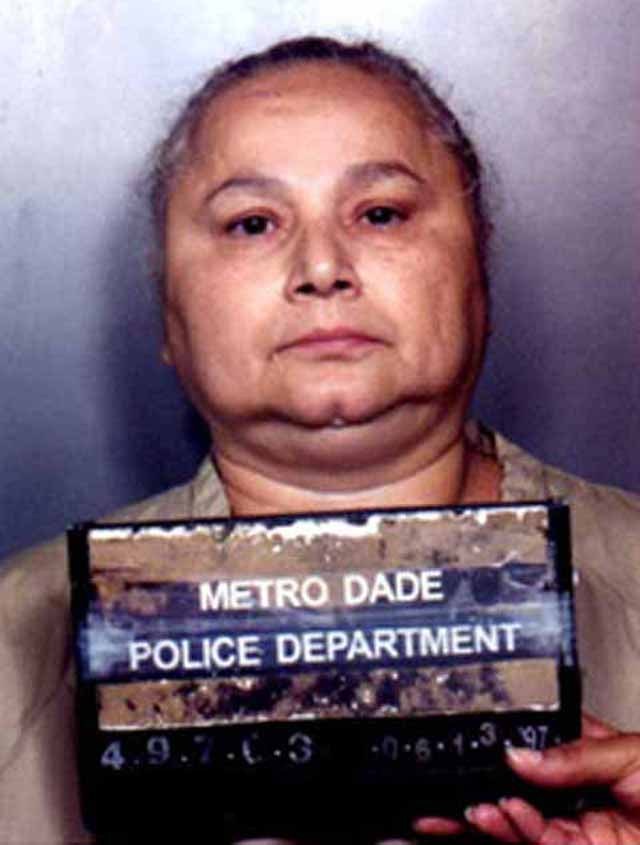
Griselda Blanco Restrepo was one of the most feared drug traffickers in American history, and almost certainly the most powerful woman in the cocaine trade. In the 1970s she built one of the first large-scale smuggling networks moving cocaine from Colombia into the United States, first through New York and then through Miami. At the height of her power she controlled a distribution empire that stretched across the American south-east, and the wave of killings that accompanied it turned Miami into one of the most violent cities in the country. She was eventually caught, spent almost twenty years in American prisons, and was deported to Colombia in 2004. Eight years later she was shot dead in a street in Medellín, by a gunman on a motorcycle — the very method of assassination she was said to have pioneered.
Blanco was born on 15 February 1943 in Cartagena, on Colombia’s Caribbean coast, and grew up in poverty in the slums of Medellín. Accounts of her childhood are coloured by legend, and some of the most lurid stories told about her early years — including a claim that she kidnapped and killed a child as a young girl — are not supported by any reliable record. What is documented is that she came from nothing, that she entered the drug trade young, and that by the early 1970s she was already a significant figure in it. She was married three times, and all three of her husbands were murdered. Her second husband, Alberto Bravo, was shot dead in 1975, reportedly by Blanco herself during a dispute — a claim that is widely repeated but was never tested in court.
The New York Years
Blanco first built her business in New York. In the early 1970s she ran a smuggling operation that brought cocaine into the city from Colombia, using couriers and a network of distributors that stretched across the north-east. She was indicted on federal drug conspiracy charges in New York in April 1975, but by then she had left the country, and the case waited a decade for her to be caught. The New York years established the pattern of her career: she moved large quantities, she paid for loyalty, and she answered challenges with murder.
It was in Miami, though, that her name became notorious. She moved her operation to Florida in the late 1970s, as the demand for cocaine in the United States exploded, and she built a distribution network that supplied dealers across the city and beyond. The period became known as the “Cocaine Cowboys” era, after the men — and Blanco — who fought over the trade with open violence. Dade County’s homicide rate soared. Officials suspected Blanco’s organisation of involvement in around forty murders in Miami, and some accounts put the total far higher, crediting her network with more than two hundred killings over her career. Those larger figures are estimates, not proven counts, and they should be treated as such. What is certain is that her organisation was responsible for a string of contract killings, and that the fear she inspired was itself a weapon: rivals and former associates alike believed that crossing her meant death.
Arrest and Conviction
The federal government built a task force to bring her down. CENTAC 26, a joint operation of the Drug Enforcement Administration and the Miami-Dade police, spent years tracking her, and on 17 February 1985 DEA agents arrested her at her home in Irvine, California, on the 1975 New York charges. She was tried in New York later that year, convicted of conspiracy to manufacture, import and distribute cocaine, and sentenced to fifteen years in federal prison.
Prison did not end her legal troubles. While she was serving her sentence, Florida prosecutors charged her with three counts of first-degree murder. The case rested largely on the testimony of her former hitman, Jorge Ayala, and it concerned the killings of two rival dealers and a two-year-old boy, the son of one of the victims, who had been shot in 1982. The prosecution’s case collapsed in one of the stranger episodes in American legal history when Ayala was caught having telephone sex with secretaries in the state attorney’s own office, destroying his credibility as a witness. Rather than risk losing the case entirely, prosecutors offered a deal. In 1998 Blanco pleaded guilty to three counts of second-degree murder and was sentenced to twenty years, to run concurrently with her existing term.
Deportation and Death
By 2004 Blanco’s health had deteriorated, and the American authorities saw no further purpose in keeping her. She was released from prison and deported to Colombia, where she settled in Medellín and lived quietly for eight years. Her empire was gone, and most of her old allies were dead, imprisoned or scattered. On 3 September 2012 she left a butcher’s shop in Medellín with her pregnant daughter-in-law when a man on a motorcycle pulled alongside her and shot her twice in the head at close range. She was 69 years old. The symmetry was noted at the time: the motorcycle gunman was the assassination method she was widely credited with introducing to Medellín’s drug wars.
Blanco’s story has since been retold in the Netflix series Griselda, starring Sofía Vergara, which introduced her to a new audience. The series is a dramatisation, not the record.
What Is Documented — and What Is Not
Documented: Griselda Blanco Restrepo was born on 15 February 1943 in Cartagena, Colombia, and became a major cocaine trafficker in New York and then Miami in the 1970s and early 1980s. She was indicted on federal drug conspiracy charges in New York in April 1975. DEA agents arrested her at her home in Irvine, California, on 17 February 1985; she was convicted in New York later that year and sentenced to fifteen years in federal prison. In 1998 she pleaded guilty in Florida to three counts of second-degree murder and was sentenced to twenty years, to run concurrently with her federal term. She was released and deported to Colombia in 2004. On 3 September 2012 she was shot dead by a gunman on a motorcycle outside a butcher’s shop in Medellín, aged 69.
Not documented / unverified: The number of murders attributed to Blanco’s organisation varies wildly between sources, from around forty in Miami to more than two hundred across her career; only the three murders she pleaded guilty to in 1998 were proven in court. The claim that she personally shot her second husband, Alberto Bravo, in 1975 is widely repeated but was never tested in court. Stories about her childhood in Medellín, including claims of an early kidnapping and killing, are legend rather than documented fact. The claim that she invented the motorcycle assassination is a widely repeated piece of underworld lore, not an established fact.
Sources
https://en.wikipedia.org/wiki/Griselda_Blanco
https://nationalcrimesyndicate.com/griselda-blanco/
https://www.aetv.com/articles/griselda-blanco
https://www.nationalgeographic.com/history/article/griselda-blanco-miami-cocaine-70s
https://www.utterlyinteresting.com/post/griselda-blanco-the-godmother-of-cocaine-and-the-queen-of-retribution