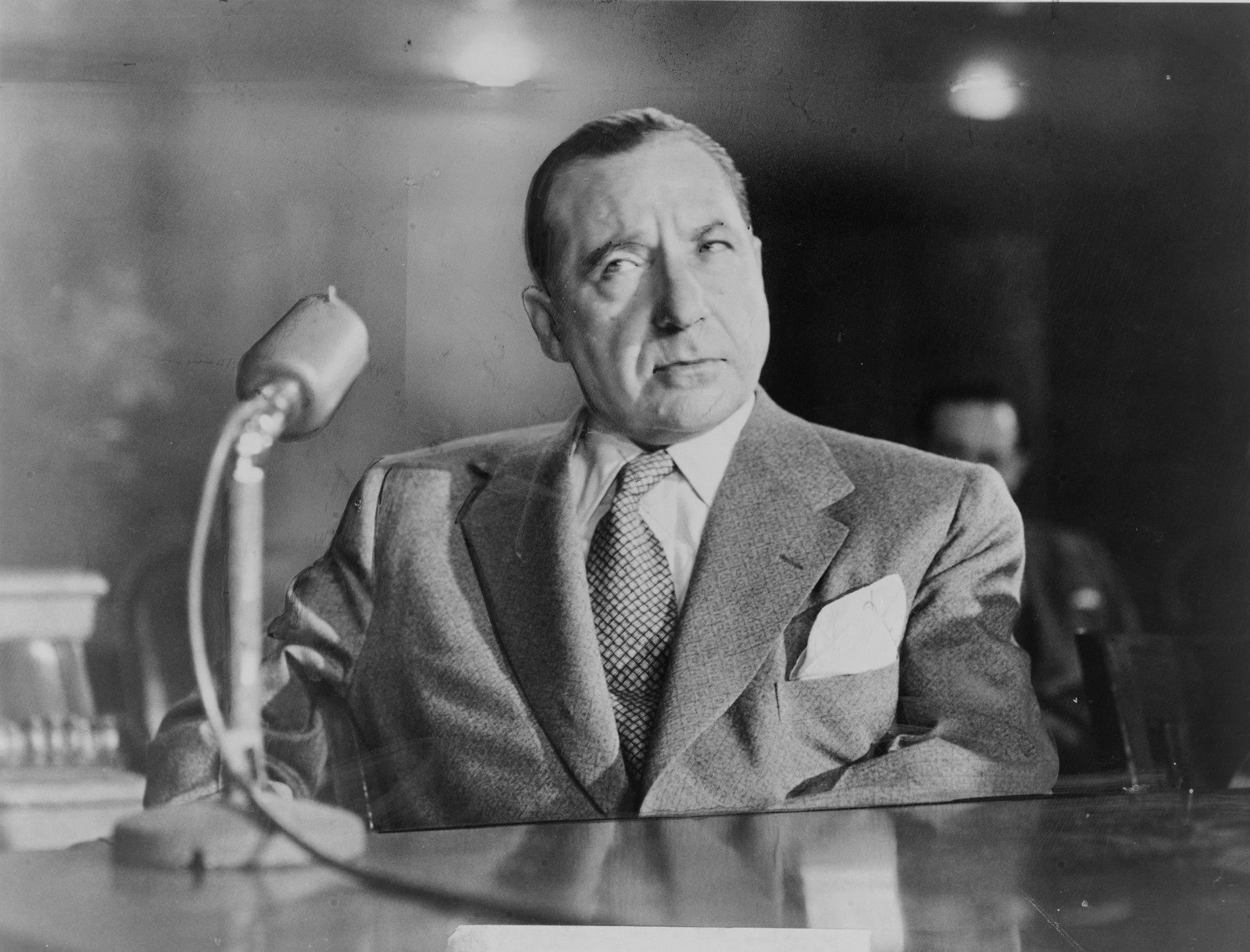
Frank Costello was the most powerful Mafia boss in America who never wanted to look like one. Born Francesco Castiglia on 26 January 1891 in Lauropoli, Calabria, Italy, he emigrated to the United States as a child and rose through bootlegging, gambling, and slot machines to lead the Luciano crime family in New York — the family later known as the Genovese family. He was called the “Prime Minister of the Underworld” because he preferred politics, negotiation, and influence to open violence, and because he cultivated relationships with politicians, judges, and businessmen. For years, the government could not convict him of the crimes he was widely believed to direct. In the end, it was the tax code, and a televised Senate hearing, that brought him down.
From Bootlegger to Boss
Costello arrived in New York in the 1890s and grew up in East Harlem. During Prohibition he worked with Lucky Luciano, Meyer Lansky, and Bugsy Siegel, building a fortune from bootleg liquor and then from slot machines and gambling. When Luciano was imprisoned in 1936, Costello gradually took effective control of the family, formally becoming boss in the late 1930s. He ran the organisation until 1957, a reign of about two decades.
The Kefauver Hearings: Only His Hands
In May 1950, the United States Senate created a Special Committee to Investigate Organized Crime in Interstate Commerce, chaired by Senator Estes Kefauver of Tennessee. The committee, universally known as the Kefauver Committee, travelled across the country for a year, hearing from more than 600 witnesses, including gangsters, bookmakers, politicians, and police officers. Its hearings were among the first congressional proceedings to be televised, and they became a national sensation.
Costello was subpoenaed to appear in New York in March 1951. He was the only major Mafia figure who agreed to testify without taking the Fifth Amendment on every question, although he did invoke it when asked for a full financial statement. His lawyer objected to his face being shown on television, and the committee agreed that the cameras would film only his hands. The result was unforgettable: for hours, tens of millions of viewers watched Costello’s hands — drumming on the table, twisting together, tearing paper — while his gravelly voice answered, evaded, and occasionally joked with the senators. When Kefauver asked him, “What have you done for your country, Mr. Costello?”, he replied, “Paid my tax!” The room laughed.
The laughter did not last. As the questioning continued, Costello grew evasive, complained of a sore throat, and on 15 March 1951 walked out of the hearings. The committee cited him for contempt of the Senate. The walkout, and the testimony of his deputy Willie Moretti — who spoke openly about the Mob’s infiltration of legitimate business and was murdered in a New Jersey restaurant on 4 October 1951 — turned Costello from a behind-the-scenes operator into a public figure. The hearings also gave the government a detailed public record of his finances, his associates, and his political connections, and the Internal Revenue Service began a full investigation in the summer of 1952.
The 1954 Tax-Evasion Trial
In April 1954, Costello went on trial in Manhattan federal court on charges of tax evasion. The government charged him with conspiracy to conceal $51,095 of income over four years — a relatively modest sum by the standards of the empire he was said to run, but enough, if proved, to send him to prison for five years. The trial featured 144 witnesses, according to contemporary accounts, and turned on the government’s reconstruction of Costello’s spending and income rather than on any single document.
The prosecution argued that Costello’s lifestyle far exceeded the income he had declared, and that the gap could only be explained by unreported earnings. The defence argued that the government’s figures were unreliable and that the case was a political prosecution dressed up as a tax case. The jury was not persuaded by the defence. Costello was found guilty and sentenced to five years in prison and fined $30,000, the maximum penalty the law allowed.
The Shooting and Retirement
While the legal battle continued, Costello’s position inside the Mafia was collapsing. His underboss, Vito Genovese, who had returned from Italy in 1945 after fleeing a murder charge, believed he should be boss, not Costello. In early 1957, Genovese ordered Vincent “Chin” Gigante to kill Costello. On 2 May 1957, Gigante approached Costello in the lobby of the Majestic, his Manhattan apartment building, called out, “This is for you, Frank!”, and shot him in the head. Costello turned at the shout, and the bullet only grazed his scalp. He survived with a minor wound.
Costello refused to identify Gigante as the shooter, and Gigante was acquitted. But the message was clear. Costello stepped aside, Genovese succeeded him as boss of the family, and Costello retired from active leadership. He lived quietly for the rest of his life, largely out of the spotlight, and died of a heart attack in Manhattan on 18 February 1973, aged 82. Genovese himself was convicted of narcotics offences in 1959 and died in prison in 1969.
What Is Documented, and What Is Not
Documented facts: Frank Costello, born Francesco Castiglia on 26 January 1891 in Calabria, Italy, led the Luciano crime family from the late 1930s until 1957. He testified before the Senate’s Kefauver Committee in March 1951, with only his hands televised, and walked out on 15 March 1951. He was convicted of contempt of the Senate in August 1952, sentenced to eighteen months, and served fourteen months. In April 1954 he was convicted in Manhattan federal court of tax evasion involving $51,095 of undeclared income and sentenced to five years in prison and a $30,000 fine. He was returned to prison in May 1956 after his appeal failed and released on appeal in early 1957. On 2 May 1957 Vincent Gigante shot and wounded him in the lobby of the Majestic on Genovese’s orders; Costello survived, retired, and was succeeded by Genovese. He died of a heart attack on 18 February 1973, aged 82.
Unverified or unestablished claims: The exact total time Costello served for tax evasion is reported inconsistently across sources and is not stated here as a single settled figure. The claim that Marlon Brando modelled Vito Corleone on Costello is a widely repeated anecdote without direct confirmation. The suggestion that Costello ordered the murder of Willie Moretti after Moretti’s Kefauver testimony is an allegation reported in some accounts, not a finding of a court, and is not presented here as established fact.
Sources
- https://themobmuseum.org/notable_names/frank-costello/
- https://en.wikipedia.org/wiki/Frank_Costello
- https://www.ebsco.com/research-starters/history/frank-costello
- https://gangstersinc.org/2021/07/31/get-frank-how-the-irs-brought-down-a-mob-boss-again/
- https://AmericanMafia.com/Feature_Articles_184.html