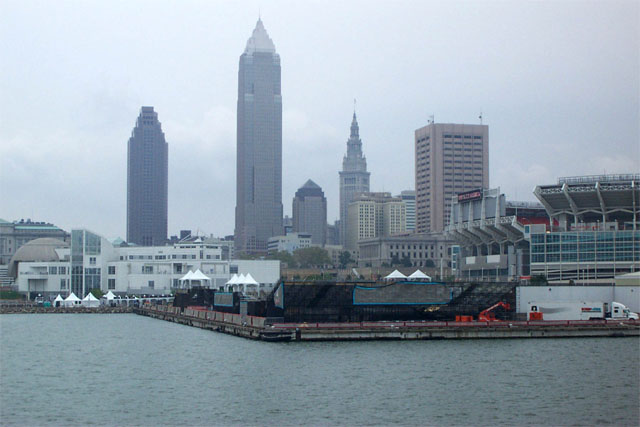
Cleveland, Ohio, in the 1930s was a city of rail yards, factories and river flats — and, along the Cuyahoga River, of shantytowns where people with nowhere else to go built shelters from scrap. One of those settlements stood in Kingsbury Run, a ravine on the city’s east side that served as a hobo camp and a rail corridor. It was there, in September 1935, that the killings began to come into focus.
Between 1935 and 1938, at least twelve people were killed in Cleveland, and their remains were found in pieces across the city’s industrial districts and along the shores of the Cuyahoga River and Lake Erie. The killer, known as the Cleveland Torso Murderer and as the Mad Butcher of Kingsbury Run, was never identified. The case became the most high-profile unsolved investigation of Eliot Ness’s career — and the one he could not close.
The first discoveries
The series, as officially counted, began on 23 September 1935, when two bodies were found in Kingsbury Run. Both had been decapitated. One was identified as Edward Andrassy, a 28-year-old local man known to drift between odd jobs; tattoos helped to identify him quickly. The second man was not identified at the time.
A possible earlier case complicates the count. On 5 September 1934, the lower half of a woman’s torso washed ashore at Euclid Beach on Lake Erie. Some investigators and researchers have counted her as the killer’s first victim; others have not, because the remains were so incomplete. Whether the official count should be twelve or thirteen, and whether the true total reaches twenty or more, is a matter of dispute among researchers, and the figures in this article follow the Cleveland Police Department’s official count of twelve confirmed victims between 1935 and 1938.
More discoveries followed through 1936, 1937 and 1938: a woman found in January 1936 behind a rooming house, later identified as Florence Polillo, aged 41; remains recovered from Lake Erie, including a woman whose body had been treated with lime and who became known as the Lady of the Lake; a woman with tattoos found in 1938; and, in August 1938, two male torsos left in a public spot beneath a bridge over the Cuyahoga River, in plain view of the city centre.
Only three of the twelve officially counted victims were ever identified: Edward Andrassy, Florence Polillo, and — tentatively — a woman believed to be Rose Wallace. The rest remain unidentified to this day, although that may yet change: in August 2024, the Cuyahoga County Medical Examiner’s Office partnered with the DNA Doe Project to exhume some of the unidentified victims and attempt identification through investigative genetic genealogy.
The victims
The people the killer chose were, for the most part, among the most vulnerable in Depression-era Cleveland: transients, people living in the Kingsbury Run shantytown, and others on the margins of the city, whose absence might not be noticed quickly and whose movements were hard to trace. That shaped the investigation in two ways: it made the victims harder to identify, and it made the killer harder to find, because the people who knew them were themselves transient, wary of police, or scattered.
Eliot Ness takes charge
Eliot Ness arrived in Cleveland in December 1935 as the city’s Director of Public Safety, under the reform administration of Mayor Harold Burton. He was already famous for his work in Chicago against Al Capone’s organisation. The Torso Murders became the most visible case of his time in Cleveland, and the most frustrating. The field investigation was led by Detective Peter Merylo of the Cleveland Police Homicide Unit, who worked the case almost full-time from 1936 until his retirement in 1943.
The medical evidence suggested a killer with some knowledge of anatomy. The remains showed signs of careful, skilled cutting, and the heads were removed after death. The county’s forensic work suggested the killer was likely right-handed. Beyond that, the physical evidence was thin: few fingerprints, no reliable witnesses, and remains that had often been exposed to the elements for days or weeks before they were found.
Ness created a dedicated squad, brought in outside experts, and ordered the systematic fingerprinting and questioning of thousands of transients. In August 1938, two days after the eleventh and twelfth victims were found in view of his office at City Hall, Ness ordered a midnight raid on the Kingsbury Run shantytown. The encampment was cleared and its shelters burned, displacing the people who lived there.
Ness’s stated reasons were to catalogue fingerprints so that any new victim could be identified quickly, and to move potential victims out of the killer’s reach. The raid remains controversial. It destroyed a community’s homes and, critics have argued, may also have destroyed evidence. It did not produce an arrest. Ness left his post in 1941, still carrying the case.
The suspects who were never charged
Two men dominate the later history of the case, and both must be described with care, because neither was ever charged with the murders.
The first is Frank Dolezal, a bricklayer who had known the victim Florence Polillo. In July 1939, Cleveland police arrested Dolezal in connection with her death. He denied involvement. On 24 August 1939, he was found dead in his jail cell, having hanged himself, according to the official account. No charges against him were ever tested in court, and his death meant the case against him — whatever it amounted to — was never proved. He should not be described as the killer.
The second is Dr. Francis Edward Sweeney, a former Navy surgeon with medical training and a history of mental health difficulties, who lived near several of the places where remains were found. Ness privately regarded Sweeney as a strong suspect. Sweeney was questioned, and Ness arranged for him to undergo polygraph examinations conducted by the polygraph expert Leonarde Keeler. Accounts of the results differ, and polygraph results are not, in any case, proof of guilt. No physical evidence ever tied Sweeney to a victim, and he was never charged. He died in 1964. He remains, in the language of the record, an alleged suspect — the strongest name attached to the case, but not an established one.
Other theories have connected the Cleveland killings to similar crimes in Youngstown and Pittsburgh. Lead detective Peter Merylo himself believed there may have been thirteen or more victims across the region between the 1920s and the 1950s. Those wider counts are research hypotheses, not official findings, and they remain disputed.
What the record shows
What is documented is this: between September 1935 and August 1938, twelve victims were officially counted in Cleveland, Ohio, in a series of killings in which the victims’ remains were found in pieces across the city’s industrial areas and waterways; only three of the twelve were identified; the victims were largely transient and marginalised people, many of them connected to the Kingsbury Run shantytown; Eliot Ness, as Director of Public Safety, and Detective Peter Merylo led an investigation that included mass fingerprinting and the clearing and burning of the Kingsbury Run settlement in August 1938; Frank Dolezal was arrested in 1939 and died in his cell before any charge was tested; Dr. Francis Sweeney was questioned and polygraphed but never charged, and no physical evidence connected him to the killings; and no one has ever been charged with the murders.
What is not documented is who the killer was, how many victims there truly were, or whether the Cleveland killings were connected to similar crimes elsewhere. In 2024, new work began to identify the unidentified victims through DNA, offering the possibility that the dead may at last get their names back, even if the killer’s name remains unknown. The case file remains open.
Sources
- https://en.wikipedia.org/wiki/Cleveland_Torso_Murderer
- https://anomalydesk.com/cleveland-torso-murderer.html
- https://truthfully.com/article/cleveland-torso-murders-12-victims-no-convictions-and-a-ca
- https://dyerbolical.com/the-mad-butcher-of-kingsbury-run-unraveling-the-cleveland-torso-murderers-unsolved-legacy/
- https://dyerbolical.com/the-cleveland-torso-murderer-the-mad-butchers-trail-of-unsolved-dismemberments/